
 Worksheets
Electrical Engineering
Total questions: 50
Worksheet time: 49mins
WHAT IS ELECTRICAL ENGINEERING?
Electrical Engineering deals with the study and application of electricity
Its Main objective is to cater the needs of Electricity
something to do with engineering
35.55 kΩ
25 Mw
16 mA
13,000 V
0.000005 A
2,220,000 V
When a 4th resistor (resistance) is connected in series with 3 resistors, the total resistance ...
increases
increases by one-fourth
decreases
remains the same
The conventional theory of current flow says that current flows ...
Positive to negative
Randomly
Negative to positive
None of these
Two identical lamps are connected in parallel to a 12-volt source. The voltage across each lamp is ...
12 volts
6 volts
4 volts
2 volts

Three lights are connected in parallel across a 12 volt source. If one light burns out,
the remaining two will glow with the same brightness as before
the remaining two will glow dimmer
the remaining two will glow brighter
the remaining two will not light
Which of the following factors does NOT affect the strength of an electromagnet ?
the direction of the windings
the type of core
the amount of current flow
the number of turns in the coil
Measure of electrical power.
Temperature
Current
Voltage
Wattage
Which law belongs to the following equation: P = IV
Ohm's Law
Watt's Law
Kirchoff's Current Law
Kirchoff's Voltage Law
Electricity that flows in one direction.
AC
DC
The type of electricity generated at a power plant and come out of the wall outlet.
AC
DC

The total resistance in this circuit is
100 ohms
450 ohms
400 ohms
30 ohms

The current through the battery of this circuit is
0.02 A
0.09 A
50 A
9 A

The voltage across the 300 ohm resistor is... (HINT - V= I R)
6 V
9 V
2 V
30 V


The voltage across the 180 ohm resistor is
9 V
6 V
2 V
12 V

The current going through the 180 ohm resistor is... (HINT V=IR)
0.05 A
0.2 A
0.1 A
20 A
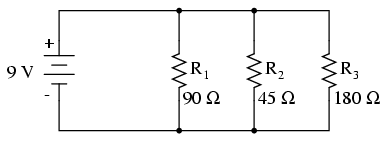
The current going through the 45 ohm resistor is
0.05 A
0.2 A
0.1 A
5 A

The current going through the 90 ohm resistor is
10 A
0.1 A
0.2 A

Kirchoff's First Law states
the sum of the currents entering any junction in an electric circuit must equal the sum of the currents leaving that junction
the sum of the charges entering any junction in an electric circuit must equal the sum of the charges leaving that junction
the sum of the emfs entering any junction in an electric circuit must equal the sum of the pds leaving that junction
none of these

i1 + i5 +i4 = i2 + i3
i1 + i5 +i3 = i2 + i4
i5 + i2 +i4 = i1 + i3
i1 + i5 = i2 + i3 + i4

