wayground logo

Free Printable Worksheets

NEW

Font size

S
M
L
XL
Worksheets

Progressive Era, Imperialism, and WWI

Total questions: 40

Worksheet time: 30mins

Name
Class
Date
1.
What amendment provided suffrage for women (1920)?
a)
16th
b)
17th
c)
18th
d)
19th
2.
Who wrote the expose piece of literature that revealed the extensive corrupt monopolistic business practices of Standard Oil?
a)
Ida Tarbell
b)
Lewis Hines 
c)
Jacob Riis
d)
Upton Sinclair
3.
Whose book led to the direct passage of the Meat Inspection Act and indirect of the Pure Food and Drug Acts?
a)
Jacob Riis
b)
Lewis Hines
c)
Ida Tarbell
d)
Upton Sinclair
4.
Who was the person who founded the settlement house (Hull House) for the Assimilation and Americanization of the immigrant poor?
a)
Elixabeth Cady Stanton
b)
Jane Addams
c)
Susan B. Anthony
d)
Belle Starr
5.
Who advocated for African Americans to take on menial jobs and earn the respect of white America with hard work ?
a)
WEB Du Bois
b)
Marcus Garvey
c)
Booker T. Washington
d)
Nat Turner
6.
Which Progressive President used Big Stick Diplomacy and was known as a Trust buster?
a)
Teddy Roosevelt
b)
Taft
c)
Woodrow Wilson
d)
Luke Skywalker
7.
Which of the following is an initiative?
a)
People have the right to remove a politician from office
b)
People have the right to choose who will run for President
c)
People have the right to propose a new law
d)
People have the right to veto or accept a law passed by the government
8.
Which of the following is a Referendum?
a)
People have the right to remove an elected official from office
b)
People have the right to choose who will run for President
c)
People have the right to propose their own law
d)
Any law passed by the government can be voted on for approval or veto by the people
9.
Which of the following is a Recall?
a)
People have the right to choose who will run for President
b)
People have the right to remove an elected official from office
c)
People have the right to propose a new law
d)
People have the right to vote on any law passed by their government for approval/veto
10.
This person helped to found the NAACP
a)
Ida B Wells
b)
Booker T Washington
c)
W E B DuBois
d)
Martin Luther King Jr.
11.
 The actions of muckrakers in the late 19th century and early 20th century resulted in
a)
Supreme Court decisions that expanded the right to vote
b)
government regulation of unfair business practices
c)
increases in the power of monopolies
d)
reduction of the president’s power to manage the economy
12.
Writers that dig up the bad things going on in society
a)
Suffragists
b)
Muckrakers
c)
Students
d)
Chaffinators
13.
To preserve water, trees, plants, and other natural resources
a)
Precipitation
b)
Confurion
c)
Conservation
d)
Infusion
14.
Banned people from making, drinking or selling alcohol
a)
17th Amendment
b)
18th Amendment
c)
19th Amendment
d)
21st Amendment
15.
Which act was rushed to Congress and passed shortly after the publication of Upton Sinclair’s novel The Jungle in 1906? 
a)
Federal Reserve Act
b)
Clayton Antitrust Act
c)
Australian Ballot Act
d)
Meat Inspection Act
16.
The banning of alcohol.
a)
Institution
b)
Referendum
c)
Principal
d)
Prohibition
17.
Who was the photographer who revealed to the world how the lower class lived?
a)
Alexander Bell
b)
Jacob Riis
c)
Upton Sinclair
d)
Theodore Roosevelt
18.

The purchase of Alaska was purchased from which nation?

a)

England

b)

Russia

c)

France

d)

Canada

19.

Yellow Journalism is

a)

A type of investigative journalism that focuses on government, big business or social issues

b)

The name of a popular dime store novel

c)

A book about the disgusting conditions of slaughter houses

d)

A type of journalism that rarely relies on facts and is prone to exaggeration

20.

The president of the United States during the Spanish American War was

a)

Theodore Roosevelt

b)

William Howard Taft

c)

William McKinley

d)

Donald Trump

21.

The war resulted in the U.S. gaining the following territories

a)

Guam, Puerto Rico, The Philippines

b)

California, New Mexico, Nevada

c)

Alaska, Hawaii, The Philippines

d)

Guam, Puerto Rice, Cuba

22.

The Treaty that ended the Spanish American War in 1898 was called

a)

The Treaty of Versailles

b)

The Treaty of Paris

c)

The Treaty of Madrid

d)

The Treaty of New York

23.
Which of the following defines the Roosevelt Corollary?
a)
Europe was not allowed to imperialize the Americas
b)
America was the police force for the Western Hemisphere
24.
Which of the following defines the Monroe Doctrine?
a)
Europe was not allowed to imperialize the Americas
b)
America was the Police force for the Western Hemisphere
25.
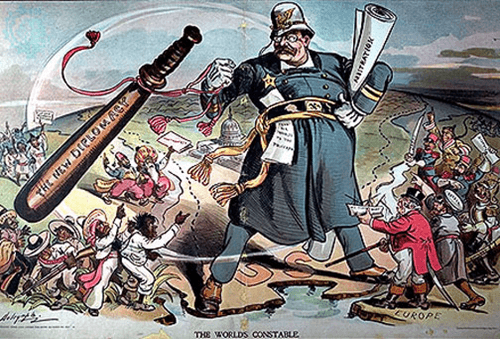
Which aspect of Imperialism does this picture represent?
a)
Roosevelt Corollary
b)
Monroe Doctrine
c)
Influence of Naval Power Upon History
d)
Spanish American War
26.
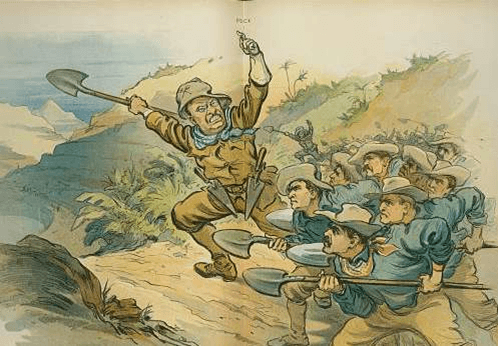
The following political cartoon refers to the construction of what by Teddy Roosevelt?
a)
Naval Base at Guantanamo Bay
b)
Suez Canal
c)
Panama Canal
d)
Washington Monument
27.
Which of the following best explains why the United States entered the first World War?
a)
German submarines engaged in unrestricted warfare
b)
Austria's Archduke Franz Ferdinand was assassinated
c)
Germany invaded the neutral nation of Belgium
d)
Britain enforced a defense treaty the US signed
28.
The Zimmerman telegram helped change American opinions about involvement in the First World War because the telegram revealed German plans to-
a)
Start using poisonous gas
b)
Invade the Panama Canal zone
c)
Enter into an alliance with Mexico
d)
Torpedo American merchant ships
29.
What are the name of the acts that made it illegal to criticize the U.S. involvement in the war or encourage draft resisters
a)
Espionage and Sedition Acts
b)
Treaty of Versailles and the Fourteen Points
c)
the Yalta Agreement and the Treaty of Versailles
d)
The Espionage Act and the Fourteen Points
30.
The tool by which business, labor, government, and American opinion were molded to fight was:
a)
Propaganda
b)
Conscription
c)
Neutrality
d)
Dollar Diplomacy
31.
When World War I began, the official United States policy was
a)
to enter on the side of the Allied Powers
b)
the enter on the side of the Central Powers
c)
to remain militarily and politically neutral
d)
to support the Central Powers by providing war materials
32.
On May 7, 1915, a German submarine torpedoed and sank
a)
the Maine
b)
The Titanic
c)
The Lusitania
d)
The Queen Mary
33.
The Great Migration refers to the shift of the African­American  population from the
a)
rural South to the rural North
b)
rural North to the rural South
c)
urban South to the urban North
d)
rural South to the urban North
34.

What was the Red Scare?

a)

The fear of communists

b)

A nationwide hunt for communist in the U.S.

c)

"Communist Scare"

d)

All of the above

35.
When did the Harlem Renaissance take place?
a)
During the Great Depression
b)
1930's-1940's
c)
1900's-1910's
d)
1910's-1920's
36.
Who was Langston Hughes?
a)
A popular swing dance singer
b)
Owner of a popular Speak Easy 
c)
A famous poet and writer 
d)
A famous actor
37.
What type of music was popularized during the Harlem Renaissance?
a)
Jazz
b)
Hip Hop
c)
Country
d)
Rock
38.
The Harlem Renaissance was important because
a)
it was the first time African-Americans published their art
b)
African-American artists broke common racial stereotypes
c)
So many African-Americans moved to that one neighborhood
d)
That's when the first African-American won an Oscar
39.
World War I began in ____ and ended in _____.
a)
1914, 1917
b)

1917, 1918

c)
1914, 1918
40.

What was the name of the Archduke who was assassinated and started World War I?

a)

Woodrow Wilson

b)

Francis Ferdinand

c)

Prince Henry the Eighth

d)

Arthur Zimmerman