
 Worksheets
7th grade science CBA3A Review
Total questions: 29
Worksheet time: 54mins
Name
Class
Date
1.
A homozygous dominant dog with brown fur is crossed with a heterozygous dog with brown fur. What are the percentages of the possible genotypes?
a)
100% BB
b)
75% BB and 25%Bb
c)
50 % BB and 50% Bb
d)
50% Bb and 50% bb
2.
The man who studied genetics and came up with genetics is
a)
Watson
b)
Crick
c)
Mendel
d)
Darwin
3.

Genotype refers to the ...
a)
physical expression of the genes
b)
the possible combination of alleles in a gene
c)
whether an allele is dominant or recessive
d)
how an organism will appear
4.

An offspring will receive how many alleles from each parent to determine a specific trait?
a)
one
b)
two
c)
three
d)
five
5.
Which of the following is a phenotype?
a)
BB
b)
Bb
c)
bb
d)
Blue eyes
6.
What is a phenotype
a)
The genetic make up (code)
b)
The physical trait
7.
G = green, g = yellow
The genotype for a yellow plant is...
The genotype for a yellow plant is...
a)
GG
b)
Gg
c)
gg
d)
all of the choices result in yellow
8.
Two heterozygous (Tt) tall pea plants are crossed. Which describes their offspring?
a)
50% tall and 50% short
b)
75%tall and 25% short
c)
100%short
9.
What word describes a trait that helps an organism survive in its environment?
a)
natural selection
b)
mutation
c)
camouflage
d)
adaptation
10.
What word describes the process of having the advantageous traits that helps an organism survive and reproduce?
a)
natural selection
b)
adaptation
c)
mutation
d)
genetic engineering
11.
Which organisms are most likely to survive?
a)
the best adapted
b)
the fastest
c)
the strongest
d)
the most domesticated (tamed)
12.
Almost all adaptations started off as?
a)
selective breeding
b)
physiological
c)
structural
d)
mutation
13.
Any inherited trait that gives an organism an advantage in its environment is called ___.
a)
a mutation
b)
an adaptation
c)
evolution
d)
natural selection
14.
The differences among a species, like different bird beaks, are called
a)
genes.
b)
variations.
c)
traits.
d)
theories.
15.
Why are advantageous traits more likely to be passed onto offspring?
a)
Because they are more likely to survive and reproduce.
b)
Because they come from dominant alleles.
c)
Because they come from recessive alleles.
d)
Because the trait is an acquired phenotype.
16.

Who studied animals on the Galapagos islands?
a)
Me
b)
You
c)
Gregor Mendel
d)
Charles Darwin
17.

The ones with better traits and are stronger,
a)
dance the night away
b)
survive
c)
burp
d)
die
18.
When every organism of a species has died.
a)
Evolution
b)
Natural Selection
c)
Extinction
d)
Artificial Selection
19.
Why are advantageous traits more likely to be passed onto offspring?
a)
Because they are more likely to survive and reproduce.
b)
Because they come from dominant alleles.
c)
Because they come from recessive alleles.
d)
Because the trait is an acquired phenotype.
20.
What is the advantage of having different shaped beaks?
a)
To look different from other species.
b)
To be able to eat the food readily available in the environment.
c)
To protect itself against predators.
d)
To protect itself against prey.
21.
The differences among a species, like different bird beaks, are called
a)
genes.
b)
variations.
c)
traits.
d)
theories.
22.

Since the 1800s humans have stopped burning coal, and the trees have returned to their original color. Which moth will be more successful in this environment?
a)
Dark moth
b)
Light moth
c)
Both will be equally successful
d)
Neither will be successful
23.
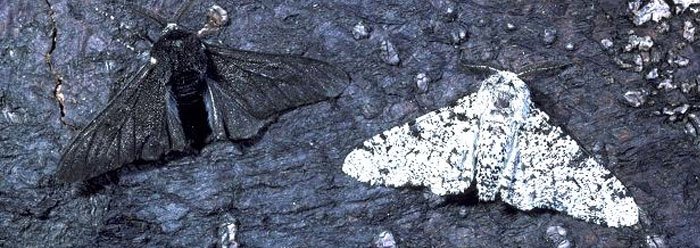
The trees these moths used to live on were white, but have been covered in soot from coal factories. Which moth will be more successful in this environment?
a)
Dark moth
b)
Light moth
c)
Both will be equally successful
d)
Neither will be successful
24.
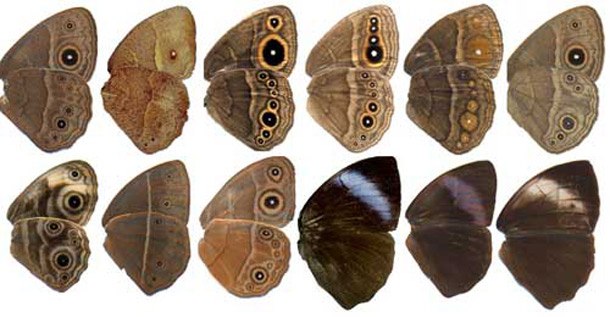
These moths are all the same species. The differences between their wings is an example of ________________
a)
Natural Selection
b)
Variation
c)
Homeostasis
d)
Extinction
25.
Selective breeding is where ___________ decides which traits should be passed on
a)
Nature
b)
A human
c)
Mr. Holt
d)
The illuminati
26.
Where did Charles Darwin travel to?
a)
Australia
b)
Barbados
c)
Galapagos
d)
Trinidad
27.
What is the title of Charles Darwin's famous book?
a)
The origin of species
b)
Origin of species
c)
On the origin of species
d)
Species. The origin
28.
What animals did Charles Darwin study when at the Galapagos Islands?
a)
Giraffes and crabs
b)
Seagulls and squirrels
c)
Seals and seagulls
d)
Finches and tortoises
29.
Can an individual organism evolve in its own lifetime?
a)
Yes
b)
No
100 %

