Font size
 Worksheets
Mod J- U2.L1: States of Matter
Total questions: 26
Worksheet time: 39mins
Why are most substances denser in the solid state than in the liquid state?
Particles in a solid are smaller.
Particles in a solid have more mass.
Particles in a solid have no kinetic energy.
The same number of particles in a solid are arranged into smaller space.

The photo demonstrates that liquids can change ...
volume
shape
density
kinetic energy
The ___________ of the spilled milk is the same as the _______ of the milk that was in the glass to start.
volume, volume
shape, volume
shape, shape
volume, density
Why does the milk flow out of the glass and spread out into a thin puddle rather than staying in the glass or spreading out more across the floor?
The particles can break apart but cannot move.
The particles can slide past each other, but attractions hold them close together.
The particles cannot move, but they can grow in size.

How can the volume of gas in the balloons be greater than the volume of the cylinder used to fill them?
A gas has a fixed shape.
A gas expands to fill its container.
The volume of the container does not depend on the gas.
How can the properties of the particles in a gas explain why the volume of the balloons is greater than the volume of the container?
The gas particles are bigger in the balloons.
The distance between the gas particles is greater in the balloons.
The gas particles are locked in place in the cylinder, but can move in any direction inside the balloons.
If the gas cylinder is empty after all of the balloons are filled, how does the total number of the particles in all the balloons compare to the total number of particles that were in the cylinder?
There are more particles in the balloons than were in the cylinder.
There are fewer particles in the balloons than were in the cylinder.
The number of particles in the balloons is the same as the number of particles that was in the cylinder.
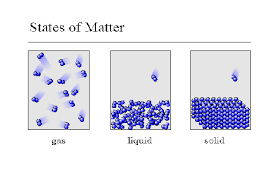
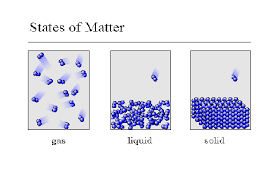
A student drew a model showing particles that are close together in a regular pattern. Which sample has the student most likely drawn a model of?
a bar of gold
molten aluminum
an air sample
bromine gas
Which are true about the properties of solids, liquids, and gases? Select all that apply.
Liquids and gases can change shape.
Only gases can change volume.
Only solids have a fixed shape.
Liquids and gases have a fixed volume.
Solids and gases can change volume.
The state of matter in which the volume and shape of a substance are fixed.
solid
liquid
gas
The state of matter that has a fixed volume, but can change shape.
solid
liquid
gas
The state of matter that can change both shape and volume.
solid
liquid
gas
What is a particle?
atom
molecule
element
Which of these is the smallest particle to retain the properties of an element?
an atom
a proton
a molecule
an electron
What makes physical properties different from chemical properties?
Physical properties relate to elements rather than compounds.
Physical properties appear only after a chemical change occurs.
Physical properties describe elements in the solid state rather than in the liquid or gas state.
Physical properties can be observed without attempting to change the identity of the substance.
According to kinetic theory, how many particles that make up a substance are constantly in motion?
all of the particles
none of the particles
more than half of the particles but not all
fewer than half of the particles but more than none