
 Worksheets
Pedigrees
Total questions: 15
Worksheet time: 11mins
Name
Class
Date
1.

If this pedigree shows an autosomal recessive disorder, what MUST the genotype of individual II-3 be?
a)
HH
b)
Hh
c)
hh
d)
None of the above
2.

How are individuals III-2 and II-4 related?
a)
Cousins
b)
Dad and Daughter
c)
Uncle and Niece
d)
Grandpa and Granddaughter
3.
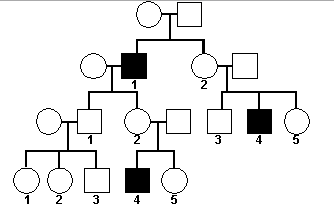
What type of heredity is shown in the pedigree?
(hint: check your notes - "modes of inheritance")
(hint: check your notes - "modes of inheritance")
a)
Sex-Linked Dominant
b)
Sex-Linked Recessive
c)
Autosomal Dominant
d)
Autosomal Recessive
4.

If this pedigree shows a recessive disorder, what MUST the genotype of individual 4 be?
a)
HH
b)
Hh
c)
hh
5.
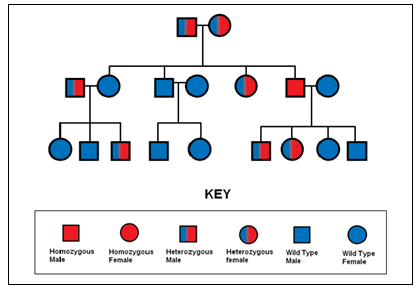
In a pedigree, what shape represents a male?
a)
circle
b)
square
c)
triangle
d)
diamond
6.

How many generations are shown in this pedigree?
a)
1
b)
2
c)
3
d)
4
7.

How many kids did the mother and father from the first generation have?
a)
2
b)
4
c)
5
d)
6
8.
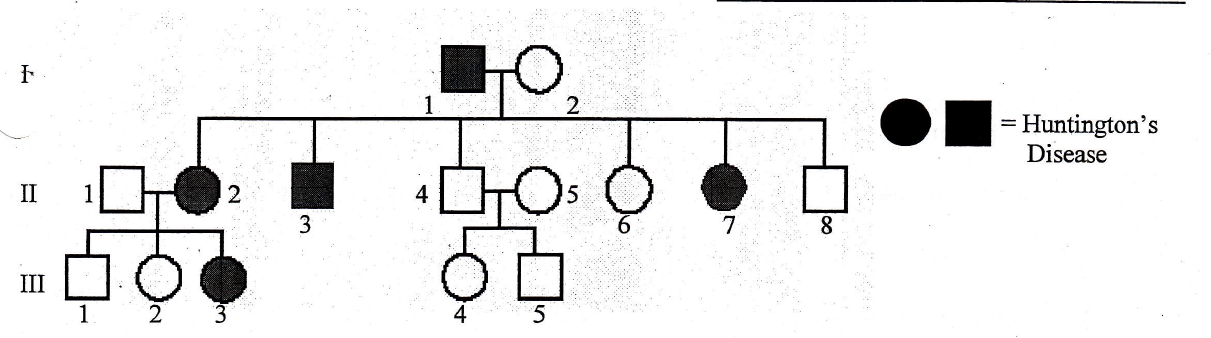
There are no carriers for Huntington's Disease- you either have it or you don't. Is Huntington's disease caused by a dominant or recessive trait?
a)
Dominant
b)
Recessive
9.

How are individuals I-2 and III-5 related?
a)
Grandpa and grandson
b)
Mom and son
c)
Uncle and nephew
d)
Grandma and grandson
10.
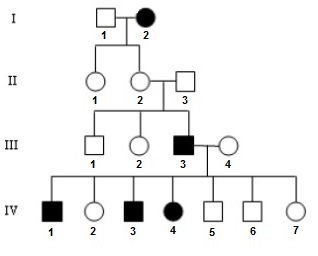
This pedigree represents the inheritance of hemophilia in this family. How many of the females have the hemophilia trait?
a)
8
b)
5
c)
2
d)
3
11.

Huntington's Disease is a dominant trait.
What is the correct genotype for individual I-2?
What is the correct genotype for individual I-2?
a)
HH
b)
Hh
c)
hh
d)
H_
12.

Does this pedigree show a dominant or recessive trait?
a)
Dominant
b)
Recessive
13.
Hemophilia is a recessive sex-linked trait. If H = normal & h = has hemophilia, which genotype represents a male with hemophilia.
a)
XHY
b)
XHXh
c)
XhXh
d)
XhY
14.

a)
Not affected Female
b)
Not affected Male
c)
Affected Male
d)
Affected Female
15.

What do half colored symbols represent?
a)
The individual is a carrier (heterozygous).
b)
The individual expresses the trait.
c)
The individual has both recessive alleles.
d)
The individual has both dominant alleles.
100 %

