
Font size
 Worksheets
Evolution
Total questions: 20
Worksheet time: 17mins

Evolution is best defined as:
the process which organisms die.
the process which organisms change over time.
the process which organisms that are extinct become revived.
the process which non-living things fossilize.

The solidified remain or imprint of a once living thing are called:
Fossils
Homologous Structures
Vestigial Structures
DNA

What type of evidence is represented in the picture above:
Fossils
Vestigial Structures
DNA
Homologous Structures

What type of evidence is shown in the image above?
Fossils
Vestigial structures
Homologous Structures
DNA

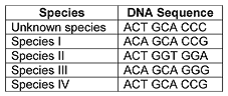
What type of evidence is shown in this picture?
Fossils
Homologous Structures
Vestigial Structures
DNA

What type of evidence are shown in the picture above?
Fossils
Embryology
Homologous Structures
Vestigial Structures

Adaptations are:
physical or behavioral tendencies.
physical or behavioral characteristics that help an organisms survive and reproduce.
physical or behavioral characteristics that do not help the organism in any way.
genetic mutations that have gone wrong.



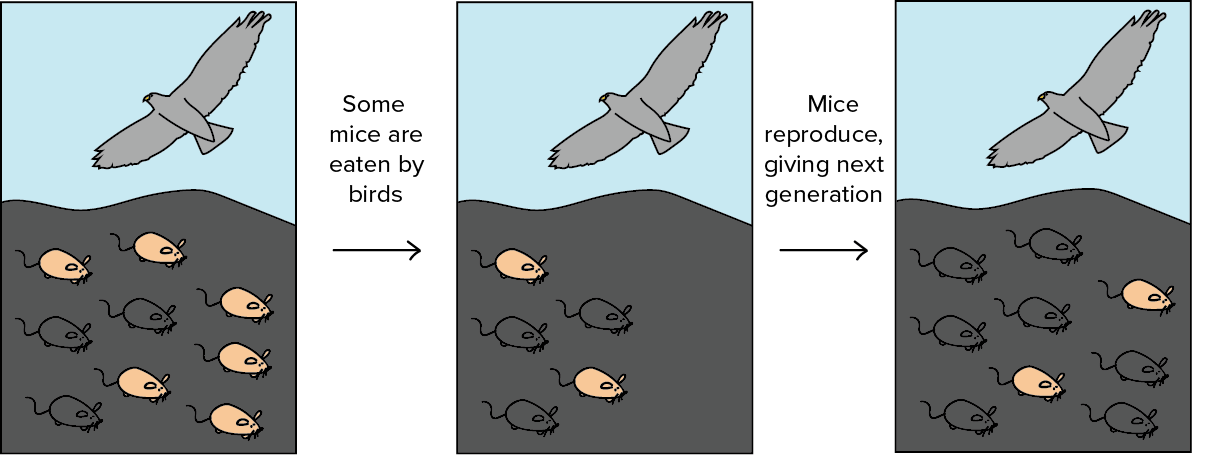

Which scientist is known for his work that he did on the Galapagos Islands to develop his theory of natural selection?
Gregor Mendel
Charles Darwin
Anton Van Leewenhoek
Robert Brown
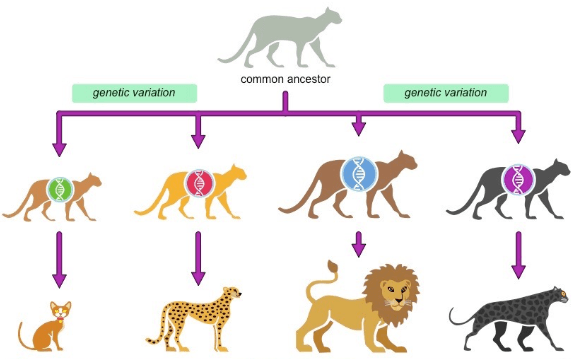
The process by which two populations of the same species become so different that they can no longer interbreed.
natural selection
artificial selection
speciation
fossilization

What are the 3 steps of speciation?
Overproduction
Separation
Struggle for survival
Adaptation
Division

Overproduction, Genetic Variation, Struggle to Survive, and Successful Reproduction are the 4 parts of:
Natural Selection
Speciation
Artificial Selection
Fossilization

A species is defined as:
a group of organisms that are extremely different.
a group of organisms that have similar characteristics and always live in the same place.
a group of organisms with similar characteristics and can reproduce to make fertile offspring.
any two organisms to make a hybrid.
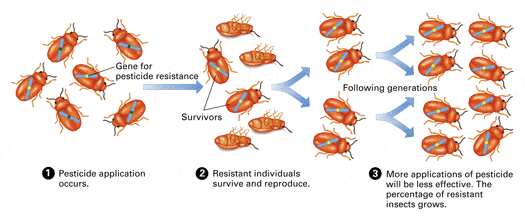
What statement is true regarding why natural selection can be easily seen in insects and bacteria?
Natural selection only occurs in prokaryotic cells
Insects and bacteria can reproduce faster than more complex organisms and pass on selected traits quicker
Insects were the first multi-cellular organism to live on land
Bacteria have directly evolved from insect traits.

Which of the following is true about the picture above?
Camels are highly adapted to cold climates.
There are no benefits to using a camel vs. a horse in the desert.
Camels have directly evolved from whales.
A camels long large intestine, long eyelashes and wide feet allow it to be very adapted to the desert.

Which of the following is true regarding the evidence of evolution
Vestigial structures are not real evidence of evolution.
Homologous structures and fossils are the most dependable forms of evidence.
Comparing DNA is the most definitive and accurate method to show evolutionary relationships.
Embryology and Homologous structures do not support the theory of evolution.

