
NEW
Font size
 Worksheets
China's Dynasties
Total questions: 40
Worksheet time: 30mins
Starting with the Zhou, it was believed that the kings' right to rule came from the gods. What was this called?
Rule of Law
Mandate of Heaven
Divine Intervention
The Chosen One
What was a cause of the Warring States Period?
The states under the Zhou stopped listening to the Zhou king and started fighting each other for power.
The states under the Zhou united to fight invading armies from the North.
The states under the Zhou formed alliances with each other to fight over control of the Huang He.
The states under the Zhou united to overthrow the Zhou king and form a new empire
Why were the ancient Chinese accepting of new philosophies between 500 BC and 200 BC?
People believed they could gain power and control people more easily by using these philosophies.
There was a lot of death and destruction during the Warring States Period and people were searching for peace and order.
There were many famines and floods during this time and people were searching for a way to end the disasters.
People believed they could earn the respect of the king and aristocrats by following these philosophies.


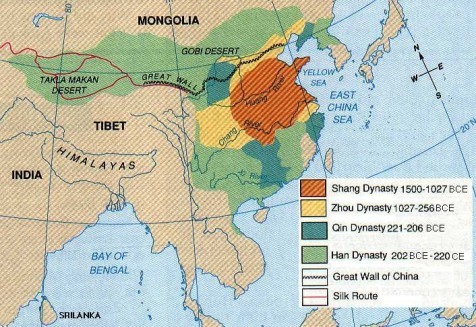
During the Qin Dynasty, the ruler Shi Huang-di began construction of the..
Great Wall
Pyramid of Giza
Ziggurat Temple
Fleet of Zheng he
The rulers of ancient china believed that they were destined to rule by the ___________.
Masters of kung fu
Eightfold Path
Mandate of Heaven
Mandate of Pharaohs
What philosophy did Emperor Q’in use?
Daoism
Buddhism
Legalism
Christianity
What was found at the tomb of Emperor Q’in?
Nothing, the location of his tomb is unknown
1000s of Terracotta soldiers
Original books on Confucianism
The formula for making gunpowder
During the Han Dynasty, China experienced its first ________________________.
Golden Age
Invasion by the Huns
Female Emperor
Exposure to the idea of the Mandate of Heaven
Which early dynasty ruled over the Huang He valley 1750 - 1045 BC
Shang
Han
Qin
Zhou
This was a period of violence that made people look for ways to restore order.
monsoon floods
the period of warring states
the apocalypse
the Mandate of Heaven
How did Shi Huangdi deal with people who opposed him?
He had them train for the civil service
He had many of them killed
He made them leave china forever, he banished them
He asked them to join his army and fight with him
Which of the following actions did Shi Huangdi take in order to control Chinese thought?
He outlawed the ideas of Confucius and others.
He built the only library in the empire.
He trained all the scholars himself.
He wrote the philosophy books read by the people.
In his tomb Shihuangdi was surrounded by
statues of angels
the bodies of his wife and children
thousands of clay soldiers to guard him
statues of dragons to protect him
The Great Wall was constructed to
connect western China to the Yellow Sea
keep out the Xiongnu who lived near the northern border of China
stop trade with Britain and France
celebrate the power of the Tang dynasty
Who founded the Han Dynasty?
Xianfeng
Tiazong of Tang
Liu Bang
Wang Zongyan
Who was the founder of the Qin dynasty?
Shi Huang
Donald Trump
Doaguang
Ronald Reagan
What was Emperor Qin also known as?
A religious emperor
A tyrant
A great and generous man
A chef
Which dynasty was the longest duration in Chinese history?
Shang
Zhou
Qin
Han
In the Dynastic Cycle, what does the new dynasty receive?
Government Jobs
Peace and Harmony
The Mandate of Heaven
strong leader
Built roads in order for the army to easily and quickly get to any uprising or attack
Shang
Zhou
Qin
Han
Confucianism and Daoism developed partially in response to
the teachings of Hanfeizi
a long period of unrest and violence that made people fearful.
the establishing of an official government religion
Boredom and looking for something to do
How was Confucianism influential during the Han Dynasty?
He invented paper
Government workers were trained in his teachings
He recorded the history of their land
His teachings influenced the religion of Buddhism

