
 Worksheets
Science Weekly #5
Total questions: 20
Worksheet time: 16mins
Name
Class
Date
1.
. The Moon is waxing as it changes from
to .
to .
a)
new moon to full moon
b)
full moon to new moon
c)
last quarter to new moon
2.
The Moon is waning when it changes from
a)
full moon to last quarter
b)
first quarter to full moon.
c)
new moon to first quarter.
3.
High tides are lowest when the Moon is in its ____________ phases.
a)
new and full
b)
new and last quarter
c)
first quarter and last quarter
4.
Mountains form from....
a)
Plates sliding past one another
b)
collision of plates
c)
plates moving away from each other
d)
none of these
5.
Which of the following is associated with transform boundary?
a)
volcanoes
b)
mountains
c)
trenches
d)
earthquakes and fault line
6.
Whenever a subduction zone is formed a ____ is formed.
a)
mountains
b)
Island arc
c)
rift valley
d)
volcanoes
7.
What type of boundary creates a new seafloor?
a)
convergent continental to continental
b)
convergent ocean to continental
c)
convergent ocean to ocean
d)
divergent
8.

What is the main function of the respiratory system?
a)
take in oxygen and exhale waste like carbon dioxide
b)
move nutrients throughout the body
c)
take in carbon dioxide and exhale oxygen
9.
The smallest units or parts of living things; the body's building blocks.
a)
cells
b)
organs
c)
tissues
d)
system
10.
A group of organs that performs a similar function is called…
a)
An organ
b)
An organ system
c)
A tissue
d)
An organism
11.
Which statement about photosynthesis is correct?
a)
Plants get the energy they need for photosynthesis from water.
b)
Plants get the energy they need for photosynthesis from soil.
c)
Plants get the energy they need for photosynthesis from sunlight.
d)
Plants do not require energy to perform photosynthesis.
12.
Where does photosynthesis occur?
a)
mitochondria
b)
stomata
c)
xylem
d)
chloroplast
13.
What is the purpose of cellular respiration?
a)
to break down food
b)
to create energy in the body
c)
to release energy from food
d)
there is none; it's a waste of time
14.

Nonliving things found in an ecosystem.
a)
factories
b)
factor trees
c)
biotic factors
d)
abiotic factors
15.

The study of interactions in an ecosystem.
a)
ecology
b)
philosophy
c)
scientology
d)
biology
16.

A group of the same type of organisms living in the same place at the same time.
a)
threatened species
b)
populations
c)
community
d)
limiting factor
17.
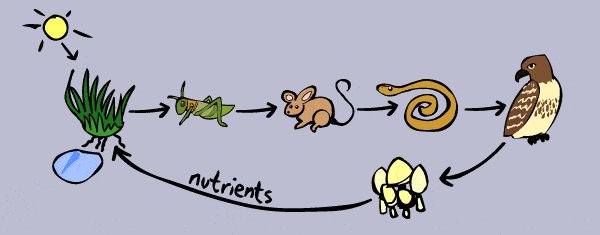
What does a food chain represent?
a)
How all living organisms within a habitat are connected.
b)
All of the things that a particular animal eats.
c)
How plants create their own food.
d)
A single path of energy transfer within a habitat.
18.
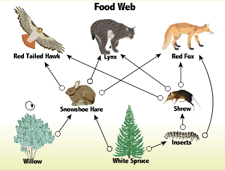
What may happen if the snowshoe hare was removed from the food web pictured?
a)
The insects in the habitat would increase.
b)
The shrew population would decrease due to being only hawk food source.
c)
The willow tree population would decrease.
d)
Foxes would dies due to no food source.
19.

An energy pyramid represents what?
a)
How much sunlight is available for the ecosystem to use.
b)
How much energy a particular organism needs.
c)
How much energy is needed to build a pyramid.
d)
The amount of energy available to the next 'feeder' in a food web.
20.
An inherited trait that helps those organisms that have it to survive
a)
niche
b)
structure
c)
characteristic
d)
adaptation
100 %

