wayground logo

Free Printable Worksheets

NEW

Font size

S
M
L
XL
Worksheets

Human/Environment Interaction

Total questions: 46

Worksheet time: 31mins

Name
Class
Date
1.

Humans _____their environment by wearing snow shoes and warm clothes in winter in Minnesota.

a)

adapt to

b)

depend on

c)

modify/change

2.

Humans _____their environment to make their lives more comfortable by building homes

a)

modify (change)

b)

adapt to

c)

depend on

3.

Humans _____ their environment by building factories to create jobs and make products people want or need

a)

modify/change

b)

adapt to

c)

depend on

4.
An example of a human factor or a way that humans affect the environment of a place is
a)
climate
b)
pollution
c)
landforms
5.

Building dams, plowing and irrigating fields, and digging mines are examples of...

a)

depending on

b)

adapting to

c)

modifying

6.
Building dams is an example of?
a)
Adapting to the environment
b)
Depending on the environment
c)
Modifying the environment
d)
Loving the environment
7.

What is an example of a natural resource?

a)

Soil

b)

Trees

c)

Water

d)

All of the above

8.

True or False: Natural Resources can be renewable or non-renewable.

a)

True

b)

False

9.

What makes something a non-renewable resource?

a)

When we can replace the resource

b)

When a resource cannot be replaced in a short amount of time

c)

When a source is manufactured by humans

d)

When humans change the environment and the resource is the result

10.

What is an example of a renewable resource?

a)

Coal

b)

Tin

c)

Copper

d)

Wind

11.

What is an example of a non-renewable resource?

a)

Wind

b)

Water

c)

Plants

d)

Gold

12.

What do natural resources provide us with?

a)

Food to eat

b)

Clothes to wear

c)

Ways to keep warm

d)

All of the above

13.

What is a common non-renewable source used for energy

a)

Oil

b)

Coal

c)

Natural Gas

d)

All of the Above

14.

Which is not an example of renewable energy?

a)

Solar

b)

Wind

c)

Hydropower

d)

Coal

15.
The destruction of forests by cutting them down or through burning is known as:
a)
Deforestation
b)
Reforestation
c)
Woodsation
d)
Forest Replacement
16.
A resource that can only be used once and cannot be replaced.
a)
Renewable Resource
b)
Nonrenewable Resource
c)
Destructible Resource
d)
Natural Resource
17.
Solar power, wind power, and hydroelectric power are all examples of:
a)
Renewable energy
b)
Fossil energy
c)
Fossil Fuels
d)
Water energy
18.
Deforestation is the burning of fossil fuels.
a)
True
b)
False
19.

A useful material found in the environment is known as a

a)

nonrenewable resource

b)

energy resource

c)

natural resource

d)

renewable resource

20.

Which of the following is an example of a non-renewable resource?

a)

Oil

b)

Soil

c)

Water

d)

Animals

21.

Some chemicals used by farmers may harm the environment by causing?

a)

deforestation

b)

oil spills

c)

pollution

d)

spillover

22.
The thin layer of gasses surrounding the earth is known as the:
a)
Atmosphere
b)
Stratosphere
c)
Gravitational Field
d)
Asteroid Belt
23.
Natural materials (like oil, land, water, solar energy), which can be used by humans are known as:
a)
Natural Resources
b)
Artificial Resources
c)
False Resources
d)
Negative Resources
24.
A resource that has an unlimited supply and does not run out when used by humans is known as a:
a)
Unlimited Resource
b)
Renewable Resource
c)
Natural Resource
d)
Special Resource
25.
This is a term for a  change in global climate patterns which started in 1880 and is caused by increasing greenhouse gasses in the atmosphere.
a)
Climate Modification
b)
Weather Change
c)
Climate Reversal
d)
Climate Change
26.
A species whose numbers are so small that the species is at risk of extinction.
a)
Extinct
b)
Endangered
c)
Jeopardized
d)
Imperil
27.
Which of the following is not an example of a renewable resource?
a)
Solar power
b)
Wind
c)
Water
d)
Coal
28.

What are the three types of human environment interaction?

a)

Movement, Region, Place

b)

Depend, Change, Adapt

c)

Detour, Change, Adapt

d)

Depend, Change, Allow

29.

How do humans adapt to the environment?

a)

Use animals for food

b)

Cut down trees

c)

Deforestation

d)

React to natural disasters

30.

How do humans change the environment?

a)

Pollution

b)

Walk around town

c)

React to natural disasters

d)

Heat your homes

31.

How do humans change the environment?

a)

Deforestation

b)

Eat dinner with your family

c)

Build shelters for different types of weather

d)

Wear warm clothes in the winter

32.

We only have a fixed amount of copper on Earth. Once we use all of the copper, we can't replace it. What type of resource is it?

a)

Renewable

b)

Nonrenewable

33.

Solar panels are a fantastic idea, because even if you use a lot of sunlight, there is an unlimited amount! What type of resource is sunlight?

a)

Nonrenewable

b)

Renewable

34.

Which one of these is an example of adapting to the environment?

a)

building a dam to produce power

b)

using animals as food

c)

deforestation

d)

hiding in a tornado shelter during a tornado

35.
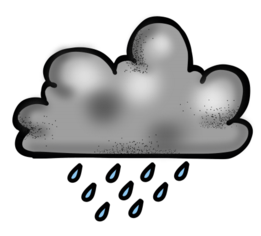
What part of the water cycle does this picture show?
a)
condensation
b)
precipitation
c)
evaporation
36.
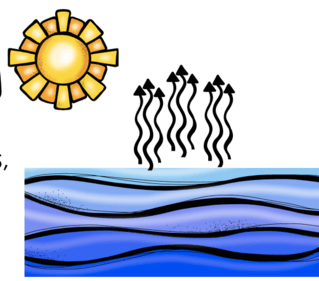
What part of the water cycle does this picture show?
a)
condensation
b)
precipitation
c)
evaporation
37.
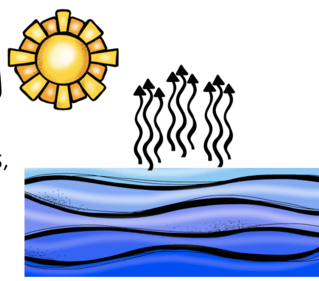
What part of the water cycle does this picture show?
a)
condensation
b)
precipitation
c)
evaporation
38.
When water condenses, the water vapor in the air gets ___________ and changes back into liquid.
a)
cold
b)
hot
c)
warm
d)
solid
39.
Precipitation happens when clouds of water droplets are too ______________.
a)
cold
b)
light
c)
heavy
d)
hot
40.
Evaporation happens when the sun ___________ water and turns it into vapor.
a)
cools
b)
heats up
c)
freezes
d)
lights up
41.
Which of these is not an example of precipitation?
a)
rain
b)
clouds
c)
sleet
d)
snow
42.
Which of these is an example of precipitation?
a)
snow
b)
air
c)
clouds
d)
vapor
43.
Which stages does liquid water from the ocean turn into water vapor?
a)
condesantion
b)
evaporation
c)
precipitation
d)
run off
44.
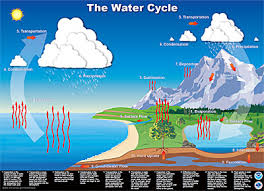
what does the #4 show in the diagram?
a)
condensation
b)
evaporation
c)
precipitation
d)
run off
45.

Which of these hurts the Earth?

a)

recycling

b)

riding a bike to work

c)

pollution

46.

What is one way to help the Earth

a)

deforestation

b)

using clean energy

c)

pollution

d)

farming