
 Worksheets
CBA REVIEW March
Total questions: 39
Worksheet time: 1hrs 3mins
Name
Class
Date
1.
Which of these BEST describes how some birds survive when the weather gets cold?
a)
a. They store twigs and sticks in their nest
b)
b. They migrate to a warmer climate
c)
c. They grow more feathers to stay warm in the winter
d)
d. They hide in bushes and wait for warm weather
2.
A trait that helps a living thing survive.
a)
instinct
b)
mimicry
c)
camouflage
d)
adaptation
3.
Animals that have something they DO to live. This includes things like hibernation, migration etc.
a)
warning coloration
b)
camouflage
c)
behavioral adaptation
d)
mimicry
4.
Color or pattern that helps an animal blend in with its habitat
Adaptation: polar bears in the Artic
Adaptation: polar bears in the Artic
a)
Hibernation
b)
Locomotion
c)
Camouflage
d)
Migration
5.
Plant's xylem transport...
a)
nutrients
b)
water
c)
soil
d)
sunlight
6.
Birds fly because
a)
they have wings and their bones are hollow
b)
they have wings that are strong
c)
they have wings that trap the air
d)
the have wings that are light with heavy bones
7.
A trait that helps a living thing survive.
a)
instinct
b)
mimicry
c)
camouflage
d)
adaptation
8.
An inherited trait that helps those organisms that have it to survive
a)
niche
b)
structure
c)
characteristic
d)
adaptation
9.

Coloring or another physical characteristic that help an organism blend in with its environment
a)
mimicry
b)
camouflage
c)
hibernation
d)
migration
10.

The seasonal movement of an organism from one place to another
a)
camouflage
b)
migration
c)
hibernation
d)
function
11.
Which adaptation (for the underlined animal) serves the function of defense?
a)
A walking stick looks like the twig on which it rests.
b)
A porcupine’s quills cause a predator to seek another meal.
c)
A whale filters plankton and krill from the water in which it swims.
d)
A penguin is dark on top and white below to blend in with the water.
12.
Which of the following is a physical adaptation for the underlined animal?
a)
A butterfly has bright colors to warn predators that it is poisonous.
b)
A hognose snake rolls over, slows its breathing, and hangs its tongue out to play dead.
c)
A herd of buffalo encircle their young to protect them from a pack of wolves.
d)
A dung beetle rolls a piece of dung across the desert.
13.
Where the better adapted organisms survive to pass traits along to offspring.
a)
Evolution
b)
Natural Selection
c)
Extinction
d)
Artifical Selection
14.
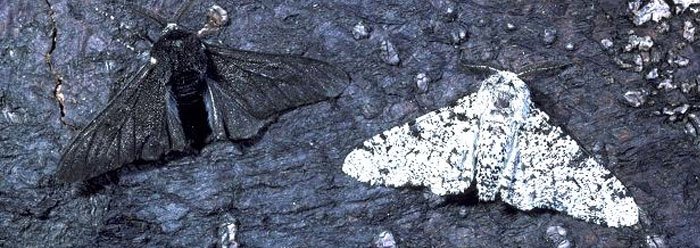
The trees these moths used to live on were white, but have been covered in soot from coal factories. Which moth will be more successful in this environment?
a)
Dark moth
b)
Light moth
c)
Both will be equally successful
d)
Neither will be successful
15.
Why are advantageous traits more likely to be passed onto offspring?
a)
Because they are more likely to survive and reproduce.
b)
Because they come from dominant alleles.
c)
Because they come from recessive alleles.
d)
Because the trait is an acquired phenotype.
16.
Which of the following characteristics will most likely be helpful in identifying a butterfly using a dichotomous key?
a)
Migrates north every spring
b)
hangs on branches
c)
flutters wings fast on hot days
d)
Wings have long extensions
17.

A table of arachnid and insect characteristics is shown. Which characteristic could be used to distinguish between
arachnids and insects?
arachnids and insects?
a)
Jointed legs
b)
Body segments
c)
Presence of eyes
d)
Presence of antennae
18.
What step do we always start with when using dichotomous keys?
a)
1
b)
2
c)
3
d)
4
19.
When using a dichotomous key to identify organisms, what do we look at?
a)
physical features
b)
weather patterns
c)
environment
d)
diet
20.

Which feature of a rose helps it grow without being eaten by large animals?
a)
flowers with bright colors
b)
sharp thorns
c)
small seeds
d)
deep roots
21.

Since the 1800s humans have stopped burning coal, and the trees have returned to their original color. Which moth will be more successful in this environment?
a)
Dark moth
b)
Light moth
c)
Both will be equally successful
d)
Neither will be successful
22.

what did Charles Darwin observe in finch populations of the Galapagos Islands off the coast of South America?
a)
different species on different islands
b)
all species on one of the islands
c)
identical species on all the islands
d)
the same species as North America
23.
Successful traits are passed onto offspring through natural circumstances.
a)
Natural Selection
b)
Primary Succession
c)
Secondary Succession
d)
Dominant
24.
Which of these is learned behavior of a dog?
a)
Begging for food
b)
Drinking water
c)
Panting on a hot day
d)
Chewing on a bone
25.
Behavioral changes of individuals of a species that allow for better survival. (Acquired traits)
a)
Variation
b)
Adaptation
c)
Behavior
d)
Environment
26.
Where the better adapted organisms survive to pass traits along to offspring.
a)
Evolution
b)
Natural Selection
c)
Extinction
d)
Artifical Selection
27.
What is the advantage of having different shaped beaks?
a)
To look different from other species.
b)
To be able to eat the food readily available in the environment.
c)
To protect itself against predators.
d)
To protect itself against prey.
28.
Why do frogs and other organism reproduce so many eggs or offspring?
a)
so that their babies can have friends to play with
b)
the more offspring the more likely the offspring will survive
c)
the more offspring the less likely offspring will survive
d)
the more offspring the less competition
29.

Identify the producer.
a)
Grass
b)
Mouse
c)
Snake
d)
Hawk
30.

Which level has the most organisms?
a)
Tertiary Consumers
b)
Secondary Consumers
c)
Primary Consumer
d)
Producers
31.
plants get their energy from the ______
a)
water cycle
b)
Sun
32.
_________ is the food plants make
a)
photosynthesis
b)
glucose
33.
How much energy is passed on to each trophic level in an energy pyramid?
a)
10%
b)
90%
c)
50%
d)
80%
34.

This picture would represent which type of tropism?
a)
Phototropism
b)
Geotropism
c)
Hydrotropism
d)
Thigmotropism
35.

What type of tropism response to light?
a)
Gravitropism
b)
Thigmotropism
c)
Phototropism
d)
Hydrotropism
36.
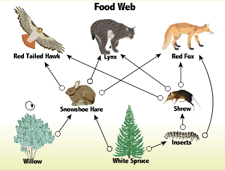
What may happen if the snowshoe hare was removed from the food web pictured?
a)
The insects in the habitat would increase.
b)
The shrew population would decrease due to being only hawk food source.
c)
The willow tree population would decrease.
d)
Foxes would dies due to no food source.
37.

The largest group of organisms found in a food web would be:
a)
Primary Consumers
b)
Producers
c)
Decomposers
d)
Tertiary Consumers
38.

What may happen if the snowshoe hare was removed from the food web pictured?
a)
The insects in the habitat would increase.
b)
The shrew population would decrease due to being only hawk food source.
c)
The willow tree population would decrease.
d)
Foxes would dies due to no food source.
39.

Which of the following would be the most likely effect, if there were a sudden increase in the cricket population?
a)
There would be a decrease in the small bird population.
b)
There would be a decrease in the grass/flowers population.
c)
There would be a decrease in the mice population.
d)
There would be an increase in the grass/flowers population.
100 %

