wayground logo

Free Printable Worksheets

NEW

Font size

S
M
L
XL
Worksheets

Biodiversity, Natural Selection, and Dichotomous Keys

Total questions: 26

Worksheet time: 37mins

Name
Class
Date
1.
A labeled diagram of a fiddler crab is provided. Which of the following is an accurate observation of the structures of a fiddler crab? Fiddler crabs have -
a)
five pairs of walking legs on each side.
b)
an enlarged propodus on both front legs.
c)
a pair of eyes on stalks at the top of the body.
d)
two pairs or chelipeds for a total of four.
2.
A dichotomous key for trees is provided. Hikers found a tree that has large brown cones and single sharp needles. What species of tree have the hikers found?
a)
Juniper
b)
Pine
c)
Spruce
d)
Fir
3.

The more diverse an ecosystem is the more...

a)

... vulnerable it is to climate change.

b)

... endangered it is to habitat fragmentation.

c)

.... resistant it is to environment changes.

4.
Which option is abiotic?
a)
Plants
b)
Bacteria
c)
Water
d)
Fungi
5.
Does this have biodiversity?
a)
Yes
b)
No
6.
Does this picture have sustainability?
a)
Yes
b)
No
7.
Survival of the Fittest and Evolution were proposed by what scientist?
a)
Charles Darwin
b)
Albert Einstein
c)
Steven Hawking
d)
Isaac Newton
8.
Behavioral changes of individuals of a species that allow for better survival. (Acquired traits)
a)
Variation
b)
Adaptation
c)
Behavior
d)
Environment
9.
Why are advantageous traits more likely to be passed onto offspring?
a)
Because they are more likely to survive and reproduce.
b)
Because they come from dominant alleles.
c)
Because they come from recessive alleles.
d)
Because the trait is an acquired phenotype.
10.
Do organisms "decide" to evolve and change?
a)
Yes, they know they need to change to survive 
b)
No, they change because of natural selection
11.
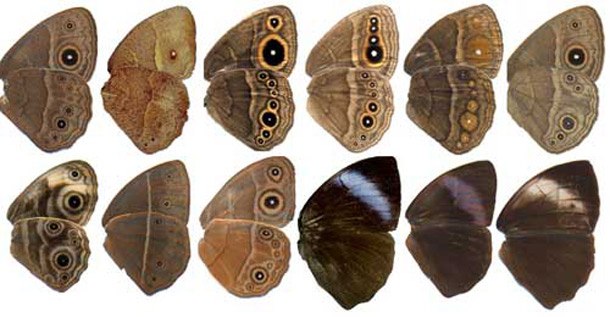
These moths are all the same species. The differences between their wings is an example of ________________
a)
Natural Selection
b)
Variation
c)
Homeostasis
d)
Extinction
12.
A farmer has bred his pineapple plants from the sweetest pineapples from his last harvest to get even sweeter pineapple plants. What is this an example of?
a)
Selective breeding
b)
Natural selection
c)
Extinction
d)
Mutagenesis
13.

The purpose of selective breeding is to

a)

Get bigger animals

b)

Get smarter animals

c)

create animals with traits desirable to humans

d)

create animals that will never go extinct

14.

A change in the environment will cause the animals that live there to...

a)

Die

b)

Migrate

c)

Adapt

d)

All of the above

15.
Coloring or another physical characteristic that help an organism blend in with its environment
a)
mimicry
b)
camouflage
c)
hibernation
d)
migration
16.

Adaptation occurs...

a)

in one individual organism after several years in a new environment

b)

in one individual organism after a lifetime in an environment

c)

right away in every member of a species after a year in a new environment

d)

only in the species' next generation

17.

The Prickly Pear Cactus can grow in a dry environment because.....

a)

it is able to store water

b)

it has spiny leaves

c)

is carnivorous

d)

collects salt

18.
Temperature, light, air, water, and soil are all  _____  parts of the environment
a)
alive
b)
biotic 
c)
abiotic
d)
living
19.
Which of the following is NOT an example of marine debris?
a)
seaweed
b)
plastic
c)
fishing nets
d)
trash
20.
A landfill overflows into the river. What could happen to the plants and animals that live in the area around the river?
a)
The river will dry up
b)
They might get sick
c)
They will be healthier
d)
They will stay the same
21.
Water from rivers, lakes and streams eventually end up in the ocean. 
a)
True
b)
False
22.

What is the source of most oil pollution found in the ocean?

a)

Runoff from land

b)

Leakage from wells located offshore

c)

Oil tanker collisions

d)

From wastewater dumped by ships

23.
Which example below is a physical adaptation?
a)
Young lions play together.
b)
Zebras form a herd and watch for predators.
c)
A bird builds a nest.
d)
A deer has flat teeth for chewing plants.
24.

What feature do most sea animals have to help them withstand the cold temperatures of the ocean?

a)

blubber (a specialized fat layer to keep animals warm)

b)

the ability to hibernate so that the temperatures do not affect them as much

c)

cold blood to match the temperature of the water they are in

d)

the ability to swim fast enough to warm themselves up in cold water

25.

Why might some plants that grow on the shady rain forest floor have large leaves?

a)

to stay safe from predators

b)

to attract different animals

c)

to survive harsh winters with heavy snowfall

d)

to take in as much sunlight as possible

26.
Almost all adaptations started off as?
a)
selective breeding
b)
physiological
c)
structural
d)
mutation