
 Worksheets
Reporting Category 1-3 Review
Total questions: 47
Worksheet time: 2hrs 30mins
∎Plastic ball
∎Glass Marble
∎Metal paper clip
∎Wood block
Which two objects are most likely less dense than water?
The classification of matter as a solid, liquid, or gas
boiling point
thermal energy
physical state
temperature
The temperature at which a substance changes from a liquid to a solid.
freezing point
boiling point
melting point
evaporation
The temperature at which a substance changes from liquid to gas.
boiling point
melting point
evaporation
condensation
The temperature at which a substance changes from a solid to a liquid.
boiling point
freezing point
melting point
evaporation
Some people add sugar to hot tea. Which property of sugar remains the same when the sugar is in the tea solution?
The taste of the sugar
The size of the sugar crystals
The color of the sugar crystals
The texture of the sugar crystals
A small bowl contains a mixture of toothpicks and glass marbles. The easiest way to separate the mixture without touching it would be...
add glue to the mixture
place a magnet in the bowl
pour the mixture into a paper cone
add water to the bowl

Water flows through turbines in dams like the one shown above. The flowing water makes the turbines spin. What type of energy is used to make the turbines spin in this type of dam?
Light energy
Thermal energy
Sound energy
Mechanical energy
Which object requires only mechanical energy to perform its main function?


A group of students built the circuit shown above. The lightbulb does not glow. Which statement explains this observation?
The battery is not charged
The lightbulb is not part of a complete circuit
The circuit does not have a switch
The bell uses most of the energy from the battery
Material through which heat or electricity does not easily flow.
conductor
insulator
electric current
electric circuit
Light hitting a mirror and bouncing off is an example of _____________________.
reflection
refraction
transmission
absorption
Light passing through a lens and bending is an example of ______________________________.
reflection
refraction
transmission
absorption

Why does the straw appear broken in the water?
Light is being reflected
Light is being refracted
Light is bouncing off the water
Light is being absorbed by the water


because oceans –

While hiking in a forest a girl found a fossil imbedded in a boulder. The fossil is shown.
According to the above information and image, what does the fossil tell us about the nature of the environment in the past?
The area was once covered by water
The area used to be a desert
The area was once a higher elevation
The area used to be a jungle

4. Which of the following is associated with the formation of sedimentary rock?
Heat and Pressure
Time and Heat
Compaction and Cementation
Melting and Pressure
Coal, petroleum, and natural gas are all fossil fuels originated from-
Buried, dead organisms changed by time, heat, and pressure
Heat preserved within the Earth’s crust
Decayed rocks from within the Earth’s crust
Plants that survived the Earth’s changes
Some students make a model to show one of the first steps in the formation of sedimentary rock. The students pour 2 centimeters of light-colored sand into a clear plastic box. Then they add 1 centimeter of gravel. Finally they pour 2 centimeters of dark-colored sand on top of the gravel. Which characteristic of sedimentary rock does this model best show?
Sedimentary rock is made of layers.
Sedimentary rock is cemented bits of rock.
Sedimentary rock is common in Texas.
Sedimentary rock is often limestone.

What is this landform?
delta
canyon
valley
sand dune

What is this landform?
canyon
delta
valley (U-shaped)
arch
Deposition
the movement of weathered material by wind, water, or ice (e.g. glaciers)
process by which weathered and eroded material is deposited by wind, water, and ice
process by which exposed rock is broken down by rain, frost, wind, or other elements of weather
a physical structure on Earth that occurs naturally
Weathering
process by which weathered and eroded material is deposited by wind, water, and ice
the movement of weathered material by wind, water, or ice (e.g. glaciers)
process by which exposed rock is broken down by rain, frost, wind, or other elements of weather
a physical structure on Earth that occurs naturally
Erosion
the movement of weathered material by wind, water, or ice (e.g. glaciers)
process by which weathered and eroded material is deposited by wind, water, and ice
process by which exposed rock is broken down by rain, frost, wind, or other elements of weather
a physical structure on Earth that occurs naturally
A sudden change in temperature can affect current weather conditions in a specific area. Changes in average weather conditions over 30 years or more result in the area’s —
precipitation
climate
air mass
forecast
What is the difference between weather and climate?
Weather is measured over a period of years, and climate changes daily
Weather changes daily and can be predicted, but climate cannot ever be predicted.
Weather cannot be predicted, but climate is certain.
Weather conditions describe the daily atmospheric conditions, and climate is the average weather of an area measured over many years.
Rain, sleet, snow, and hail are all examples of ________________.
Climate
Precipitation
Temperature
Weather
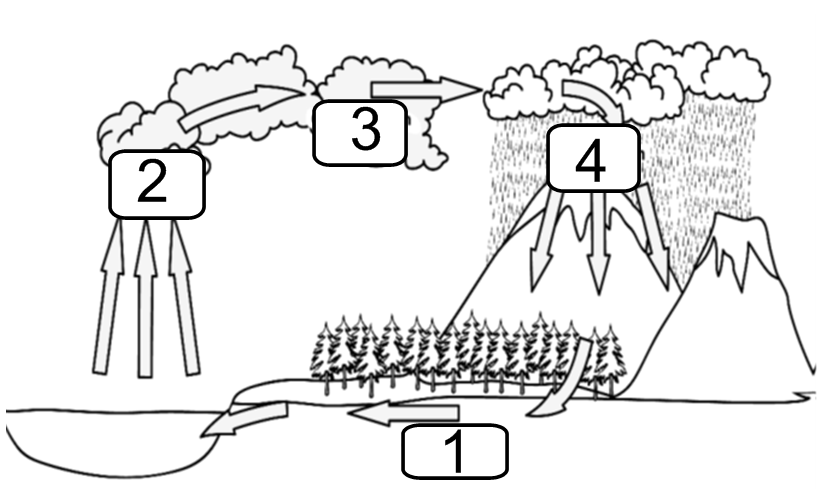


What role does the Sun play in the water cycle?
The Sun causes cools the water to stop the cycle
The Sun causes water vapor to condense
The Sun is not part of the water cycle
The Sun provides thermal energy to power the water cycle
Day and night on Earth are caused by Earth's
orbit
rotation
revolution
axis
It takes ________ hours for Earth to complete one rotation.
8
16
24
36
It takes __________ days for Earth to complete one revolution.
120
250
365
420

People in the shaded area of Earth are experiencing ______________.
sundown
sunrise
day
night
Which object in our solar system has a rocky surface and supports life?
Earth
Moon
Sun
Which of the following objects experiences erosion?
Earth
Moon
Sun
What orbits around Earth?
asteroid
meteror
moon
sun
Shadows in the morning point to what direction?
east
north
south
west
Shadows in the afternoon point in which direction?
east
north
south
west

