

wayground logo

Free Printable Worksheets

NEW

Font size

S
M
L
XL
Worksheets

Populations & Communities

Total questions: 45

Worksheet time: 47mins

Name
Class
Date
1.

This is the movement of individuals into an area.

a)

Immigration

b)

Emigration

c)

Birth Rate

d)

Death Rate

2.

This is the movement of individuals out of an area.

a)

Immigration

b)

Emigration

c)

Birth Rate

d)

Death Rate

3.

A lack of resources can lead to ___________ growth.

a)

Logistic

b)

Exponential

4.

Number of individuals per unit area.

a)

Population Density

b)

Immigration

c)

Emigration

d)

Population

5.

A limiting factor will cause a population to ____________.

a)

Increase

b)

Decrease

6.

Competition, Predation, Parasitism, and Disease are all examples of Density-_____________ Limiting Factors.

a)

Independent

b)

Dependent

7.

This is not a Density-Independent Limiting Factor:

(HINT: ABIOTIC factors are usually Independent)

a)

Weather

b)

Natural Disaster

c)

Temperature

d)

Sunlight

e)

Plague Epidemic

8.

Where an organism lives.

a)

habitat

b)

niche

c)

population

d)

migrates

9.

The role played by an organism within its ecosystem. The way this organism uses its physical and biological conditions.

a)

habitat

b)

niche

c)

population

d)

migrates

10.

A close relationship between two organisms living closely together.

a)

Symbiosis

b)

Niche

c)

Emigration

d)

Immigration

11.

A symbiotic relationship where one individual is helped, and the other is harmed.

a)

Parasitism

b)

Mutualism

c)

Commensalism

d)

Predator-Prey

12.

A symbiotic relationship where both individuals benefit.

a)

Parasitism

b)

Mutualism

c)

Commensalism

d)

Predator-Prey

13.

A symbiotic relationship where one individual is helped, and the other is neither helped nor harmed.

a)

Parasitism

b)

Mutualism

c)

Commensalism

d)

Predator-Prey

14.

An interaction where one animal captures and feeds upon another animal.

a)

Parasitism

b)

Mutualism

c)

Commensalism

d)

Predator-Prey

15.

When habitats are destroyed, there are usually fewer niches for animals and plants. This action would most likely not lead to a change in the amount of

a)

biodiversity

b)

competition

c)

interaction between species

d)

solar radiation reaching the area

16.

The removal of nearly all the predators from an ecosystem would most likely result in

a)

an increase in the number of carnivore species

b)

a decrease in new predators migrating into the ecosystem

c)

a decrease in the size of decomposers

d)

an increase in the number of herbivores

17.

Ten breeding pairs of rabbits are introduced onto an island with no natural predators and a good supply of water and food. What will most likely happen to the rabbit population?

a)

it will remain relatively constant due to equal birth and death rates

b)

it will die out due to an increase in the mutation rate

c)

it will increase until it exceeds carrying capacity

d)

it will decrease and then increase

18.
In early spring, many wildflowers begin to grow, produce flowers, and release seeds. The leaves of the wildflowers make food before the leaves of the trees in the area begin to develop. the early growth pattern of the wildflowers would result in
a)
decreased competition for sunlight between the trees and the wildflowers
b)
decreased competition for suitable temperature between the trees and the wildflowers
c)
increased competition for space between the trees and the wildflowers
d)
increased competition for oxygen between the trees and wildflowers
19.
Which statement best describes an ecosystem maintaining a state of approximate equilibrium?
a)
Nutrients from decayed organisms are recycled in a forest ecosystem.
b)
 All the frog species in a South American rain forest become extinct.
c)
A mutation spreads through a species of bacterium, making them unable to decompose wastes
d)
 Mice are released into a field ecosystem as food for a declining predator population.
20.

Role or position and species has in its environment

a)

habitat

b)

ecological niche

c)

ecosystem

21.
The ecological niches of three bird species are shown in the diagram. What is the advantage of each bird species having a different niche?
a)
As more birds feed higher in the tree, available energy increases.
b)
More abiotic resources are available for each bird.
c)
Predators are less likely to feed on birds in a variety of locations.
d)
There is less competition for food.
22.
Two closely related species of birds live in the same tree.  Species A feeds on ants and termites, while Species B feeds on caterpillars.  The two species coexist successfully because –
a)
each occupies a different niche
b)
they interbreed 
c)
they use different methods of reproduction
d)
birds compete for food
23.
The resources a population actually uses as a result of competition.
a)
niche
b)
realized niche
c)
fundamental niche
d)
competition
24.
An organisms Niche can be defined as
a)
The role its plays in the ecosystem
b)
It's physical and biological requirements 
c)
the interactions between it and other organisms
d)
All of these
25.
The idea that no two species within an ecosystem can occupy the exact same niche
a)
niche overlap
b)
niche differentiation
c)
competitive exclusion
d)
niche decay
26.
An organism's _________ is defined as the environment in which it lives.
a)
habitat
b)
niche
c)
social structure
d)
ecosystem
27.
A collection of organisms that belong to different populations but all live in the same area and interact with one another.
a)
population
b)
ecosystem
c)
community
d)
biosphere
28.

Which of the following statements about human carrying capacity is the most likely true?

a)

We have exceeded our carrying capacity as exemplified by world hunger.

b)

Human technology has been responsible for periodically increasing the carrying capacity.

c)

The earth can probably support 40-50 billion people on a vegetarian diet.

d)

In all likelihood, human do not have a carrying capacity.
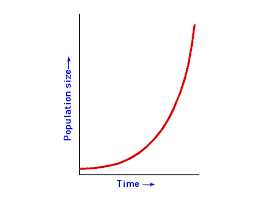
29.
What type of growth is shown in the diagram?
a)
exponential growth
b)
logistic growth 
c)
predator-prey cycle
d)
boom-bust curve
30.
Largest number of individuals of a population that the environment can support...  
a)
carrying capacity
b)
population crash
c)
lag phase
d)
mutualism
31.
What do you call a period of rapid growth?
a)
exponential growth
b)
logistic growth
c)
emigration
d)
predator-prey cycle
32.
Which type of growth is best illustrated by this rabbit population?
a)
exponential
b)
logistic
c)
S-shaped
d)
predator-prey
33.
Type of growth that occurs when disease and parasites are present...
a)
exponential
b)
J-shaped
c)
predator-prey
d)
logistic
34.
Why has the population been able to grow so quickly in such a short period of time?
a)
Doctors have developed easier and safer ways to have babies
b)
People needed more help to work their farms so they had more children
c)
Because people stayed in one place and only moved when crowded out
d)
Because of medical care, clean water and better access to nutritious food
35.
If a disease destroying barley plants in a field swept through an ecosystem, what would happen to the barley eating bird population in the the field ?
a)
The bird population would stay the same
b)
The bird population would infinitely increase
c)
The bird population would decrease
36.
Will competition increase/decrease the carrying capacity of an ecosystem for the animal in competition?
a)
Decrease
b)
Increase
37.
When a population grows past the ecosystem's carrying capacity, what happens to the population?
a)
Continues to grow
b)
The population starts to die off to return to carrying capcity
c)
The population will go extinct due to lack of resources
d)
The population grows then finds a new carrying capacity
38.
What type of growth is shown in the diagram?
a)
exponential growth
b)
logistic growth 
c)
predator-prey cycle
d)
boom-bust curve
39.
species help determine the types and numbers of other species in an area, helping to sustain the ecosystem
a)
keystone
b)
native
c)
indicator
d)
foundation
40.
One difference between parasitism and predation is that parasites
a)
do very little harm to their hosts.
b)
keep their hosts alive for a period of time.
c)
attack the host only from the inside.
d)
are not very big.
41.
Two different species fighting for the same resources often enough will lead to what outcome?
a)
Interspecific mating
b)
Intraspecific competition
c)
competitive exclusion
d)
predation
42.
To hunt, capture, kill, and eat another organism 
a)
predation
b)
parasitism
c)
herbivory
d)
exclusion
43.
While exploring a lake in Argentina, Laguna del Diamante (Diamond Lake), scientists found rocks covered with mats made of photosynthetic microbes. Flamingos in the area filter the nutrient rich microbes by pumping the lake water through their bill. What is the relationship between the photosynthetic microbes and the flamingos in the Laguna del Diamante ecosystem?
a)
The microbes are parasites, and the flamingos are hosts.
b)
The microbes are carnivores, and the flamingos are predators.
c)
The microbes and flamingos are in a mutualistic relationships.
d)
The microbes are prey, and the flamingos are predators.
44.
In which kind of relationship does one organism benefit, while the other is harmed?
a)
mutualism
b)
parasitism
c)
amensalism
d)
commensalism
45.
Which best explains why many kinds of plants and animals can live together in an ecosystem?
a)
The plants and animals are all part of a food chain and depend on each other to live.
b)
Plants and animals are interdependent of one another.
c)
One species may overpopulate, killing all plant life.
d)
Over population of a species results in a biodiversity.
