wayground logo

Free Printable Worksheets

NEW

Font size

S
M
L
XL
Worksheets

Unit 2: States of Matter and Changes of State

Total questions: 34

Worksheet time: 1hrs 4mins

Name
Class
Date
1.

Which phrase describes the changes that take place when a gas condenses?

a)

loss of energy and increased freedom of particle motion

b)

gain of energy and increased freedom of particle motion

c)

loss of energy and decreased freedom of particle motion

d)

gain of energy and decreased freedom of particle motion

2.

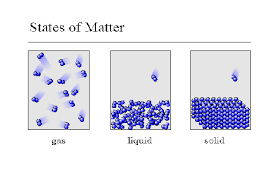
Frost forms when water vapor changes directly from a gas to ice in a process called deposition. If you were to model the water particles before and after deposition, how would they compare?

a)

Before deposition, the particles vibrate in place; after deposition, they slide by each other.

b)

Before deposition, the particles slide by each other; after deposition, they vibrate in place.

c)

Before deposition, the particles vibrate in place; after deposition, they move quickly in all directions.

d)

Before deposition, the particles move quickly in all directions; after deposition, they vibrate in place.

3.

Which energy transfer takes place when water freezes to form ice crystals in the atmosphere?

a)

Energy is transferred from the air into the water.

b)

Energy is transferred from the water into the air.

c)

Energy is transferred from the water into the ground.

d)

Energy is transferred from warmer ice crystals to colder ones.
4.
At higher temperatures
a)
particles in an object have less energy
b)
particles in an object move faster
c)
a gas contracts
5.
Freezing
a)
Solid to gas
b)
Liquid to solid
c)
Gas to solid
d)
Liquid to gas
6.
Boiling
a)
liquid to gas
b)
gas to solid
c)
gas to liquid
d)
solid to liquid
7.
Define a liquid.
a)
Indefinite shape, indefinite volume
b)
Definite shape, definite volume
c)
Found in stars
d)
Definite volume, indefinite shape
8.
The state of matter that has no definite size or shape is
a)
Solid
b)
Liquid
c)
Gas
9.
Particles (molecules) in a ______________________ have more energy than the other states of matter.
a)
gas
b)
solid
c)
liquid
10.
Particles of a liquid
a)
are tightly packed together and stay in a fixed position.
b)
have no viscosity.
c)
decrease in volume with increasing temperature.
d)
are free to move around one another but still touch.
11.
What term describes a solid changing to a gas?
a)
Deposition
b)
Sublimation
c)
Evaporation
d)
Freezing
12.
What is condensation?
a)
gas to solid
b)
gas to liquid
c)
liquid to solid 
d)
solid to liquid 
13.
What are the states of matter?
a)
solid, liquid, and juice
b)
solid and liquid
c)
solid and gas
d)
solid, liquid, and gas
14.
The change from liquid to solid, or the reverse of melting, is called:
a)
freezing
b)
condensation
c)
boiling
d)
sublimation
15.
During the process of sublimation,
a)
a solid turns directly into a gas
b)
a liquid turns to a gas
c)
a solid turns into a liquid
d)
a gas turns directly into a solid
16.
A shrinking puddle is an example of ___________, or vaporization that takes place only on the surface of a liquid.
a)
evaporation
b)
boiling
c)
freezing
d)
melting
17.
_______ occurs when a liquid changes to a gas below its surface as well as at the surface.
a)
Boiling
b)
Evaporation
c)
Freezing
d)
Melting
18.

Water drops forming on the outside of a cold glass is and example of:

a)

condensation

b)

melting

c)

vaporization

d)

freezing

19.
Matter changes state when...
a)
energy is added or removed
b)
energy is added
c)
energy is removed
d)
there is no energy
20.
What is an example of sublimation?
a)
Ice cream melting
b)
Dry ice
21.
When a gas forms directly into a solid, skipping the liquid phase
a)
deposition
b)
sublimation
c)
evaporation
d)
condensation
22.
Boiling point of water is
a)
0 0C
b)
100 0C
23.
Freezing point of water
a)
0 0C
b)
100 0C
24.
When you increase your altitude, the air pressure 
a)
increases
b)
decreases
c)
stays the same
25.
What is the unit of measurement for pressure?
a)
pascal
b)
grams
c)
milliters
d)
meters
26.
When you increase your depth under water, the water pressure on your body
a)
increases
b)
decreases
c)
stays the same
27.
What is altitude?
a)
how much something weighs
b)
the distance above sea level
c)
how big something is
d)
how far away something is
28.
As you climb up a mountain what happens to the air pressure?
a)
decreases
b)
increases
c)
stays the same
29.
What happens to the amount of oxygen molecules as altitude increases?
a)
fewer molecules
b)
more molecules
c)
same amount of molecules
d)
nothing happens to the molecules
30.
Air pressure is greatest when near Earth's surface because?
a)
The air molecules are farther apart.
b)
The air molecules are closer together.
c)
Air molecules collide.
d)
Air molecules are tightly packed.
31.
Which container will have a lower pressure?
a)
left
b)
right
c)
they both have the same pressure
d)
I don't know
32.
Compared to a man standing on a tall mountain, a man standing at sea level 
a)
has less atmospheric pressure on him 
b)
has more atmospheric pressure on him 
c)
weighs less 
d)
has more mass 
33.
Atmospheric pressure increases as you move towards lower elevations and decreases as you move into higher elevations.
a)
True
b)
False
34.

What is pressure?

a)

The amount of force exerted on a surface

b)

The surface area of an object

c)

The weight of an object