
NEW
Font size
S
M
L
XL
 Worksheets
04c - Angular Velocity and Acceleration
Total questions: 25
Worksheet time: 28mins
Name
Class
Date
1.
When an object spins it is said to undergo ______________.
a)
rotational motion
b)
angular momentum
c)
axis differentiation
d)
rotational axis
2.
Two children, Jack and Jill, ride on a merry-go-round. Jack is at a greater distance from the axis of rotation than Jill. Which of the following are true statements?
a)
Jill and Jack have the same tangential speed.
b)
Jack has a greater tangential speed than Jill.
c)
Jill has a greater angular speed than Jack.
d)
Jill has a smaller angular speed than Jack.
3.
Which of the following is NOT a unit of rotational speed?
a)
Meters per second
b)
Revolutions per minute
c)
Revolutions per second
d)
Rotations per second
4.

The linear speed of an object directed along the tangent to the object’s circular path.
a)
centrifugal speed
b)
tangential speed
c)
linear speed
d)
angular speed
5.
Which has greater angular speed, a horse near the outside rail of a merry-go-round or a horse near the inside rail?
a)
The inside horse
b)
The outside horse
c)
Neither - they both have the same angular speed
6.
A bug on a turning phonograph record will make more turns per minute if it is located toward the center of the record.
a)
True
b)
False
7.
Which has greater linear speed, a horse near the outside rail of a merry-go-round or a horse near the inside rail?
a)
the inside horse
b)
the outside horse
c)
Neither
8.

Stars originate as large bodies of slowly rotating gas. Because of gravity, these clumps of gas slowly decrease in size. What happens to the angular speed of the start as it shrinks?
a)
It rotates faster.
b)
It rotates slower.
c)
It starts to accelerate in the forward direction.
d)
The rotation rate stays the same.
9.

Which of these has the greatest centripetal acceleration?
a)
Large Velocity, Large Radius
b)
Small Velocity, Small Radius
c)
Large Velocity, Small Radius
d)
Small Velocity, Large Radius
10.
The rotational equivalent to x (displacement), v (velocity) and a (acceleration) are?
a)
m, m/s, m/s2
b)
θ, ω, α
c)
x, x/t, α
d)
μ, Σ, τ
11.
What does ROTATION mean?
a)
To SPIN
b)
To ORBIT or GO AROUND
12.
An object completes 1.5 circular orbits in half a minute. What is its approximate angular velocity?
a)
0.05 rad/s
b)
0.30 rad/s
c)
0.5 rad/s
d)
3 rad/s
13.
An object completes 1.5 circular orbits in half a minute. It orbits with a radius of 2 m. What is the object's tangential speed?
a)
0.15 m/s
b)
0.60 m/s
c)
1.6 m/s
d)
6 m/s
14.
A tin can whirled on the end of a string moves in a circle because
a)
the can continually pulls on the string.
b)
once the can starts moving, that is its natural tendency.
c)
there is a force on the can pulling it outward.
d)
there is an inward force acting on the can.
15.

Which would have a greater linear velocity?
a)
Kid near the center of the merry go round
b)
Kid near the outside of the merry go round
c)
neither
16.
A possible unit for angular acceleration is:
a)
rad/s2
b)
rad/s
c)
N*m
d)
Kg*m2
17.

What is the direction of the acceleration at point A, if the ball is revolving clockwise?
a)
up
b)
right
c)
down
d)
left
18.
Which statement is true about an object that is traveling in uniform circular motion?
a)
The speed of the object varies.
b)
The net force on the object is directed toward the center of the circular path.
c)
The direction of the object's velocity is constant.
d)
The net force on the object is directed away from the center of the circular path.
19.
The velocity is always _____ to the line of a circle.
a)
outwards
b)
towards the center
c)
tangent
d)
faster
20.
What is the force that causes centripetal acceleration when a car goes around a curve?
a)
Friction
b)
Gravity
c)
Normal
d)
Tension
21.

What happens to her angular velocity when a figure skater brings in her arms?
a)
Increases her angular velocity
b)
Decreases her angular velocity
c)
Has no affect
22.
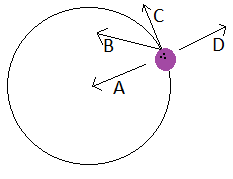
Which represents the acceleration of the ball?
a)
A
b)
B
c)
C
d)
D
23.
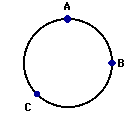
What is the direction of the velocity at point B, if the ball is revolving clockwise?
a)
up
b)
right
c)
down
d)
left
24.
What is the direction of the acceleration at point A, if the ball is revolving clockwise?
a)
up
b)
right
c)
down
d)
left
25.
Which statement is true about an object that is traveling in uniform circular motion?
a)
The speed of the object varies.
b)
The net force on the object is directed toward the center of the circular path.
c)
The direction of the object's velocity is constant.
d)
The net force on the object is directed away from the center of the circular path.
Reset

