wayground logo

Free Printable Worksheets

NEW

Font size

S
M
L
XL
Worksheets

AP Bio Natural Selection

Total questions: 23

Worksheet time: 19mins

Name
Class
Date
1.
a bird that can easily outcompete other birds for food and that can produce many eggs has a high
a)
sexuality
b)
mutation rate
c)
fitness
d)
adaptability
2.
Which of the following is a true statement about natural selection?
a)
it is goal directed
b)
individuals evolve
c)
variation exists in a population
d)
acquired characteristics
3.

The small seeded plants in an area were killed by a fungus. Finches with a small beak cannot crack open the large seeds from the plants that were left. What type of selection is likely to occur?

a)

directional selection

b)

stabilizing selection

c)

disruptive selection

d)

artificial selection

4.

A fire has wiped out the vegetation that produces medium sized seeds. As a result, the finches left can feed on seed that are available in two sizes: small and large. What type of selection is likely to take place in this population?

a)

directional selection

b)

disruptive selection

c)

stabilizing selection

d)

artificial selection

5.

In Canada, the people have overfished the salmon in a particular river. They catch the larger salmon and throw the smaller salmon back into the river. Over time, what type of selection is likely to take place?

a)

directional selection

b)

disruptive selection

c)

stabilizing selection

d)

artificial selection

6.

In a forest in Germany, there is a rat who has three fur coat colors: a light creamy color, a medium tan color, and a dark brown color. In this particular forest, the floor is a medium brown and the intermediate tan color mouse is better camouflaged.

a)

directional selection

b)

disruptive selection

c)

stabilizing selection

d)

artificial selection

7.
What type of selection is depicted in the picture? 
a)
stabilizing 
b)
directional 
c)
disruptive 
d)
the answer is not here
8.
What type of selection?
a)
Directional 
b)
Stabilizing
c)
Disruptive
9.
What type of natural selection is this?
a)
Disruptive Selection
b)
Directional Selection
c)
Stabilizing Selection
d)
Sexy Selection
10.
Scientists find that most feral cats in a neighborhood have whiskers about 12 cm long. After about 15 generations of stabilizing selection, what would you expect to see?
a)
even more cats with 12 cm long whiskers
b)
most cats with less than 12 cm long whiskers
c)
most cats with more than 12 cm long whiskers
d)
most cats with whiskers either less than or more than 12 cm long, very few with whiskers 12 cms 
11.
Characteristics that allow a population to become better suited to its environment
a)
accommodation
b)
adaptation
c)
variation
d)
selection
12.
Why did the population of peppered moths in England change from light to dark after the Industrial Revolution produced a lot of pollution?
a)
Light moths were easy to see against sooty trees and were eaten
b)
Light moths were killed by soot
c)
The birds that ate the dark moths were killed by soot
d)
Dark moths were produced by industrial processes
13.
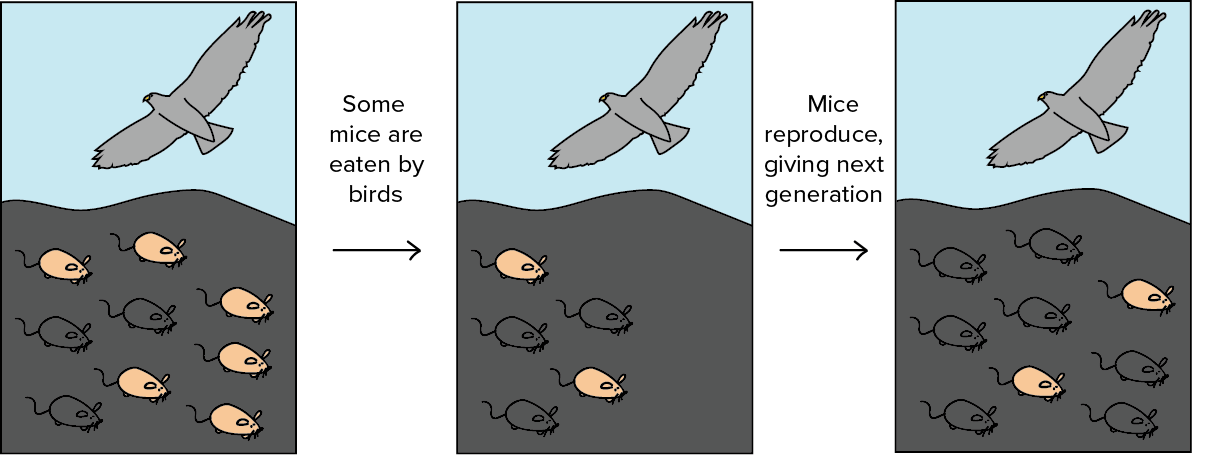
Why is the mouse population changing over time?
a)
The light mice can reproduce more successfully than the dark mice
b)
The hawks eat more dark mice than light mice because the dark mice taste better
c)
The hawks eat more light mice than dark mice because they can see the light mice more easily
d)
The hawks eat more dark mice than light mice because they can see the dark mice more easily
14.
The Tasmanian devil is a marsupial that resembles the North America wolf, which is a placental mammal.
a)
adaptive radiation
b)
divergent evolution
c)
founder effect
d)
convergent evolution
15.
variations in a population are maintained by
a)
mutations
b)
genetic recombination
c)
gene flow
d)
all of the above
16.
Mutations are important because they bring about
a)
death of the organism in which they develop
b)
genetic variation needed for a population to evolve
c)
benefits for the individual, not for the population
d)
Hardey-Weinberg equilibrium within a population
17.
Which statement correctly explains how resistance to penicillin appeared after a few years of its widespread use to fight bacterial infection? 
a)
in order to survive exposure to penicillin, bacteria developed a resistance to the drug 
b)
a few bacteria became resistant to penicillin, and through sexual reproduction , most bacteria acquired the resistance
c)
penicillin never really successfully wiped out populations of bacteria, scientist did not use proper controls in their studies
d)
some bacteria were resistant to penicillin and their population spread rapidly, without competition from bacteria that were killed by penicillin
18.
The wing of a bat and a humans' arm have different functions and appear very different.  Yet, the underlying anatomy is basically the same.  therefore, these structures are examples of
a)
geographic isolation
b)
analogous structures
c)
homology
d)
reproductive isolation
19.
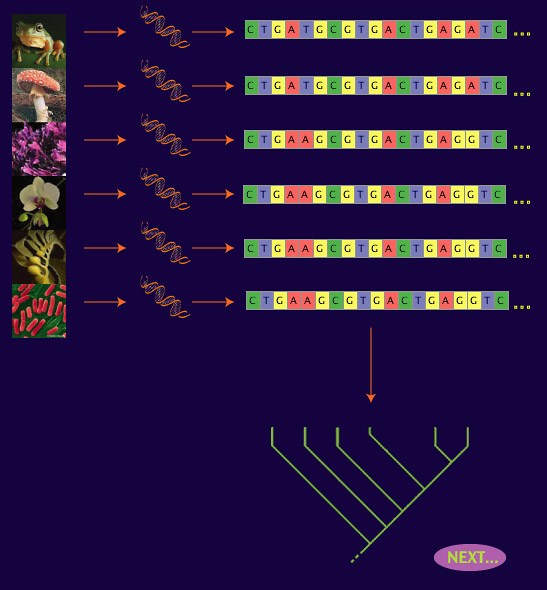
Two organisms that are closely related would have
a)
very similar DNA sequence
b)
exactly the same DNA sequences
c)
no proteins in common
d)
completely different DNA sequence
20.
The table shows the survival rate of two types of beetles in the same environment over a period of three years.  

Which statement about the beetles in this environment is best supported by the data?
a)
Brown beetles have a shorter life cycle than green beetles have
b)
Green beetles are more fit for their environment than brown beetles
c)
 brown beetles are undergo more unfavorable mutations than green beetles
21.
A graph regarding the effect of agricultural bioengineering on insect pests is shown below How has natural selection affected species of insect pests?
a)
A.  Natural selection has not affected the number of species that are resistant to pesticides
b)
A.  Natural selection has rapidly increased the number of species that are resistant to pesticides
c)
A.  Natural selection has only affected the number of species that are resistant to pesticides
22.
The green frog (Lithobates clamitans clamitans) is found in many parts of the United States. The table contains some information about this frog.
Why does the ability to lay 1,000 to 5,000 eggs increase the fitness of the species L. clamitans clamitans?
a)
A.  It increases the probability that some offspring will survive long enough to reproduce.
b)
It increases the chance of the recombination of alleles, leading to genetic drift in the population.
c)
A.  It increases opportunities for offspring to compete for limited resources.
23.
A prey population consists of individuals with a variety of running speeds.
The adaptation that allows some of these animals to run fast would be an example of natural selection if it helps them —

a)
survive and undergo mutations in their DNA
b)
produce offspring that run at average speeds
c)
reproduce and increase the frequency of their genes in the population
d)
lower the mortality rates of the population