
 Worksheets
Thermodynamics Review
Total questions: 26
Worksheet time: 25mins
According to the second law of thermodynamics, natural processes go in the direction that ____ the total entropy of the universe.
Increases or Decreases
Increases
Decreases
maintains
The total change in the thermal energy of a system is the heat added to it minus the ____ the system.
entropy of
work done by
kinetic energy of
temperature of
The form of energy transfer that takes place in a house heated by forced air is primarily ____ .
Convection
Conduction
Radiation
Induction
If the final temperature of a system is greater than the initial temperature, Δt is __________.
positive
eliminated
negative
reduced
__________ is the amount of energy that must be added to a material to raise one unit of mass by one temperature unit.
Temperature
Specific Heat
Radiation
Hotness
Thermodynamics is the study of __________.
Heat
Light
Stars
Sound
In which direction does thermal energy flow?
From hot to cold
From cold to hot
From light to dark
Either from hot to cold or from cold to hot
Absolute zero is __________.
273.15 K
273.15 F
-273.15 C
-273.15 K

You have equal masses of four of the substances listed. All are at the same initial temperature. If you place them in a warmer room, which of the substance's temperature will increase most rapidly?
Iron
Aluminum
Lead
Zinc
The Sun warms the Earth by __________.
Convection
Conduction
Radiation
Induction
The thermal energy needed to boil a liquid is the heat of __________.
Condensation
Vaporization
Fusion
Specific heat

Using information from the table below, determine which of the following processes requires the most added energy.
1 kg of iron is changed from liquid to gas.
2 kg of water is evaporated.
1 kg of liquid mercury is frozen.
1 kg of copper is converted from solid to liquid.
Heat spontaneously flowing from a cold body to a hot body violates the __________.
Law of conservation of energy
kinetic-molecular law
1st law of thermodynamics
2nd law of thermodynamics
Which is an example of a heat engine?
Windmill
Automobile engine
solar panels
volcano
How much thermal energy must be added to a 250-g aluminum pan to raise its temperature from 200C to 850C? The specific heat of aluminum is 897 J/(kg •K).
1.5 x 10⁴ J
1.0 x 10⁶ J
1.45 x 10⁷ J
2.3 x 10⁴ J
A 1.00-kg block of ice at 0°C is melted and converted to water at 0°C. What is its change in entropy?
1,222.8 J
12,228 J
122,280 J
1.22 x 10⁷ J


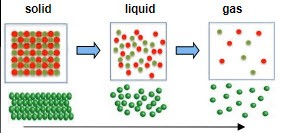
Entropy increases from solid, liquid to gas. Why?
Molecular dispersion increases
Molecular randomness decreases
Molecules are more energetic
Molecules are more reactive



