wayground logo

Free Printable Worksheets

Font size

S
M
L
XL
Worksheets

DKV31083 CH2: Equilibrium of a Particle

Total questions: 25

Worksheet time: 13mins

Name
Class
Date
1.

When a particle is in equilibrium, the sum of forces acting on it equals ------- . (Choose the most appropriate answer)

a)

A constant

b)

A positive number

c)

Zero

d)

A negative number

2.

"A point at which entire weight of object concentrated toward the earth".


Identify the concept explained in the statement above.

a)

Free body diagram

b)

Concurrent forces

c)

Centre of gravity

d)

Rigid body

3.

A particle is in equilibrium state when it is at _________ if originally at rest or has a constant __________ if originally in motion.

a)

motion, acceleration

b)

kinetic, veocity

c)

rest, velocity

d)

acceleration, kinetic

4.

Below are the condition of equilibrium for particles except:

a)

Total force x -axis = 0

b)

Total force y - axis = 0

c)

Resultant force = 0

d)

Velocity = 0

5.

Condition for equilibrium are:


  • Resultant force = 0
  • Moving with constant velocity
  • Stationary/ rest
a)

True

b)

False

6.

For a frictionless pulley and cable, tensions in the cable (T1 and T2) are related as

a)

T1 > T2

b)

T1 = T2

c)

T1 < T2

7.

What are the TWO equilibrium cases for forces acting on an object?

a)

When the object is moving at a constant velocity

b)

The object is speeding up

c)

The object is at rest

d)

The object is slowing down

8.
A combination of all the forces acting on the object is...
a)
Inertia
b)
Force
c)
Newton
d)
Net force
9.
Which of Newton's three laws does the formula F=ma describe?
a)
1st law
b)
2nd law
c)
3rd law
d)
Newt who?
10.
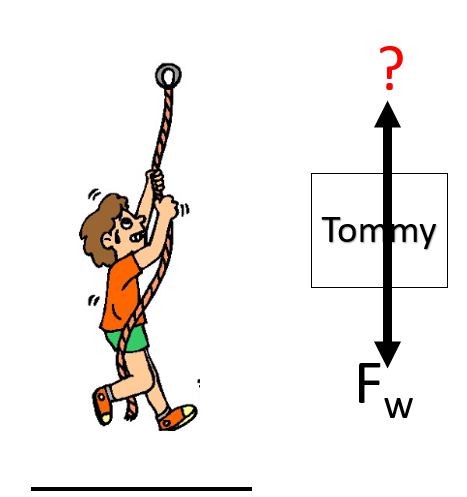
Name the missing force...
a)
tension force
b)
gravitational force
c)
normal force
d)
applied force
11.
What makes a rolling ball stop moving?
a)
gravity
b)
friction
c)
a balanced force
12.
Forces that have a net force of zero ( the object is still).
a)
Balanced force
b)
Unbalanced force
13.
The force that pulls things toward earth.
a)
Speed
b)
Gravity
14.
Which one is balanced?
a)
top
b)
bottom
c)
both
15.
If these boys are pulling with the same amount of force.  What will happen?
a)
The boy in blue will win.
b)
They will not move at all.
c)
The boy in red will win.
d)
Both will fall down.
16.

What force is always present when an object is close to the earth's mass?

a)

Applied Force

b)

Normal Force

c)

Frictional Force

d)

Gravitational force

17.
Match description with free-body diagram.
a)
A book is at rest on a tabletop.
b)
A gymnast holding onto a bar, is suspended motionless in mid-air. The bar is supported by two ropes that attach to the ceiling. Diagram the forces acting on the combination of gymnast and bar.
c)
An egg is free-falling from a nest in a tree. Neglect air resistance.
d)
A flying squirrel is gliding (no wing flaps) from a tree to the ground at constant velocity. Consider air resistance.
18.
Name the missing force...
a)
spring force
b)
weight force
c)
normal force
d)
buoyant force
19.
Name the missing force...
a)
frictional force
b)
weight force
c)
thrust
d)
buoyant force
20.
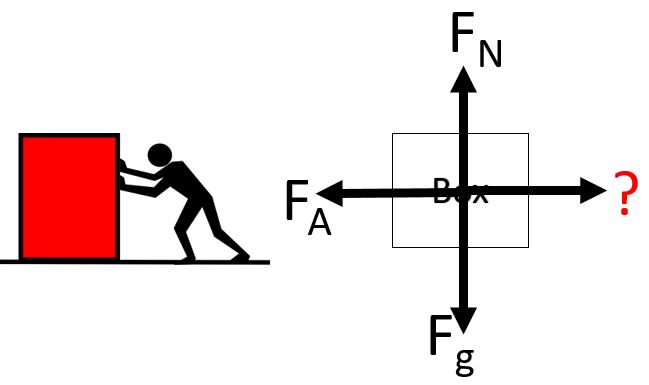
Name the missing force...
a)
normal force
b)
applied force
c)
frictional force
d)
tension force
21.
What is the net force?
a)
5000 N right
b)
4000 N right
c)
40 N left
d)
4000 N left
22.
Calculate the net force acting upon the object.
a)
10 N north
b)
20 N south
c)
10 N south
d)
22.4 N north
23.

What forces are on a hot air balloon hovering in the air but being blown by the wind?

a)

gravitational force, normal force and applied force

b)

gravitational force, buoyant force and the force from the wind

c)

gravitational force, normal force, applied force and frictional force

d)

gravitational force, buoyant force and optimistic force

24.

In physics, this may be described as the pulling force transmitted by the means of a string, cable, chain, or similar one-dimensional continuous object

a)

Tension

b)

Buoyancy

c)

Friction

d)

Normal Force

25.

An object resting on a surface experiences +980 N of Normal force. What is the mass of the object?


W=mg

a)

-98 kg

b)

9.8 kg

c)

100 kg

d)

-100 kg