wayground logo

Free Printable Worksheets

NEW

Font size

S
M
L
XL
Worksheets

Early Cold War

Total questions: 65

Worksheet time: 55mins

Name
Class
Date
1.
What two nations were in competition with each other during the Cold War?
a)
Spain and Portugal
b)
England and France
c)
Germany and Italy
d)
United States and Soviet Union
2.

What was the term 'iron curtain' used to describe the division of?

a)

North and South Vietnam

b)

East and West Asia

c)

North and South Korea

d)

East and West Europe

3.
President Truman adopted a new foreign policy during the Cold War know as the Truman Doctrine. What was the main goal of the Truman Doctrine?
a)
To expand trade with Europe
b)
To limit the build up of nuclear weapons
c)
To stop the spread of communism
d)
to send financial aid to Europe
4.
The United States got involved in conflicts like Korea and Vietnam because they were afraid of the domino theory. What is the domino theory?
a)
If one country fell to democracy, others would follow
b)
If one country fell to communism, others would follow
5.
How did the Marshall plan try to stop the spread of communism in Western Europe after WWII?
a)
by providing government housing for refugees
b)
by providing military assistance to Vietnam
c)
by providing money to stop poverty
6.
Why was the United States involved in the Berlin Airlift?
a)
to airlift food to the people of West Berlin
b)
to bomb East Berlin
c)
to demolish the Berlin Wall
d)
to transport people out of East Berlin
7.
Why did the United States become involved in the Korean War?
a)
to contain communism
b)
to colonize Korea
c)
to spread communism
d)
to Christianize Koreans
8.
Where was Korea divided?
a)
18 parallel
b)
34 parallel
c)
38 parallel
d)
15 parallel
9.
In 1950, Korea fought a civil war over the spread of communism.  Communists from the north tried to take over the south.  What role did he US play in this war?
a)
The US and its allies went to Vietnam to fight Korean Communists.
b)
The US and its allies join the fight to keep communism from spreading.
c)
The US and its allies did not join the Korean War.
d)
The US and its allies fought to defend the North.
10.
In the 1950s, the United States became involved in the Vietnam War. Why did the United States become involved in this war?
a)
to prevent the collapse of the government of North Vietnam
b)
to stop Vietnam from taking over Hong Kong
c)
to stop the spread of communism to South Vietnam
d)
to prevent attacks against United States shipping
11.
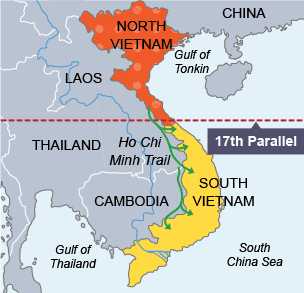
Where was Vietnam divided? 
a)
17th Parellel
b)
20thParellel
c)
38th Parellel
d)
34th Parellel
12.
How did the US respond to finding out that the Soviets had missiles in Cuba?
a)
They sent the Air Force to bomb Cuba
b)
They began placing missiles in the Soviet Union.
c)
They placed a naval blockade around Cuba.
d)
They invaded Cuba and the Soviet Union.
13.
Who were the two participants in the Space Race?
a)
The US and Cuba
b)
China and US
c)
The USSR and US
d)
US and North Vietnam
14.
What was the name of the first satellite in space launched by the Soviet Union?
a)
Gagarin
b)
Apollo 11
c)
Sputnik
d)
Apollo 13
15.
This "figurative" wall divided communist countries from democratic counties--
a)
Great Wall of China
b)
Berlin Wall
c)
Iron Curtain
d)
Wall of Democracy
16.
These were the opposing superpowers during the Cold War years
a)
China and Russia
b)
Cuba and Russia
c)
USA and Russia
d)
Iran and Russia
17.
The purpose of "containment" was to--
a)
stop the spread of democracy
b)
stop the spread of hate
c)
stop global warming
d)
stop the spread of communism
18.
In this economic system, the government owns all property and means of production.
a)
communism
b)
capitalism
c)
socialism
d)
democracy
19.
Who was the U.S. President who made the decision to drop the atomic bombs? 
a)
Eisenhower
b)
JFK
c)
Truman
d)
FDR
20.
Which of the following foreign policies gave financial aid to European nations to rebuild after WWII?
a)
Truman Doctrine
b)
Marshall Plan
c)
Warsaw Pact
d)
Domino Theory
21.
Which foreign policy promised to aid countries resisting Communist takeover?
a)
Marshall Plan
b)
Iron Curtain
c)
Truman Doctrine
d)
Massive Retaliation
22.
Which of the following organizations supports Democratic ideals and self governance?
a)
Warsaw Pact
b)
Satellite Nations
c)
NATO
d)
Domino Theory
23.
The physical barrier separating Communist East Berlin and Democratic West Berlin--
a)
Berlin Bloackade
b)
Berlin Base
c)
Berlin Wall
d)
Berlin Barrier
24.
Nations that were aligned with, but also under the influence and pressure of, the Soviet Union were called--
a)
European Nations
b)
NATO
c)
Warsaw Pact
d)
Satellite Nations
25.
The ideology that if one country in Southeast Asia fell to Communism, others would follow--
a)
Domino Theory
b)
Berlin Arilift
c)
Eisenhower Doctrine
d)
Warsaw Pact
26.
The organization whose members agreed to mutually defend other Communist nations is called--
a)
Korean Pact
b)
Warsaw Pact
c)
NATO
d)
Satellite Nations
27.
Select the best cause and effect relationship that describes the Korean War--
a)
Threat of Communism spreading --> Communism is contained to North Korea
b)
Threat of Communism spreading --> Communism infiltrates South Korea
c)
Threat of Democracy spreading --> Communism leaves Korean Peninsula
d)
Threat of Democracy spreading --> Communism spreads to China
28.
The Space Race, Arms Race and McCarthyism are characteristics of which era?
a)
Conservative 1980s
b)
Roaring 20s
c)
Cold War
d)
World War II
29.
What event happened in 1949 to strengthen the threat of Communism spreading in Asia?
a)
Russia falls to Communism
b)
China falls to Communism
c)
The Arms Race begins
d)
Sputnik is launched
30.
Which event lead to the creation of the NDEA, increasing educational funding in math and science--
a)
the launch of a Soviet nuclear missile
b)
the launch of the Soviet satellite Sputnik
c)
the passage of the Space Race Act
d)
the Soviet mission to the moon
31.
Which of the following was a failed invasion by the United States under Kennedy in an attempt to overthrow Fidel Castro?
a)
Invasion of Moscow
b)
Cuban Missile Crisis
c)
Bay of Pigs Invasion
d)
Korean Invasion
32.
Because of a Soviet blockade of West Germany to West Berlin--
a)
the US bombed the Soviets until they retreated
b)
the Soviets flew supplies into East Germany
c)
the US flew supplies into East Germany
d)
the US flew supplies into West Germany
33.
During the Cold War, the fear of Communism infiltrating the US and McCarthyism both contributed to the--
a)
Red Fever
b)
Domino Theory
c)
Red Scare
d)
Red Army
34.
Which event is the newspaper headline describing?
a)
Bay of Pigs Invasion
b)
Fall of the Soviet Union
c)
Cuban Missile Crisis
d)
Vietnam War
35.

What is the name of the alliance of these countries during the Cold War?

-US

-Great Britain

-France

a)

Warsaw alliance

b)

Allies Against Communism

c)

North Atlantic Treaty Organization

36.

The US and the Soviet Union tried to build as many ___________________ as possible in the arms race.

a)

weapons

b)

walls

c)

allies

37.

What was the name of the alliance of Russia and its communist allies?

a)

Warsaw Pact

b)

NATO

c)

Alliance for Global Communism

38.

2 wars that were really part of the Cold War were

a)

Korean War and Vietnam War

b)

Civil War and Spanish American War

c)

Gulf War and Vietname War

39.

What was the name of the invisible line across Europe that separated communism from democracy?

a)

Great Wall

b)

Containment Barrier

c)

Iron Curtain

40.

The city of ______________________ was divided by a wall during the Cold War. For 11 months, the US military airlifted supplies into part of this German city.

a)

Moscow

b)

London

c)

Berlin

41.

This president’s doctrine was the commitment to “support free peoples who are resisting attempted subjugation by armed minorities or by outside pressures,” and became the justification for US intervention into several countries during the Cold War.

a)

Truman Doctrine

b)

Eisenhower Doctrine

c)

Monroe Doctrine

d)

Roosevelt Corollary

42.
Which US initiative was designed to provide financial aid for war-torn European countries after WWII?
a)
the Geneva Accords
b)
the United Nations
c)
the Marshall Plan
d)
the NATO Alliance
43.

What international organization was created to arbitrate disputes among members and impede aggressors if necessary?

a)

League of Nations

b)

United Nations

c)

Warsaw Pact

d)

NATO

44.
Who was put in charge of the American forces in Korea and even wanted to use the atomic bomb against China?
a)
John Bassilone
b)
Douglas MacArthur
c)
Harry Truman
d)
Richard Nixon
45.

What best describes the outcome of the Korean War?

a)

South Korea and the U.S. won, unifying a Democratic Korea

b)

North Korea and China won, unifying a Communist Korea

c)

Stalemate, with the boarder remaining at the 38th parallell

d)

The U.S. and China split Korea, each controlling a part

46.

What was the conference that divided Europe?

a)

Yalta Conference

b)

Kiev Conference

c)

Moscow Conference

d)

Berlin Conference

47.

The United States threatened to use nuclear weapons during the-

a)

Cuban Missile Crisis

b)

Iraqi invasion of Kuwait

c)

Chinese Civil War

d)

Soviet invasion of Afghanistan

48.

Who was the leader of Communist forces in North Vietnam?

a)

Ho Chi Minh

b)

Chaing Kai Shek

c)

Mao Zedong

d)

Kim Il Sung

49.

What two alliances are formed during the Cold War?

a)

NATO & Warsaw Pact

b)

OPEC & Allies

c)

Axis & Allies

d)

Central Powers & NATO

50.

Which leader was most responsible for the picture event?

a)

Mao Tse-tung (Mao Zedong)

b)

Deng Xiaoping

c)

Ho Chi Minh

d)

Sun Yat-sen

51.
During the Cold War, the fear of Communism infiltrating the US and McCarthyism both contributed to the--
a)
Red Fever
b)
Domino Theory
c)
Red Scare
d)
Red Army
52.
What major historical event is represented in this map?
a)
Attack on Pearl Harbor
b)
The Cuban Missile Crisis
c)
The Wright Brother's first flight
d)
The building of the Panama Canel
53.

What major country was behind the "Iron Curtain"?

a)

Germany

b)

Japan

c)

United States

d)

Soviet Union

54.
Why is the Cold War called a "cold" war?
a)
The areas affected were in the polar regions of the world
b)
The war was fought during winter months only
c)
Leaders of the superpowers were sick with coughs and fevers
d)
There was never direct fighting between the two superpowers
55.
How did the US respond to finding out that the Soviets had missiles in Cuba?
a)
They sent the Air Force to bomb Cuba
b)
They began placing missiles in the Soviet Union.
c)
They placed a naval blockade around Cuba.
d)
They invaded Cuba and the Soviet Union.
56.

Controversies involving McCarthyism and Julius and Ethel Rosenberg reflected the post-World War II concern over

a)

testing nuclear missiles

b)

joining the United Nations

c)

placing weapons in outer space

d)

spying by Communists in the United States

57.

The rivalry during the Cold War was one between two superpowers; the U.S. and U.S.S.R. However, it was also a conflict between which two vastly different ideologies?

a)

authoritarianism and capitalism

b)

totalitarianism and socialism

c)

communism and socialism

d)

capitalism and communism

58.

Who made the statement "An Iron Curtain has descended across the continent"?

a)

President Roosevelt

b)

Joseph Stalin

c)

Winston Churchill

d)

President Harry Truman

59.

Which country was the aggressor that started the Korean War?

a)

North Korea

b)

South Korea

c)

Neither - they were forced into war by Germany

d)

Japan

60.

Who was the Senator who started rumors of the Red Scare?

a)

John F. Kennedy

b)

Joseph Stalin

c)

Neil Armstrong

d)

Joseph McCarthy

61.

What was the name of the government organization created to investigate potential communists in the US during the fifties?

a)

HUAC

b)

Hollywood Ten

c)

FBI

d)

CIA

62.

What did the following people have in common: Gary Powers, Rosenbergs, A. Hiss

a)

all were involved in espionage (spying)

b)

all were members of the NAACP

c)

All represented the US in the United Nations

63.

Because of Sputnik, the US directly created

a)

CIA

b)

HUAC

c)

NASA

d)

NATO

64.
In the 1940s and 1950s, what did the region described as being "behind the iron curtain" include?
a)
Soviet Union only
b)
Soviet Union and its satellite nations
c)
democratic nations of Western Europe
d)
German Democratic Republic, or East Germany
65.
What idea was the major justification for U.S. foreign policy during the Cold War era?
a)
Vietnamization
b)
domino theory
c)
nonaligned nations
d)
Khmer Rouge