
NEW
Font size
S
M
L
XL
 Worksheets
Viruses
Total questions: 10
Worksheet time: 9mins
Name
Class
Date
1.
What do viruses need to reproduce?
a)
they need genetic material
b)
They need a host cell
c)
They need bacteria
d)
They need insulin
2.
Which viral life cycle allows viral genetic material to lay dormant while the host cell reproduces?
a)
lytic
b)
mitosis
c)
lysogenic
d)
S phase
3.
Cold sores are caused by the herpes simplex virus type 1. A company that wants to develop antiviral drugs would ask a research immunologist to study —
a)
the mechanism used by the virus to infect cells
b)
how closely related the virus is to cold viruses
c)
the metabolism of the virus
d)
meiosis in the virus
4.
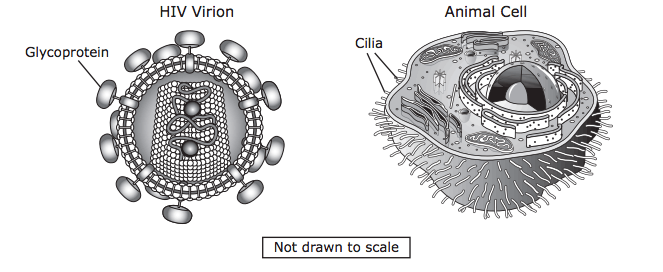
Models of the human immunodeficiency virus (HIV) and an animal cell are shown below.
What is the difference in the function of the glycoprotein structures of an HIV virion and the cilia of an animal cell?
What is the difference in the function of the glycoprotein structures of an HIV virion and the cilia of an animal cell?
a)
The glycoprotein structures are used for attachment, and the cilia are used to move fluids surrounding the cell.
b)
The glycoprotein structures are used to obtain nutrition, and the cilia are used to secrete proteins.
c)
The glycoprotein structures are used to provide physical support for the viral envelope, and the cilia strengthen the cell membrane.
d)
The glycoprotein structures are used for defense, and the cilia are used for locomotion.
5.

H1N1 flu is a highly contagious viral infection caused by the influenza A (H1N1) virus. The symptoms of H1N1 flu are listed in the box below. An antiviral agent administered within 48 hours of the appearance of symptoms can reduce the severity of the illness.
Why is it important to administer an antiviral agent to an infected person within 48 hours of the appearance of symptoms?
Why is it important to administer an antiviral agent to an infected person within 48 hours of the appearance of symptoms?
a)
The H1N1 virus is dormant in cells.
b)
The H1N1 virus replicates quickly
c)
The H1N1 virus does not mutate.
d)
The H1N1 virus is transmitted through a vector host, such as a mosquito.
6.
Severe acute respiratory syndrome (SARS) is an illness caused by a coronavirus. Symptoms including a high fever, headaches, and body aches typically occur two to seven days after infection by the virus. SARS is more serious in elderly patients. This information suggests that the reproductive cycle of the SARS virus is —
a)
lysogenic, because the virus is a coronavirus
b)
lytic, because the virus causes respiratory illness
c)
lysogenic, because the virus primarily affects older people
d)
lytic, because of the quick onset of symptoms after infection
7.

A photograph of a virus is shown below.
The projections on the surface of this virus allow the virus to —
The projections on the surface of this virus allow the virus to —
a)
move inside a host cell
b)
attach to a host cell
c)
control a host cell’s DNA
d)
signal other viruses to infect a host cell
8.

During an infection, some viruses remain inside cell but do not cause symptoms of disease. The graphic below depicts the...
a)
lytic cycle and the host cell is destroyed by rapidly reproducing viral particles
b)
lytic cycle and the viral nucleic acid inserts into the host cell chromosome
c)
lysogenic cycle and the viral nucleic acid inserts into the host cell chromosome
d)
lysogenic cycle and the viral nucleic acid replicates independently of the host cell chromosome
9.
How does a virus cause a person to develop the common cold?
a)
invades the host cell to reproduce
b)
removes energy from the host cell
c)
produces toxins in the host cell
d)
protects the host cell from bacteria
10.
How could you describe the size of a virus?
a)
Smaller than bacteria
b)
Larger than a parasite
c)
About the size of a dime
d)
Smaller than a proton
Reset

