
 Worksheets
GCSE Network Topologies and Protocols
Total questions: 24
Worksheet time: 13mins
Choose all that are true about star networks
All devices have a connection to a central switch or server
They are the most fault tolerant type of network
If one connection fails, only that one device is affected
They can be expensive because of the large amount of cabling needed
Choose all that are true about mesh networks
if one connection fails there may be an alternative
They are the most fault tolerant type of network
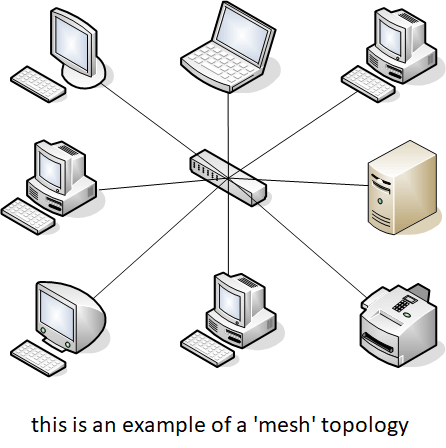
'Mesh' is an example of network topology
Choose all that are true about WiFi
WiFi is a wireless protocol
WiFi is just a catchy name for the protocol IEEE 802.11
WiFi needs Ethernet cables to connect you to it
WiFi is just another name for Internet
Choose all that are true about WiFi
It uses radio waves
It uses unlicensed frequencies
Small animals can actually hear WiFi signals
WiFi frequencies are strictly licensed by the WiFi Alliance
Which are true about WiFi?
There are 2 main frequency bands for WiFi
WiFi frequencies are measured in gigaHertz
You can use any frequency for WiFi signals
You can only use WiFi with a smartphone
Which are true about WiFi frequency bands and channels?
Each channel is divided into several bands
Each band is divided into several channels
Using different channels helps stop interference
Each channel has a slightly different frequency
Choose all that are true about frequency
Its unit of measurement is the hertz.
It's a measure of how many times something changes per second
The unit of measurement is the freq
Radio waves can have a variety of frequencies
WiFi encryption is especially important because... (choose all true answers)
People sometimes need to log on to private accounts using WiFi
Places that use WiFi often have strangers looking over your shoulder (shoulder surfing)
WiFi signals can be picked up by anyone in range
It is not (this is a trick question)
Choose all that are WiFi encryption methods?
WPA2
WEP
WAP
WYSIWYG
Choose all that are true about Ethernet
It's just a catchy name for a protocol
Ethernet involves signals moving through wires
It can be used in LANs
It's not an Internet protocol
Choose all that are true about IP addresses
They are used to let routers decide where packets should go
You can use IP addresses to send postcards and letters
IP addresses are only put on the FIRST packet in a transmission
Devices add the destination AND their own IP addresses to requests
Choose all that are true. 'IP addresses are hierarchical' means that
IP addresses can tell routers which country or zone they point to
Some IP addresses are more powerful than others
IP addresses can breed like viruses
IP addresses are basically random numbers
Choose all the MAC addresses
00-06:5B-BC-7A-C7
135.58.24.17
239.255.255.255
192.168.0.0
Choose all that are true about MAC addresses
Every MAC address is 100% unique
All network devices have a MAC address
Routers and switches don't need MAC addresses
MAC addresses can tell you where a device is on the Internet
Network protocols are... (choose all that are true)
Controlled by the government
Only used for WiFi
Sets of rules that set out how devices will communicate
Things like Bluetooth and Ethernet
The protocol that manages the creation of packets is called
TCP (transmission control protocol)
IP (Internet protocol)
POP (Post Office protocol)
SMTP (simple mail transfer protocol)
The protocol that controls the addressing of packets is called
IP (Internet protocol
TCP (transmission control protocol)
FTP (file transfer protocol)
Ethernet protocol
The protocol used for normal web requests (such as to see a webpage) is called
HTTP (hyper-text transfer protocol
FTP (file transfer protocol)
POP (Post Office protocol)
IP (Internet protocol)
The protocol used with financial sites such as banks or PayPal is called
HTTPS (Hyper Text Transfer Protocol Secure)
POP (Post Office Protocol)
HTTP (Hyper Text Transfer Protocol)
IMAP (Internet Message Access Protocol)
The protocol used to upload a new webpage to a server is called
FTP (File Transfer Protocol)
SMTP (Simple Mail Transfer Protocol
HTTP (Hyper Text Transfer Protocol)
HTTPS (Hyper Text Transfer Protocol Secure)
The protocol for SENDING an email is
SMTP (Simple Mail Transfer Protocol)
POP (Post Office Protocol)
FTP (File Transfer Protocol)
HTTP (Hyper Text Transfer Protocol)
Which TWO of these protocols are for receiving email?
SMTP (Simple Mail Transfer Protocol)
IMAP (Internet Message Access Protocol)
POP (Post Office Protocol)
FTP (File Transfer Protocol)
Protocols are arranged in layers so that...
One layer can be altered without having to redesign the entire system
So that they can be like onions
Choose all that are true
The Internet works with packet switching
The Internet works with circuit switching
Packet switched networks use bandwidth more efficiently than circuit switching
Packet switched networks rely on routers

