
 Worksheets
Enzymes
Total questions: 10
Worksheet time: 7mins
Name
Class
Date
1.

What is structure A?
a)
Substrate
b)
Active site
c)
Enzyme
d)
Products
2.

Which of the following conclusions can be drawn from this graph?
a)
The optimum pH of the enzyme is 6.6.
b)
The optimum pH of the enzyme is 5.8
c)
The enzyme’s activity increases as pH increases 5.0 to 9.0
d)
The enzyme’s activity is greater around pH of 8.0 .
3.
After the enzyme and substrate bind together and perform the reaction, what does the substrate become?
a)
a substrate
b)
an enzyme
c)
a product
d)
an active site
4.

The current model of enzyme action is referred to as the...
a)
Induced Fit Model
b)
Lock & Key Model
c)
Singer-Nicolson Model
d)
Davson-Danielli Model
5.
Which of these is NOT true.
a)
Enzymes can denature (change shape) when the temperature gets too high.
b)
Enzymes can only be used once in a chemical reaction.
c)
Enzymes can denature when the pH changes.
d)
Enzymes speed up chemical reactions.
6.
Glycogen is a large molecule which can be converted into smaller glucose molecules by enzymes. This is an example of which type of reaction?
a)
anabolism
b)
catabolism
7.
If a molecule blocks an enzymes active site, it stops the enzyme from working. This is called:
a)
Allosteric inhibition
b)
Competitive Inhibition
c)
Denaturation
d)
Substrate inhibition
8.
Which of the following descriptions best describes an induced fit?
a)
The active site alters shape such that it is ready to accept a substrate.
b)
A substrate binds to an active site and alters the shape of the active site.
c)
An active site alters the shape of the substrate such that it can adopt the necessary active conformation for binding.
9.

Based on the graph, which of the following could be used to increase the reaction rate beyond point C?
a)
Increase the amount of substrate
b)
Add more water
c)
Increase the temperature
d)
Increase enzyme concentration
10.
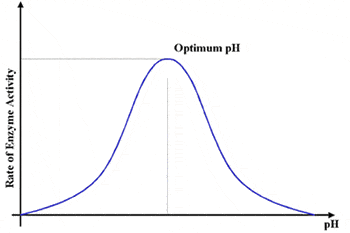
Which explanation best fits the graph for pH's effect on an enzyme?
a)
As the pH gets closer to neutral more H-Bonds are broken
b)
Larger numbers of H+ & OH- ions distort the active site
c)
There are more collisions between substrates and active sites near the optimal pH
d)
Low pHs cause more H-Bonds to happen near the active site
100 %

