Wayground logo

Free Printable Worksheets

Font size

S
M
L
XL
Worksheets

Reproduction

Total questions: 25

Worksheet time: 17mins

Name
Class
Date
1.

How many pairs of chromosomes are in a human being?

a)

23

b)

44

c)

89

d)

72

2.

Where are chromosomes found in a cell?

a)

In the neutron of the cell.

b)

In the nucleus of the cell.

c)

In the proton of the cell.

d)

In the cell membrane of the cell.

3.

Why is DNA important?

a)

it is very small and very complicated

b)

it's in everything

c)

it serves as the blueprint for traits of all living things

d)

because we eat it every day for energy

4.
What percentage of chromosomes are handed down by a sperm cell?
a)
75%
b)
25%
c)
50%
d)
100%
5.

Traits are passed from one generation to the next through the transfer of

a)

DNA

b)

calories

c)

ice cream cones

6.

Genetics is

a)

The passing of traits from 1 organism to another

b)

the mix of elements

c)

the process where plants make food from the sun

7.

1 unit of hereditary information

a)

chloroplast

b)

gene

c)

hair

8.

Pure dominant

a)

bb

b)

Bb

c)

BB

9.

Which genotype represents a hybrid trait?

a)

Bb

b)

BB

c)

bb

10.

Threadlike structures within a cell’s nucleus that contain DNA that is passed from one generation to the next

a)

Alleles

b)

Genes

c)

Chromosomes

11.

Every cell in your body other than sex cells has ____ chromosomes

a)

23

b)

46

c)

48

12.
What is the definition of phenotype?
a)
The physical expression of a trait
b)
The genetic combination of alleles
c)
A gene on the DNA strand
13.
What is the definition of genotype?
a)
The physical expression of a trait
b)
The genetic combination of alleles 
c)
the genes on a DNA strand
14.

Which statement describes why eye color is an inherited trait?

a)

It depends on the color of light entering the eye.

b)

It is passed from the parents to the offspring

c)

It depends on the amount of vitamin A in the diet.

d)

It changes as a child grows to become an adult.

15.

deoxyribonucleic acid

a)

DNA of course!

b)

RNA

16.

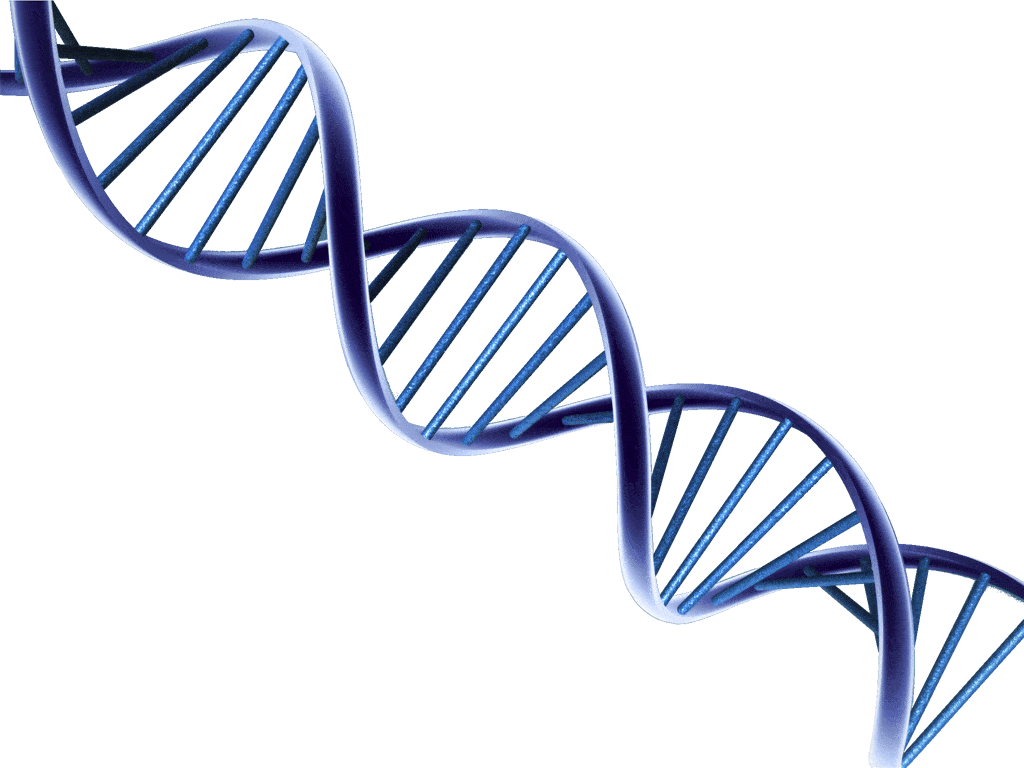
How should you describe DNA's shape?

a)

a ladder twisted into a double helix

b)

a ladder bent in half

c)

a bench twisted into a double helix

d)

a short stepping stool twisted into a double helix
17.
DNA is inside your cells. What part of the cell is the DNA inside of?
a)
cell membrane
b)
cytoplasm
c)
nucleus
18.
The drawing shows the structure of what molecule?
a)
A DNA molecule
b)
A lipid molecule
c)
A carbohydrate molecule
d)
A protein molecule
19.
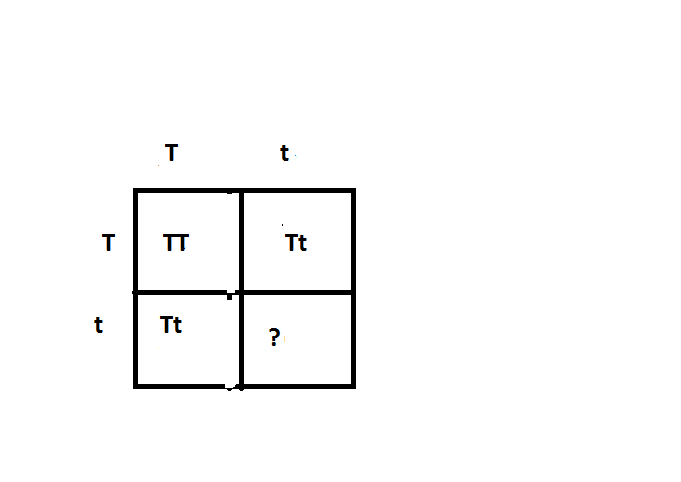
T - tall and t = short
In the punnett square below, what belongs in the missing square
a)
tt
b)
Tt
c)
Bb
d)
TT
20.
What is a punnett square?
a)
graph used to predict the possible genotypes of offspring in a given cross
b)
a graph used to predict the possible birth rate of offspring.
c)
a graph used to predict the possible behavioral characteristics an offspring could have
d)
None of the above
21.

Males have

a)

2 X Chromosomes

b)

1 X Chromsome

c)

1 X and 1 Y Chromosome

d)

2 Y Chromosomes

22.
I have 2 X chromosomes. What am I?
a)
Male
b)
Female
23.
This image shows a...
a)
Punnett Square
b)
Phenotype
c)
Genotype
d)
Dominant allele
24.
Who was the father of genetics 
a)
Sagan 
b)
Issac Newton 
c)
Gregor Mendel 
d)
C.jenkins 
25.
Any change in the sequence of DNA is...
a)
transgenic shift
b)
Single Genotype
c)
Monohybrid Trait
d)
Mutation