
Font size
 Worksheets
Groundwater
Total questions: 20
Worksheet time: 20mins
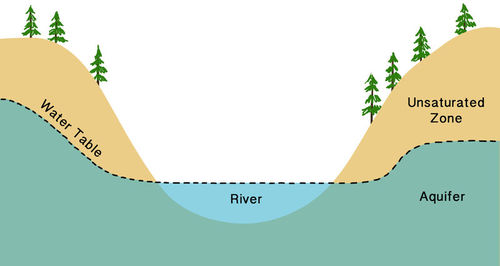
What is the best definition of a water table?
The level to which a river rises when it floods
The boundary between the land and the ocean
The top of the saturated zone in an aquifer
The bottom of the saturated zone in an aquifer
The top of the unsaturated zone in an aquifer

What would cause the water table to lower?
High rates of evaporation and transpiration
Low rates of evaporation and transpiration
Increasing amounts of runoff
A heavy rainstorm with a lot of precipitation
What is infiltration?
The process by which water sinks into the ground
The zone where there are still air spaces left between the particles.
The process by which water vapor turns into liquid water and forms fog or clouds.
The process by which water does not sink into the ground, but rather travels along the surface.

What process transforms the water vapor in the atmosphere to the liquid water in a cloud?
evaporation
infiltration
precipitation
transpiration
condensation

What process causes liquid water to evaporate from plant leaves and enter the atmosphere as water vapor?
evaporation
infiltration
precipitation
transpiration
condensation

Which soil would have the greatest permeability rate after a rainstorm?
sand (0.02 cm)
silt (0.002 cm)
clay (0.0002 cm)
Which soil would have the greatest capillarity?
sand (0.02 cm)
silt (0.002 cm)
clay (0.0002 cm)
What is capillarity?
When water cannot infiltrate a substance
Water being held onto by rock or sediment
The ability of water to move upward against gravity in a material
The percentage of empty space in a material

These containers have the same volume of beads which are representing soil particles. What is the relative porosity and permeability of each?
The container on the left has the higher permeability and porosity
The container on the right has the higher permeability and porosity
The container on the left has the higher permeability, but they both have the same porosity
The container on the right has the higher permeability, but they both have the same porosity

500 mL of water is added to each tube and allowed to drain out. Which container would have the highest retention of water after it drained? (particle size gets bigger as you move to the right)
A
B
C
D
They would all be the same in terms of retention

How would the porosity of the poorly sorted sediment compare to the well sorted sediment?
It would be greater in the poorly sorted sediment
It would be less in the poorly sorted sediment
It would be the same in both
How does the porosity of frozen soil compare with unfrozen soil?
It is less in the frozen soil
It is greater in the frozen soil
The porosity of both would be the same
Which surface would have the most runoff from it after a rainstorm?


Which surface would be impermeable?

The height of the water that moved upward within the soil was measured. Students repeated this procedure using
soils with different particle sizes. Results of this experiment lead to the conclusion that
permeability is greater in soils with larger
particles
permeability is greater in soils with smaller
particles
capillarity is greater in soils with smaller particles
capillarity is greater in soils with larger particles

Which graph best represents the relative amount of water retained by the beads in each tube?


When an equal volume of water is added to each column, the greatest rate of infiltration will occur in which
column?
A
B
C
D

Which data table best represents the porosity and infiltration time of the beads in the three containers?


Drag the label to the correction location on the water cycle diagram
Where does Long Island obtain its water from?
Lakes
Upstate NY
Aquifers
The ocean

