wayground logo

Free Printable Worksheets

Font size

S
M
L
XL
Worksheets

UNIT 5 REVIEW

Total questions: 131

Worksheet time: 2hrs 32mins

Name
Class
Date
1.
Consider the electric field lines shown in the diagram below. From the diagram, it is apparent that object A is ____ and object B is ____.
a)
+,+
b)
+,-
c)
-,+
d)
-,-
2.

The diagram shows two charged objects, X and Y.


Based on the field lines, what are the charges of the objects?

a)

X: positive

Y: negative

b)

X: negative

Y: positive

c)

X: negative

Y: negative

d)

X: positive

Y: positive

3.
If each of the charges doubles, what happens to the electric force?
a)
Quadruples
b)
Doubles
c)
Stays the same
d)
Reduced by half
4.
The Electric Force is strongest when charges are...
a)
close together
b)
far apart
c)
the electric force is constant everywhere
5.
If an object has a net charge of +2e this means it has
a)
lost 2 electrons
b)
gained 2 electrons
c)
lost 2 protons
d)
gained 2 protons
6.

In order to create an electric charge, what type of particle must be added or removed from an object?

a)

proton

b)

electron

c)

neutron

d)

alpha particle

7.
The push or pull between charged objects is an
a)
electric force
b)
electric discharge
c)
electric field
8.

what is the type of this charge?

a)

positive

b)

negative

9.

which of the following has more electric filed?

a)

B

b)

c

c)

A

d)

B and A

10.
At which point is the electric field the strongest
a)
A
b)
B
c)
C
d)
D
11.
At which point is the electric field the weakest?
a)
A because it is the furthest away
b)
A because the field lines are further apart
c)
C because the field lines are further apart
d)
C  because it is the furthest away
12.
Consider the electric field lines drawn at the right for a configuration of two charges. Several locations are labeled on the diagram. Which of these shows the ranking in order of weakest to strongest correctly
a)
A, E, C
b)
D, E, C
c)
D, B, A
d)
A, D, B
13.
Qand Qare two charges creating an electric field. Based on the electric field lines, we can conclude
a)
Qand Qare both positive
b)
Qand Qare both negative
c)
Qis positive and Qis negative
d)
Qis negative and Qis positive
14.
Which of the following is a true statement about the electric field between the two plates?
a)
The field is attractive between the plates and uniform in strength
b)
The field is repulsive between the plates and uniform in strength
c)
The field is attractive between the plates and strongest near the positive
d)
The field is repulsive between the plates and strongest near the positive
15.
The electrical force between charges is strongest when the charges are
a)
close together
b)
far apart
c)
 the electric force is constant everywhere.
d)
there is no pattern
16.
If a substance has a higher number of electrons than protons on its surface, what type of charge does it have?
a)
A positive charge.
b)
A negative charge.
c)
A neutral charge
d)
No charge at all
17.
An object that is positively charged contains all protons and no electrons.
a)
True
b)
False
18.
An object that is neutral contains the same number of electrons and protons.
a)
True
b)
False
19.
the charging of an object by the contact of a charged object to a neutral object (like touching a door knob)
a)
induction
b)
conduction
c)
friction
20.
Transferring a charge without touching is ___
a)
conduction
b)
induction
c)
grounding 
d)
Newtons 3rd law
21.
The process of transferring charge between objects by touching or rubbing
a)
charging by induction
b)
static discharge
c)
charging by contact
d)
proton
22.

Two small hollow metal spheres hung on insulating threads attract one another as shown. It is known that a positively charged rod will attract sphere A. Which statements can be correctly concluded about the charge on the spheres?

a)

A has a positive charge

b)

B has a negative charge

c)

A and B have opposite charges

d)

A is neutral

23.

How is the electric force between two charges affected when both of the charges are cut in half?

a)

decreases four times

b)

no change

c)

increase four times

d)

increases 2 times

24.

How does a neutral object become positively charged?

a)

remove protons

b)

remove electrons

c)

add electrons

d)

add protons

25.
What subatomic particles would you find in the nucleus of an atom?
a)
Protons only
b)
Protons and Neutrons
c)
Neutrons and Electrons
d)
Protons and Electrons 
26.
Which subatomic particles contribute the most to the mass of an atom?
a)
Protons, Neutrons, Electrons
b)
Protons only
c)
Protons and Electrons
d)
Protons and Neutrons
27.
Protons and Electrons balance the charge of an atom.
a)
True
b)
False
28.
If an atom has 12 positively charged subatomic particles, which of the following must it also have to be considered a neutral atom?
a)
12 neutrons
b)
12 electrons
c)
12 protons
d)
24 protons and neutrons
29.
What is true about electricity and magnetic fields?
a)
Electricity is needed to create any magnet.
b)
Electricity always creates a magnetic field.
c)
Electricity is stronger than a magnetic field.
d)
Electricity prevents magnetic fields from occurring.
30.

A positively charged subatomic particle

a)

proton

b)

neutron

c)

electron

d)

newton

31.

A negatively charged subatomic particle

a)

proton

b)

neutron

c)

electron

d)

nucleus

32.

Process of charging a neutral object by touching it with a charged object

a)

polarization

b)

conduction

c)

induction

d)

friction

33.

A substance in which electrons are loosely held; for example: copper

a)

conductor

b)

insulator

c)

inductor

d)

convection

34.

A force exerted by a charged particle

a)

electric field

b)

gravitational field

c)

magnetic field

d)

soccer field

35.

A charged balloon is brought near an electroscope but does not touch the electroscope. This is an example of charging by

a)

conduction

b)

convection

c)

friction

d)

induction

36.
Removing a static charge by providing a path to the ground is called __.
a)
electric transfer
b)
grounding
c)
switching
d)
seperation
37.

The loss of static electricity as electric charges transfer from one object to another

a)

power

b)

voltage

c)

static discharge

d)

current

38.

The flow of electricity in a circuit is called

a)

current

b)

flow

c)

circuit

d)

resistance

39.
the tendency for a material to oppose the flow of electrons
a)
current
b)
circuit
c)
resistance
d)
difference
40.
What do you call the process of charging a conductor by bringing it near another charged object?
a)
induction
b)
polarization
c)
neutralization
d)
conduction
41.
When you charge a balloon by rubbing it on your hair this is an example of what method of charging?
a)
Friction
b)
Conduction
c)
Grounding
d)
Induction
42.
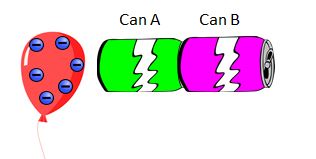
The negatively charged balloon is brought near the two cans. What happens?
a)
The negative charges in Can B move towards the balloon
b)
The negative charges in Can A move away from the balloon
c)
The positive charges in Can B move towards the balloon
d)
The positive charges in Can A move away from the balloon
43.
Neutral atoms contain equal numbers of positive __ and negative __.
a)
Electrons and Protons
b)
Protons and Electrons
c)
Neutrons and Electrons 
d)
Protons and Neutrons
44.
___ are good conductors because they have loose electrons.
a)
copper
b)
aluminum 
c)
metals
d)
all of the above
45.
Materials through which electrons move easily__.
a)
insulator
b)
conductor
46.
Which particle in an atom can you physically manipulate?
a)
protons
b)
electrons
c)
neutrons
d)
you can't manipulate any particle in an atom
47.
In a neutral atom ___.
a)
protons = neutrons
b)
electrons = neutrons
c)
protons = electrons
d)
neutrons = protons = electrons
48.
If a negatively charged rod touches a conductor, the conductor will be charged by what method? 
a)
Friction
b)
Conduction
c)
Induction
d)
Convection
49.
The process of transferring charge between objects by touching or rubbing
a)
charging by induction
b)
static discharge
c)
charging by contact
d)
proton
50.
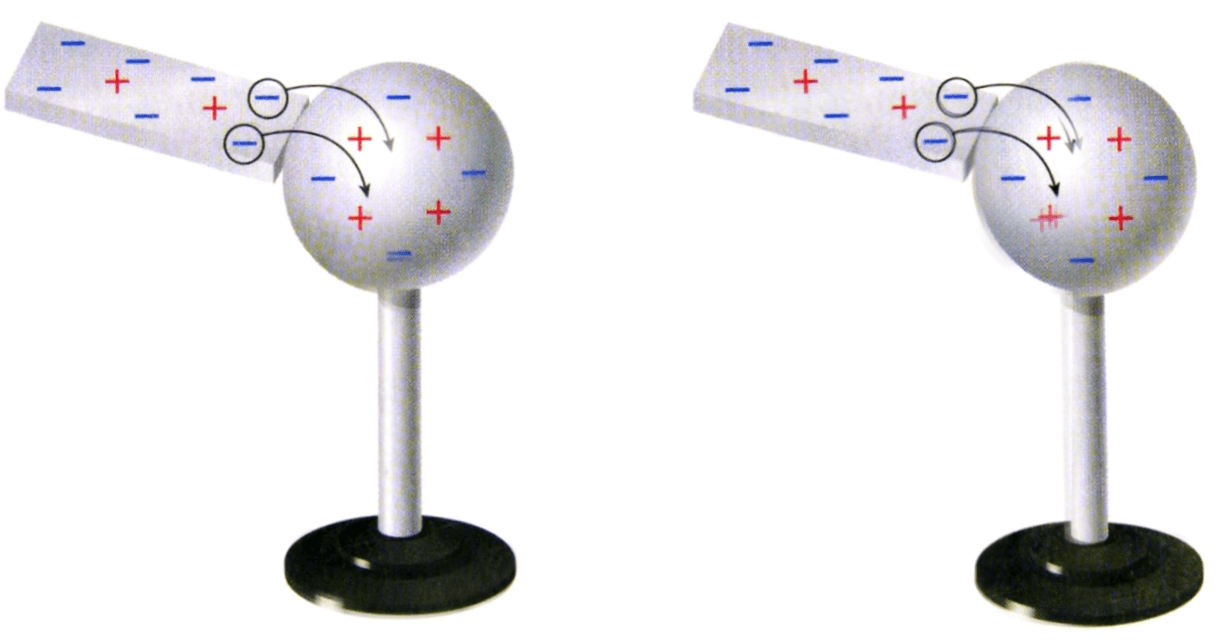
A negatively charged rod is touched to the top of an electroscope
a)
A
b)
B
c)
C
d)
D
51.
Charging by contact results in both objects having the same charge.
a)
True
b)
False
52.
Charging by Friction results in two objects with the same charge.
a)
True
b)
False
53.
A charged balloon is brought near an electroscope but DOES NOT touch the electroscope.  This is an example of charging by
a)
Conduction
b)
Convection
c)
Friction
d)
Induction
54.

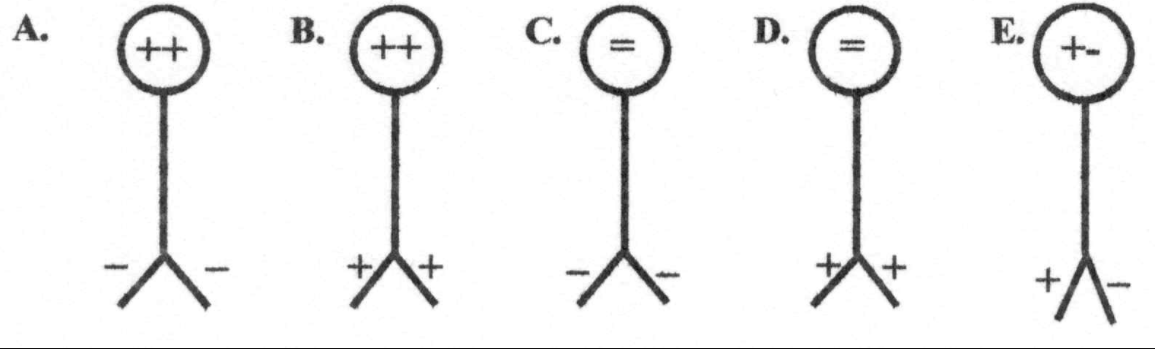
A positively charged balloon is brought near to a metal pop can. Which diagram shows the arrangement of charge on the pop can as the balloon is held near it?

a)

A

b)

B

c)

C

d)

D

55.

Two students are trying to decide whether or not Object A is charged. They perform the following two tests:


Test 1: They bring Object A near a positively charged tape and observe repulsion.

Test 2: They bring Object A near a negatively charged tape and observe attraction.

These two tests lead to the conclusion that Object A is _____.

a)

charged negatively

b)

charged positively

c)

electrically neutral

d)

charged, but with an unknown type of charge

56.

Two neutral objects are rubbed together and subsequently become charged. The objects have become charged by the method of _____.

a)

friction

b)

conduction

c)

induction

d)

polarization

57.
What subject is attracted to a magnet?
a)
Silver
b)
Water
c)
Metal
d)
Iron
58.
A north pole and a south pole will attract.
a)
True
b)
False
59.
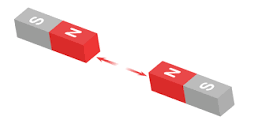
What will happen when these magnets are brought close together?
a)
They will attract each other.
b)
They will repel each other.
c)
Both magnets will turn to the left
d)
Both magnets will turn to the right
60.
True or False: All metals stick to magnets.
a)
True
b)
False
61.
Where is the force of attraction the strongest on a magnet?
a)
at the poles
b)
in the middle
c)
above the magnet
d)
below the magnet
62.
What are the parts of the magnet that is attracted to the paper clips?
a)
the center
b)
the poles
c)
the equator
d)
the horseshoe
63.
True or False:
Most rocks are magnetic.
a)
True
b)
False
64.
a)
A push away
b)
A pull towards
c)
No Force
65.
Which statement is true?
a)
All Magnets have a North and South Pole
b)
All magnets can attract large objects
c)
Magnets can not pull through Solids.
d)
All Magnets have the Same shape and Size
66.
Which of these materials will a Magnet Attract?
a)
Plastic
b)
Iron
c)
Rubber
d)
Wood
67.
The South end of a Magnet will...
a)
Repel to a Copper Nail
b)
Repel to the North End of another Magnet
c)
Repel to the South end of another Magnet
68.
Mr.  Novales makes a mixture of four solid materials.  Which of these 4 materials will a bar magnet be able to pull out?
a)
Rubber
b)
Sand
c)
Sugar
d)
Iron Fillings
69.
Looking at the drawing. If you tried to move these 2 magnets closer together, what would you feel?
a)
Push Away
b)
Pull Closer together
c)
No Force
d)
Let the Force be with YOU
70.
When Magnets push away from each other they...
a)
Repel
b)
Attract
71.
The AREA around a magnet where you feel a pulling force.
a)
Gravity
b)
Magnetic Field
c)
Magnetism
72.
The Earth is the Largest Magnet of All.
a)
True
b)
False
73.
Magnets are _____ to objects that contain Iron, Nickel, Cobalt or Steel
a)
Attracted
b)
Repelled
74.
Magnets ________ to objects that contain Wood or Plastic.
a)
Repel
b)
Attract
75.
Magnetism is a type of ____________
a)
force
b)
book
c)
plant
d)
animal
76.
When two magnets attract, they ______________
a)
push apart
b)
change color
c)
get colder
d)
pull together
77.
When two magnets repel, they ________________
a)
change color
b)
pull together
c)
push apart
d)
get colder
78.
The force of magnetism can go through many materials.
a)
True
b)
False
79.
Magnets have a north and a south ___________
a)
shape
b)
color
c)
pole
d)
region
80.
Two north poles will attract.
a)
True
b)
False
81.
A north pole and a south pole will attract.
a)
True
b)
False
82.
What would we call a nail that can pick up a paperclip because it is touching a magnet?
a)
temporary magnet
b)
poles
c)
force
d)
detector
83.
The force of magnetism is stronger when magnets are ________________
a)
cold
b)
round
c)
closer together
d)
farther apart
84.

Which direction will the north pole of a magnet turn to point at?

a)

North

b)

South

c)

East

d)

West

85.

What is magnet sorrounded by?

a)

nothing

b)

magnetic field

c)

magnetic energy

d)

i don't know

86.

Why are magnetics field drawn?

a)

For fun

b)

To see a plants organisms

c)

To show the strength of the field

87.

How can an electromagnet be stronger?

a)

Boost it with electricity

b)

Add an iron core

c)

It can't

88.

Which situations repel and attract?

a)

Like poles repel,unlike repel

b)

Unlike attract,like poles repel

c)

Like poles attract,unlike repel

d)

Like poles attract,unlike attract

89.

How many poles are there in a magnet?

a)

1

b)

2

c)

3

d)

4

90.
How is Earth's magnetic field similar to that of a magnet?
a)
It is hundreds of miles long
b)
It has north and south poles
c)
It is made in Earth's core
d)
It is shaped like a horseshoe
91.
What is our best evidence that Earth has a magnetic field?
a)
All things fall toward Earth's center
b)
A compass needle lines up with it
c)
Winds blow from east to west
d)
Earth's oceans all have currents
92.
Where is Earth's magnetic field strongest?
a)
Along the outside lines
b)
Along the inside lines on either side
c)
Where the lines are close together at the poles
d)
In the space outside of the lines
93.
How is an electromagnet different from a permanent magnet?
a)
An electromagnet is smaller and less powerful.
b)
An electromagnet's magnetism can be turned off.
c)
An electromagnet can be built without using metal.
d)
An electromagnet does not attract objects containing iron.
94.
A simple electromagnet can be made with which of the following?
a)
an electric current
b)
a turbine and nail
c)
a nail, a wire, and a battery
d)
a compass and a battery
95.
A coil that is magnetized only when an electric current flows through it is_______.
a)
a battery
b)
a generator
c)
a conductor
d)
an electromagnet
96.
How can the strength of an electromagnet be increased?
a)
by rubbing it with a stronger magnet
b)
by increasing the coils of wire around the iron
c)
by increasing the length of the wire from the battery
d)
by loosening the coil of wire around the iron
97.
How are electromagnets different from magnets?
a)
magnets can be turned on/off
b)
you can turn an electromagnet on/off
c)
magnets are more powerful
d)
magnets have a North and South pole
98.
The strongest part of a magnet is...
a)
the bars.
b)
the force field.
c)
the poles. 
d)
the middle.
99.
The further two magnets are apart, the __________________ the force of magnetism.
a)
stronger
b)
weaker
c)
same
100.
True or False: A magnetic field is invisible.
a)
True
b)
False
101.

The poles are called north and south.

a)

True

b)

False

102.

Same poles attract (N and N, S and S).

a)

True

b)

False

103.

Things made of paper stick to magnets.

a)

True

b)

False

104.

Things made of iron stick to magnets.

a)

True

b)

False

105.

Unlike poles (N and S) attract or stick together.

a)

True

b)

False

106.
What kind of magnet can be turned on and off? (Man-made magnet)
a)
refrigerator magnet
b)
electromagnet
c)
magnetite
d)
iron
107.
If you wrap more coils around an electromagnet, it will become...(think about the Webquest.)
a)
brighter
b)
stronger
c)
weaker
d)
invisible
108.
How do like poles interact with each other? (north to north)
a)
They repel each other.
b)
They attract each other.
c)
Throw a toaster into a bathtub.
d)
No relationship.
109.
Choose the best option to complete this gap:
A magnetic field is the ________ around a magnet in which the magnetic force acts.
a)
pole
b)
electron
c)
area
d)
iron
110.
Opposite poles _____ .
a)
attract
b)
push away
c)
are balanced
d)
transfer electrons
111.
What is the flow of electricity?
a)
electric motor
b)
Electric current
c)
Electric eel
d)
electric circuit
112.
What is inside a toy car that turns the wheels?
a)
generator
b)
electric motor
c)
electromagnet
113.
A device that converts electrical energy into kinetic energy
a)
A. electromagnet
b)
B. electromagnetic induction
c)
C. electric motor
d)
D. electromagnetism
114.
What is the attraction and repulsion of magnetic materials called?
a)
A. electric generator
b)
B. magnetism
c)
C. solenoid
d)
D. electromagnet
115.
A material in which electrons are not able to move easily 
a)
Circuit 
b)
Insulator 
c)
Resistance 
d)
Conductor
116.

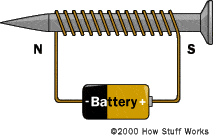
This picture best illustrates the construction of a(n)

a)

magnet

b)

electromagnet

c)

series circuit

d)

parallel circuit

117.
How do you make an electromagnet stronger?
a)
Add a motor and/or lightbulbs
b)
Add more light bulbs and/or wire coils
c)
add more wire coils and/or a switch
d)
add more wire coils and/or batteries
118.
What is true about electricity and magnetic fields?
a)
Electricity is needed to create any magnet.
b)
Electricity always creates a magnetic field.
c)
Electricity is stronger than a magnetic field.
d)
Electricity prevents magnetic fields from occurring.
119.
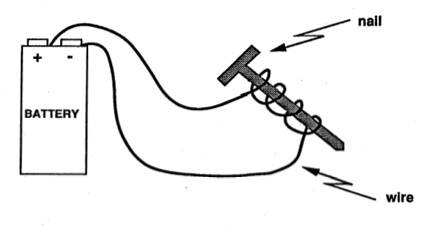
This is a picture of a simple electromagnet. How can the electromagnet be made stronger?
a)
Add more coils of wire to the nail.
b)
Use a smaller battery.
c)
Reverse the poles of the magnet.
d)
Remove all the coils and the nail.
120.
What kind of magnet can be turned on and off?
a)
refridgerator magnet
b)
electromagnet
c)
magnetite
d)
iron
121.
A compass needle responds to a magnetic field, because the compass needle is a
a)
A. generator.
b)
B. motor.   
c)
C. magnet.
d)
D. transformer.
122.

What is magnetic force?

a)

A force exerted by electrically charged particles

b)

A force exerted by magnets that can be felt by objects near a magnet

c)

A force exerted by magnets that makes an object become electrically charged

d)

A force exerted by a magnet only when it physically touches an object

123.

Which of the following is not a good conductor?

a)

Copper

b)

Silver

c)

Aluminium

d)

Plastic

124.

Particles with opposite charges ____________ and particles with same (or like) charges ____________.

a)

attract, repel

b)

repel, repel

c)

attract, attract

d)

repel, attract

125.

The picture above is an example of what?

a)

Magnetic field

b)

Electric field

c)

Repulsion

d)

Attraction

126.

What would happen with the magnets in the picture above?

a)

They would repel

b)

Nothing

c)

They would attract

d)

They would repel and then attract

127.

Which sides of the magnet repel each other?

a)

A) North and North Pole

b)

B) South and South Pole

c)

C) The North and South Pole

d)

D) A and B

e)

E) A, B,C

128.

What is responsible for creating a magnetic field around Earth?

a)

Earth's crust

b)

Earth's iron core

c)

Earth's mantle

d)

Earth's atmosphere

129.

What happens to the strength of a magnetic field as you move away from the magnet?

a)

The strength of the magnetic field increases.

b)

The strength of the magnetic field doesn't change.

c)

The strength of the magnetic field is doubled.

d)

The strength of the magnetic field decreases.

130.

What happens if you cut a magnet in half?

a)

Nothing

b)

The magnets repel

c)

There will be two magnets

131.

The picture above is an example of what?

a)

Magnetic field

b)

Electric field

c)

Repulsion

d)

Attraction