
NEW
Font size
S
M
L
XL
 Worksheets
4th Grade Science Review
Total questions: 65
Worksheet time: 38mins
Name
Class
Date
1.
1. What is an adaptation?
a)
A feature or behavior that helps an animal survie.
b)
The food that an animal eats.
c)
How energy moves in a food web.
2.
This is a period of deep sleep that occurs in some animals when outside temperatures are cold: ______
a)
hibernation
b)
migration
3.
An example of a physical adaptation is...
a)
a turtle hiding inside its shell
b)
The spikes on a porcupine fish
c)
a rabbit burrowing underground
d)
a viper biting when threatened
4.
An animal's color or pattern that helps it blend into its surroundings
a)
Environment
b)
Mimicry
c)
Camouflage
5.
Which adaptation would NOT help a hawk catch a mouse?
a)
Hollow Bones
b)
Good eye sight
c)
Talons
d)
Camouflage
6.
Which of these BEST describes how some birds survive when the weather gets cold?
a)
a. They store twigs and sticks in their nest
b)
b. They migrate to a warmer climate
c)
c. They grow more feathers to stay warm in the winter
d)
d. They hide in bushes and wait for warm weather
7.

Which feature of a rose helps it grow without being eaten by large animals?
a)
flowers with bright colors
b)
sharp thorns
c)
small seeds
d)
deep roots
8.
Plants with spines and waxy leaves are well suited for life in which environment?
a)
Desert
b)
Temperate forest
c)
Grassland
d)
Tropical Rainfroest
9.
A resting state through the winter.
Adaptation: Bear sleeping in a cave during the winter months
Adaptation: Bear sleeping in a cave during the winter months
a)
Locomotion
b)
Hibernation
c)
Migration
d)
Defense
10.
The space, conditions and all the living and non-living things around an organism is its _________________.
a)
home
b)
environment
c)
neighborhood
d)
ecosystem
11.
An organism that hunts and feeds on another organism is a ______________________.
a)
prey
b)
producer
c)
predator
d)
decomposer
12.
An animal that is hunted as food
a)
prey
b)
predator
c)
decomposer
d)
producer
13.

The role an organism plays in its ecosystem
a)
niche
b)
behavior
c)
structure
d)
function
14.

When an organism copies a characteristic of something else in order to better its chances for survival and reproduction
a)
hibernation
b)
camouflage
c)
mimicry
d)
migration
15.

When an organism slows its life functions for a period of time to better its chances for survival during harsh conditions
a)
camouflage
b)
migration
c)
mimicry
d)
hibernation
16.
The place or environment where an organism naturally lives
a)
function
b)
habitat
c)
community
d)
ecosystem
17.
A group of organisms which are similar to each other and can combine to have offspring
a)
species
b)
characteristic
c)
club
d)
organisms
18.
Function is ________________________.
a)
the way something looks
b)
how something sounds
c)
what something does
d)
the role of an organism
19.
Animals disperse seeds by _________.
a)
eating seeds and dropping waste later on
b)
hiding seeds for late and not coming back for them
c)
catching seeds on their fur and carrying them to different places
d)
all of the above
20.
The part of the plant that holds the plant in place and absorbs water and minerals from the soil.
a)
stem
b)
roots
c)
leaves
21.

What part of the plant is #2?
a)
leaf
b)
flower
c)
stem
d)
root
22.

What part of the plant is #3?
a)
leaf
b)
root
c)
flower
d)
stem
23.

What part of the plant is #4?
a)
leaf
b)
flower
c)
stem
d)
root
24.
Helps the plant to transport water, nutrients, and food from their roots to their leaves.
a)
Leaves
b)
Roots
c)
Stems
d)
Small leaves
25.
Helps the plant to anchor to the soil and get water and nutrients.
a)
Leaves
b)
Stems
c)
Roots
d)
Odd shapes
26.
Which part of the plant soaks in the sun to help feed the plant?
a)
stem
b)
root
c)
seed
d)
leaf
27.
This part of the plant supports it and carries water.
a)
root
b)
stem
c)
leaf
d)
seed
28.

What is the main reason that flowers need bees?
a)
So the flower smells fragrant.
b)
So the flower can make seeds.
c)
To create pollen.
d)
To create food.
29.

What is the main reason that bees need flowers?
a)
wax
b)
food
c)
honey
d)
protection
30.

What kinds of food do bees collect from flowers?
a)
stigma and anther
b)
stigma and pollen
c)
anther and nectar
d)
pollen and nectar
31.
The amount of time where seeds grow and become tiny plants is called
a)
miracles
b)
germination
c)
xylem
d)
photosynthesis
32.
Plants always grow toward_____?
a)
the wind
b)
the rain
c)
the light
d)
the snow
33.
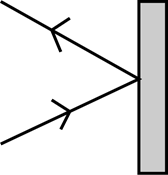
The illustration shows a light ray striking an object.
In the illustration, the light ray striking the object is-
In the illustration, the light ray striking the object is-
a)
absorbed
b)
stopped
c)
reflected
d)
refracted
34.

A student placed a pencil in a cup of water. The pencil appears broken because light-
a)
always travels in a straight line
b)
bends when it passes through water
c)
makes the water in the glass evaporate
d)
reflects the pencil on the water's surface
35.
The bouncing off of light rays from the surface of an object such as a mirror or other shiny surface is called:
a)
mirror
b)
laser
c)
reflection
d)
refraction
36.
When objects allow only part of the light that hits them to pass through, they are__________
a)
translucent
b)
transparent
c)
opaque
37.
________objects allow almost all the light that hits them to pass through.
a)
Translucent
b)
Transparent
c)
Opaque
38.
__________ objects do not let any light pass through.
a)
Translucent
b)
Transparent
c)
Opaque
39.
What happens when light hits a transparent object?
a)
The light reflects.
b)
The light is absorbed.
c)
The light is blocked.
d)
The light passes through it.
40.
What falls from the sky & acts like a prism?
a)
snow
b)
rain
c)
sleet
41.
Why do we see objects as black?
a)
They absorb all the light
b)
They reflect all the light
c)
They absorb some light and reflect
42.
A convex lens curves ____________.
a)
outward
b)
inward
c)
opaque
d)
refracts
43.
How does light travel?
a)
in a wavy path
b)
in a straight path
c)
in a zig zag path
44.
What does it mean to refract?
a)
bounce off
b)
to bend
c)
curve outward
d)
reflect
45.
White light can be separated into different colors by using a__________.
a)
microscope
b)
prism
c)
mirror
d)
convex lens
46.

Why does light bend when it moves from one material to another?
a)
because it travels slow
b)
because it travels fast
c)
because it changes speed and bends
d)
light does not bend
47.
Sound travels FASTEST through which of these materials?
a)
Air
b)
Empty space
c)
Metal
d)
Water
48.
Sound is caused by?
a)
force
b)
vibrations
c)
instruments
49.
What is vibration?
a)
how loud a sound is
b)
the back and forth movement of matter
c)
how high or low a sound is
d)
the loudness or softness of a sound
50.

What is frequency?
a)
the number of vibrations per second
b)
how high or low a sound is
c)
the loudness or softness of a sound
d)
the back and forth movement of matter
51.

Sound is a form of?
a)
energy
b)
pitch
c)
volume
52.

Measure of how high or low a sound is
a)
amplitude
b)
compression
c)
speed of sound
d)
pitch
53.
A longer string makes a _______ pitch than a short string.
a)
louder
b)
softer
c)
higher
d)
lower
54.
An object that does not vibrate cannot produce
a)
sound
b)
light
c)
heat
d)
electricity
55.
What is volume?
a)
how high or low a sound is
b)
the loudness or softness of a sound
c)
the number of vibrations per second
d)
vibrations
56.
Material (matter) through which a wave travels
a)
medium
b)
Doppler Effect
c)
sound
d)
pitch
57.
The part of a longitudinal wave where the particles of the medium are close together.
a)
rarefaction
b)
compression
c)
crest
d)
trough
58.
A part in a longitudinal wave where the particles are spread apart
a)
compression
b)
rarefaction
c)
crest
d)
trough
59.
Q1.If you press down on a piano key it makes a sound wave. Now you press the key harder, and it's louder. How did that change the sound wave?
a)
The sound's amplitude and energy increased.
b)
The sound's wavelength increased.
c)
The sound's frequency increased.
d)
The sound's energy would decrease
60.
Which scale measures the intensity of the ground movement?
a)
Mercalli Scale
b)
Richter Scale
c)
Seismogram Scale
d)
Bernoulli Scale
61.

What do you call the crack in Earth's surface along which movement takes place?
a)
earthquake
b)
epicenter
c)
fault
d)
focus
62.

What do you call melted rock below the Earth's surface?
a)
lava
b)
fault
c)
focus
d)
magma
63.

What do you call waves of energy sent through Earth's crust when parts of the crust move suddenly?
a)
thermal waves
b)
energy waves
c)
seismic waves
d)
magma
64.

What do you call melted rock once it hardens on the Earth's surface?
a)
focus
b)
magma
c)
lava
d)
seismic waves
65.

An earthquake of 8.5 or higher would do this.
a)
No damage
b)
Minor damage
c)
Major damage
d)
Can't be detected
Reset

