wayground logo

Free Printable Worksheets

Font size

S
M
L
XL
Worksheets

quarter4topics

Total questions: 83

Worksheet time: 1hrs 19mins

Name
Class
Date
1.

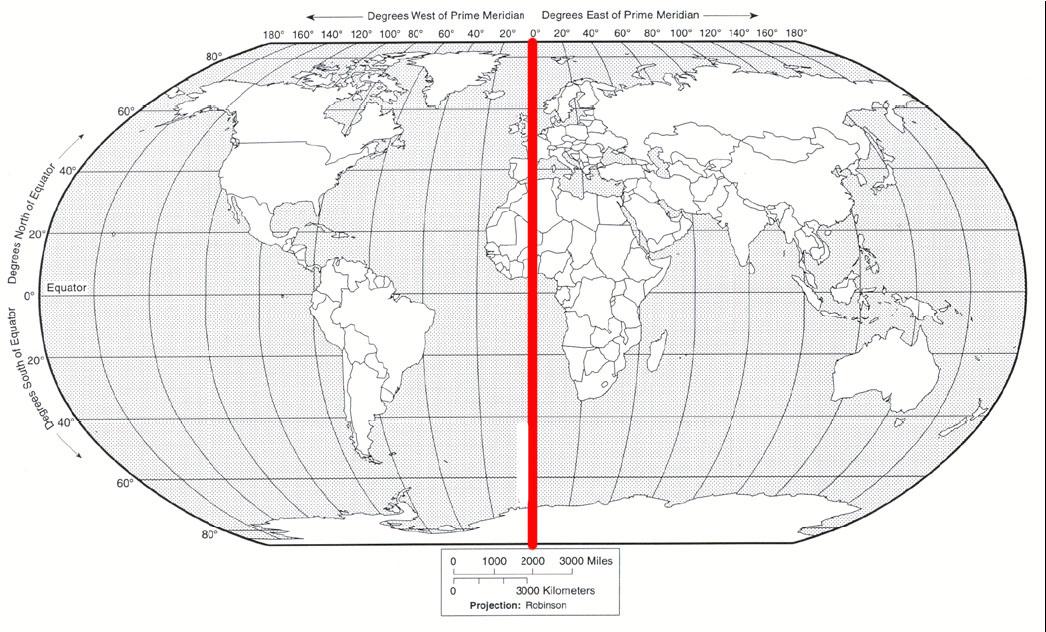
1.) To locate exact places on the earth, one must look at

a)

The lines of latitude only

b)

The lines of longitude only

c)

A neighboring area to describe the location

d)

The intersecting lines of latitude and longitude
2.
What is the name of the line at zero degrees longitude?
a)
Equator
b)
Prime Meridian
c)
North Pole
d)
South Pole
3.
Latitude and Longitude are measured in______.
a)
kilometers
b)
degrees
c)
miles
d)
hours
4.
Which of the following letter is at approximately 60 degrees S, 40 degrees W? 
a)
A
b)
D
c)
E
d)
H
5.
Which letter would you find at 15oS, 60oW?
a)
A
b)
C
c)
L
d)
H
6.
The 0 degree line of latitude is the ___________.
a)
Equator
b)
Prime Meridian
c)
International Date Line
d)
Contour line
7.
Which of the following natural resources are nonrenewable?
a)
Water
b)
Animals
c)
Natural gas
d)
Wind
8.
Fossil fuels are nonrenewable because...
a)
they are used to produce heat
b)
they take a long time to form
c)
they can be found underground
9.
What does conserving resources mean?
a)
Use as much of the resources as you can
b)
Only use the resources at school
c)
Protecting the resource so it does not run out
10.
Any useful material that is found in nature:
a)
Natural Resource
b)
Human Resource
c)
Plants
11.
Diamonds and other minerals
a)
Nonrenewable
b)
Renewable
12.
Which group includes ALL renewable resources?
a)
Coal, trees, water, oil
b)
Water, wind, sun, plants
c)
Minerals, sun, natural gas, water
13.
Which of these is renewable?
a)
Water
b)
Oil
c)
Coal
d)
Minerals
14.
The Jones family cares about the environment. They run their dishwasher only when it is completely full. Which of the following BEST explains why they do this?
a)
To save money
b)
To recycle dish soap
c)
To reduce sewage
d)
To conserve water
15.
What is a watershed?
a)
a place where water comes off and flows to bodies of surface water
b)
the area where water is accumulates underground 
c)
water that has accumulated in the atmosphere
d)
an area under the earth's surface where infiltrated water collects
16.
Which type of rock results from melting and cooling of magma?
a)
Igneous
b)
Metamorphic
c)
Sedimentary
d)
Extrusive
17.
What is the movement of soil from one place to another?
a)
weathering
b)
deposition
c)
discharge
d)
erosion
18.
What does the Mohs Scale measure?
a)
Streak
b)
Luster
c)
Hardness
d)
Cleavage
19.
We live in the __________________layer, a level of the atmosphere.
a)
Troposphere
b)
Stratosphere
c)
Mesosphere
d)
Exosphere
20.
What absorbs ultraviolet rays in the atmosphere?
a)
troposphere
b)
stratosphere
c)
ozone layer
d)
greenhouse gases
21.
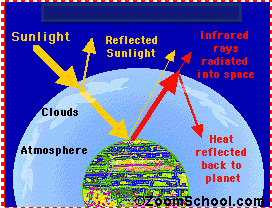
What does this diagram illustrate?
a)
Ozone Layer
b)
The Greenhouse Effect
c)
Ultraviolet Radiation
d)
Layers of the atmosphere
22.
The coldest layer.
a)
troposphere
b)
thermosphere
c)
exosphere
d)
mesosphere
23.
The hottest layer.
a)
troposphere
b)
thermosphere
c)
exosphere
d)
mesosphere
24.

What are the two most common gases in the atmosphere?

a)

Nitrogen and oxygen

b)

Oxygen and carbon dioxide

c)

Carbon Dioxide and methane

d)

Nitrogen and carbon dioxide

25.
What does the earth's atmosphere do?
a)
help to regulate the temperature on Earth
b)
Help UV rays to reach the Earth's surface
c)
Creates meteors in the sky
d)
Keep ocean waters cold
26.
Which statement is true?
a)
The troposphere has the highest temperature because of the distance from the Sun
b)
The troposphere has the highest pressure because gravity keeps the air down.
c)
The exosphere has the highest temperature because of the distance from the Sun
d)
The exosphere has the highest pressure because gravity keeps the air down.
27.
Which of these layers is farthest from Earth?
a)
thermosphere
b)
stratosphere
c)
mesosphere
d)
exosphere
28.
What is the greenhouse effect?
a)
The warming of a planet due to trapped radiation.
b)
The cooling of Earth due to air pollution.
c)
The heating of a solid, such as a rock.
29.
As you go higher in the troposphere, the temperature _______________.
a)
decreases
b)
increases
c)
stays the same
30.
What gas from the list below is a cause for global warming?
a)
Urethane
b)
Oxygen
c)
Carbon Dioxide
31.
As you go higher in the stratosphere, the temperature _______________.
a)
decreases
b)
increases
c)
stays the same
32.
As you go higher in the thermosphere, the temperature _______________.
a)
decreases
b)
increases
c)
stays the same
33.
Where weather and clouds occurs.
a)
stratosphere
b)
thermosphere
c)
troposphere
d)
mesosphere
34.

Why is cutting down large areas of trees(deforestation) bad?

a)

Plants remove a large amount of nitrogen from the air

b)

Plants root systems absorb many toxins from the soil

c)

Plants roots systems hold the soil in place

d)

Plants remove a large amount of carbon dioxide from the air

35.
Where you will find the ozone layer.
a)
stratosphere
b)
thermosphere
c)
exosphere
d)
mesosphere
36.
Do sea breezes typically happen during the day or night?
a)
Day
b)
Night
37.
Do sea breezes typically happen during the day or night?
a)
Day
b)
Night
38.
During a land breeze which way does the wind blow?
a)
from the sea to the land
b)
from the land to the sea
39.
During a sea breeze which way does the wind blow?
a)
from the land to the sea
b)
from the sea to the land
40.
How does the air move in a land breeze?
a)
From east to west
b)
From west to east
c)
From the land to the ocean
d)
From the ocean to the land
41.
How does the air move in a sea breeze?
a)
wind moves from north to south
b)
wind moves from ocean to the land
c)
wind moves from the land to the ocean
d)
wind moves from south to north
42.
In a sea breeze, the air is warmer above the _____.
a)
land
b)
ocean
c)
sky
d)
beach
43.
Why do land breezes occur at night?
a)
Land cools off slower than water, so the air above water is cooler.
b)
Water cools off faster than land, so the air above land is warmer.
c)
Land heats up slower than water, so the air stays cooler during the day.
d)
Water cools off slower than land, so the air above water is warmer.
44.
What occurs when cool air moves from the beach toward the ocean during the night? 
a)
a land breeze 
b)
prevailing winds 
c)
a sea breeze 
d)
updrafts
45.
What does monsoon mean?
a)
Extreme weather
b)
prolonged drought
c)
storm surge
d)
seasonal wind
46.
What causes global winds to curve?
a)
Goedtel effect
b)
Pressure gradient force
c)
Coriolis effect
d)
Einstein effect
47.
The Earth's axis is tilted _____ degrees.
a)
23.5
b)
25.3
c)
30.2
d)
24
48.
At position A, which hemisphere would have summer?
a)
Northern hemisphere
b)
Southern hemisphere
49.
What happens when the area in which you live tilts away from the sun?
a)
It is summer.
b)
It is spring.
c)
It is winter.
d)
It is fall.
50.
The term equinox means....
a)
equal amount of day light and equal amount of night
b)
Equal amount of winter and summer
c)
Equal amounts of hot dogs for everyone
d)
The longest day of the year
51.
Which season is taking place in the Northern Hemisphere in Position 2?
a)
Winter
b)
Spring
c)
Summer
d)
Fall
52.
Which season is taking place in the Northern Hemisphere in Position 3?
a)
Winter
b)
Spring
c)
Summer
d)
Fall
53.
Why do globes lean sideways?
a)
To allow them to spin easier.
b)
To demonstrate the tilt of Earth's axis.
c)
To demonstrate the effects of gravity.
d)
To demonstrate day and night.
54.
What season is it in the Southern Hemisphere when it is fall in the Northern Hemisphere?
a)
winter
b)
spring
c)
summer
d)
fall
55.
In the Northern Hemisphere, on which day will you receive the most daylight?
a)
September 21
b)
December 21
c)
March 21
d)
June 21
56.
Which season is taking place in the Northern Hemisphere in Position 3?
a)
Winter
b)
Spring
c)
Summer
d)
Fall
57.
Which season is taking place in the Southern Hemisphere in Position 4?
a)
Winter
b)
Spring
c)
Summer
d)
Fall
58.
What is Earth's annual motion around the sun called?
a)
Rotation
b)
Revolution
59.
One rotation of Earth is equal to
a)
a day.
b)
a year.
60.
How long does Earth take to make a complete rotation?
a)
365 days
b)
24 hours
61.
Which seasons have an equal amount of daylight and darkness?
a)
Spring and Fall
b)
Winter and Summer
c)
Winter and Spring
d)
Summer and Fall
62.
Which climate zone experiences 4 seasons?
a)
Polar
b)
Temperate
c)
Tropical
d)
None
63.
What do June 21 and December 21 have in common?
a)
equinox dates
b)
the moon is full
c)
solstice dates
d)
the cold fronts blow in
64.
What is the longest day of the year?
a)
winter solstice
b)
summer solstice
c)
fall equinox
d)
spring equinox
65.
The hemisphere where you live 
a)
equator
b)
southern
c)
northern
d)
eastern
66.
In summer, the axis of the earth is pointed away or toward the sun?
a)
towards
b)
up
c)
down
d)
away
67.
What moon phase would be seen from Earth when the moon is at position 1? 
a)
new moon
b)
first quarter
c)
third quarter 
d)
full moon
68.
What does "waxing" mean?
a)
growing
b)
shrinking
c)
lighted
d)
dark
69.
What does "waning" mean? 
a)
growing
b)
shrinking
c)
lighted
d)
dark
70.
What side of the moon is the light on when the moon is waning? 
a)
left
b)
right
c)
front
d)
back
71.
What side of the moon is the light on when the moon is waxing? 
a)
left
b)
right
c)
front 
d)
back
72.
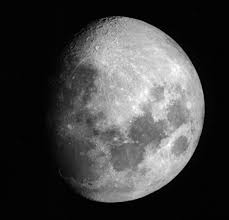
Name the moon phase
a)
waning crescent
b)
waxing crescent
c)
waning gibbous
d)
waxing gibbous
73.
How many phases does the moon have? 
a)
4
b)
6
c)
8
74.
What moon phase would you see a full moon?
a)
1
b)
3
c)
5
d)
7
75.
In order to have an eclipse, the Moon, Sun and Earth have to be?
a)
In Alignment
b)
Above each other
76.
Which type of eclipse occurs when the Moon comes directly between Earth and the Sun?
a)
Lunar eclipse
b)
Solar eclipse
77.
A solar eclipse only happens during a ________ moon.
a)
New
b)
Cresent
c)
Gibbous
d)
Full
78.
What do we call the sun's outer atmosphere that you see during a solar eclipse?
a)
an umbra
b)
a corona
c)
an orbit
d)
a shadow
79.
What is the darkest inner part of the shadow cone called, where a total eclipse can be viewed.
a)
Total
b)
Umbra
c)
Penumbra
80.

A lunar eclipse only happens during a full moon.

a)

false

b)

true

81.

What moon phase comes after a Full Moon?

a)

Waxing Crescent

b)

Waning Crescent

c)

New Moon

d)

Waning Gibbous

82.

What order is the Sun, Moon, and Earth during a Lunar Eclipse?

a)

Moon,Earth,Sun

b)

Sun,Moon,Earth

c)

Sun,Earth,Moon

d)

Earth,Sun,Moon

83.
Which type of eclipse occurs when the Moon comes directly between Earth and the Sun?
a)
Lunar eclipse
b)
Solar eclipse