wayground logo

Free Printable Worksheets

NEW

Font size

S
M
L
XL
Worksheets

Science 7-12 Practice Test

Total questions: 53

Worksheet time: 46mins

Name
Class
Date
1.

Which of the following describes the process skill of of concluding?

a)

Explaining or interpreting observations

b)

Making a determination based on results of a controlled experiment

c)

Reading an instrument during an experiment

d)

Listing similarities and differences

2.

A chemistry experiment is performed to determine the effect of a nonvolatile solute on the boiling point of water. 3 trails are performed in which 10mg, 20mg, and 30mg of salt are added to 500 ml of distilled water. Which of the following correctly identifies the independent and dependent variables?

a)

The independent variable is the amount of salt, and the dependent variable is the temperature at which the water boils

b)

The independent variable is the amount of water, and the dependent variable is the temperature at which water boils

c)

The independent variable is the temperature at which water boils, and the dependent variable is the amount of salt

3.

Which of the following is NOT true concerning forming and testing hypotheses?

a)

A controlled experiment should have only one independent variable.

b)

A controlled experiment may have several constants.

c)

A good hypothesis should take all of the available background material on the topic into consideration.

d)

A good hypotheses will not be disproved by testing.

4.
How would you write 564,000,000 in scientific notation?
a)
5.64 x 10⁻⁷
b)
5.64 x 10⁶
c)
5.64 x 10⁸
d)
56.4 x 10⁷
5.
How would you write 0.0005 in scientific notation?
a)
50 x 105
b)
5 x 10⁻⁴
c)
5 x 10³
d)
.5 x 10-3
6.

The following number has 4 significant figures.

a)

1010

b)

0.0055

c)

5000

d)

101.0

7.

What is the correct expression of 91,000 x 87,000 using scientific notation and significant figures?

a)

7.91 x 10⁹

b)

7.9 x 10⁹

c)

79.2 x 10⁸

d)

79 x 108

8.
The attendance for the basketball game was estimated to be 15,000 people but 12,500 people attended. What was the percent error?
a)
16.67%
b)
20%
c)
2500%
d)
80%
9.
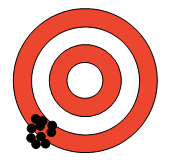
This bullseye demonstrates...
a)
High Accuracy & High Precision
b)
High Accuracy & Low Precision
c)
Low Accuracy & High Precision
d)
Low Accuracy & Low Precision
10.

Which of the following sets of quantities are equivalent?

a)

2,310 mg and 2.310 g

b)

2.310 g and 231.0 mg

c)

2.310 kg and 231.0 g

d)

2.310 kg and 231,000 mg

11.
convert 0.08 km to m
a)
80
b)
8
c)
0.8
d)
800
12.
You have been injured in the laboratory (cut, burn, etc.). First you should
a)
apply first aid yourself
b)
tell the science instructor at once
c)
see a doctor after school
d)
visit the school nurse after class
13.
Which statement is true?
a)
Oil is the most dense substance.
b)
Corn syrup is less dense than water.
c)
Oil is less dense than water.
d)
Oil and corn syrup have the same density but different masses.
14.
I added scoop after scoop of a specific solute until I saw the solute build up at the bottom of the test tube and knew the solute was no longer able to dissolve. This is an example of a(n) _____________.
a)
Insoluble solute
b)
Solvent
c)
Saturated Solution
d)
Homogeneous Mixture
15.
What is a solvent?
a)
The substance that does the dissolving in a solution.
b)
The substance that is being dissolved in a solution.
c)
The mixing of different substances.
d)
The process in which neutral molecules lose or gain electrons
16.

When the amount of solute increases-

a)

The boiling point increases and the melting point decreases

b)

The boiling point increases and melting point increases

c)

The boiling point decreases and melting point decreases

d)

The boiling point decreases and the melting point increases

17.

What are pure substances that consists of more than one one type of atom?

a)

Elements

b)

Compounds

c)

Molecules

d)

Mixtures

18.

Which of the following statements concerning the states of matter is NOT true?

a)

Plasmas are high temperature collections of ions and free electrons

b)

Solids are the least compressible due to the more rigid positions of the particles

c)

Gases have no definite volume and expand to fill their containers

d)

Liquids have no definite shape and no definite volume

e)

Liquids can flow but are incompressible and have a volume

19.

The symbol for a calcium ion is Ca2+ which of the following statements is true concerning this ion?

a)

This cation has fewer electrons than protons

b)

This anion has fewer electrons than protons

c)

This cation has more electrons than protons

d)

This anion has more electrons than protons

20.

Which subatomic particle is the smallest?

a)

Proton

b)

Neutron

c)

Electrons

d)

Quarks

21.
How many neutrons in C-14?
a)
6
b)
7
c)
14
d)
8
22.
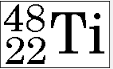
How many protons does this isotope of titanium have?
a)
48
b)
22
c)
26
d)
70
23.
How many neutrons does the isotope of lithium have?
a)
8
b)
3
c)
4
d)
5
24.

Which of the following represents an alpha particle?

a)

0 e

-1

b)

2 H+

1

c)

4 He2+

2

d)

0 e

+1

25.
particle consisting of two protons and two neutrons that is emitted from a decaying atomic nucleus
a)
Alpha Particle
b)
Beta Particle
c)
Critical Mass
d)
Gamma Ray
e)
Geiger counter
26.
electromagnetic wave with no mass and no charge which travels at the speed of light and usually emitted with alpha or beta particles from a decaying atomic nucleus
a)
Alpha Particle
b)
Beta Particle
c)
Critical Mass
d)
Gamma Ray
e)
Geiger counter
27.
electron which is emitted from a decaying atomic nucleus
a)
Alpha Particle
b)
Beta Particle
c)
Critical Mass
d)
Gamma Ray
e)
Geiger counter
28.

Which of the following is an example of a chemical change?

a)

Salt dissolving in water

b)

Water evaporating

c)

Silver tarnishing

d)

Dry ice sublimating

29.

Which temperature scales have exactly 100 degrees between the freezing point and the boiling point of water?

a)

Celsius only

b)

Celsius and Kelvin

c)

Celsius and Fahrenheit

d)

Kelvin only

30.
The kinetic theory of gasses states...
a)
The molecules are really small and move randomly
b)
The molecules are small and move together
c)
The molecules are big and move together
d)
The molecules move in a set way 
31.
0 K is ____ degrees Celsuis
a)
-100
b)
273
c)
200
d)
-273
32.
The formula for Charles's Law is...
a)
T1/V1=T1/V2
b)
V1/T1=V2/T2
c)
T1/V1=T2/V2
d)
T2/V1=T1/V2
33.
Which is true about the molecules at 0 K?
a)
They are moving really fast
b)
They are moving really slowly
c)
There is no motion at 0 K
d)
All of the above are true
34.
In heat transfer, heat always flows from the _______________ substance to the _______________ substance.
a)
Hotter to colder
b)
Colder to hotter
c)
Hotter to hotter
d)
Colder to colder
35.
Which situation best represents convection?
a)
Heat from a campfire
b)
A hot air balloon taking off
c)
Touching a hot piece of metal
d)
Getting sunburned
36.

The energy flow through an ecosystem is represented by an energy pyramid. The producer (1st trophic level) utilizes 8,000 g per year. What amount of energy is transferred to the third trophic level of this ecosystem?

a)

0.8 g per year

b)

8 g per year

c)

80 g per year

d)

800 g per year

37.
Specific heat is....
a)
The measure of kinetic energy of an objects particles
b)
A measure of the energy needed to increase the average kinetic energy of the particles
c)
The heating caused by the motion of flluid due to temperature difference
d)
The transfer of energy by electromagnetic radiation
38.
The heat content of a system at constant pressure is called
a)
entropy
b)
enthalpy
c)
heat
d)
energy
39.
How many calories are required to boil 75 grams of water?
(not in sig figs)  Hf = 80.0 cal/g,  Hv = 560.0 cal/g, SH = 1.00 cal/g ºC
a)
6,000 cal
b)
3,360,000 cal
c)
42,000 cal
d)
7.46 cal
40.
When the temperature of matter increases the particles...
a)
speed up and move closer
b)
speed up and move farther apart
c)
slow down and move closer together
d)
slow down and move farther apart
41.

According to the kinetic theory of matter, which of the following statements is true? Ke=1/2 MV2

a)

The average kinetic is inversely proportional to the square of the average velocity of the particles

b)

The average kinetic energy is inversely proportional to the average velocity of the particles

c)

The average kinetic energy is directly proportional to the square of the average velocity of the particles

d)

The average kinetic energy is directly proportional to the average velocity of the particles

42.

In general, where on the periodic table are the elements with the largest atomic radii located?

a)

Upper-right corner

b)

Upper-left corner

c)

Bottom-left corner

d)

Bottom-right corner

43.
Chlorine and Fluorine are both very electronegative, as they are both missing a single electron from their valence energy level.  Why is Fluorine more electronegative than Chlorine? 
a)
Fluorine has less energy levels.
b)
Chlorine has more electrons in its outer shell
c)
Fluorine has more protons.
d)
None of these
44.

Use your electronegativity and polarity charts to determine if the bond between these two elements is Ionic or non-polar covalent or polar covalent?


K-Br

a)

Ionic

b)

non-polar covalent

c)

polar covalent

45.

What is the name of the compound CuCl2?

a)

Copper (I) Chloride

b)

Copper (II) Chloride

c)

Copper (I) Chlorine

d)

Copper (II) Chlorine

46.

Name the ionic compound, FeBr3

a)

Iron (II) bromide

b)

Iron (III) bromide

47.

K1+ and N3- forms the ionic compound

a)

KN3

b)

K3N

c)

KNO3

d)

KN2

48.

Name the molecular compound S4N3

a)

sulfur nitrate

b)

tetrasulfur trinitride

c)

trisulfur tetranitride

d)

none of these

49.

Which shows a polar bond?

a)

NaCl

b)

CO2

c)

C6H12O6

d)

H2O

50.
What explains the very high melting and boiling point of water
a)
Strong dipole-dipole bonds between water molecules
b)
Strong hydrogen bonds between water molecules
c)
Dispersion forces which are present in all molecules
d)
Asymmetrical shape of the polar bonds.
51.
Which of the following geometries could be nonpolar?
a)
bent
b)
tetrahedral
c)
trigonal pyrimidal
d)
none of the above
52.
Which formula represents a nonpolar molecule?
a)
HBr
b)
H2S
c)
CBr4
d)
PCl3
53.

CO2 has polar bonds but is a NON POLAR molecule. Why?

a)

it has an asymmetrical shape

b)

bond polarity or dipole moment between C and O atoms cancel

c)

there is net dipole moment between C and O atoms in molecule

d)

bond polarity does not exist between C+ and O- atoms