wayground logo

Free Printable Worksheets

NEW

Font size

S
M
L
XL
Worksheets

Test Review for Radicals, Functions, and Inverses

Total questions: 50

Worksheet time: 1hrs 29mins
Name
Class
Date
1.
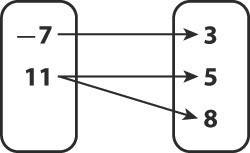
Is the relation a function? Why.
a)
Yes, because the x-value 11 has two y-values pair with it.
b)
Yes, because each x-value has only one y-value paired with it.
c)
No, because the x-value 11 has two y-values pair with it.
d)
No, because each x-value has only one y-value paired with it.
2.
a)
Function
b)
Not a Function
3.
Is this table a function or not a function? 
a)
Function
b)
Not a Function
4.
Which set of values is a function?
a)
(9,5) (10,5) (9,-5) (10,-5)
b)
(3,4) (4,-3) (7,4) (3, 8)
c)
(6,-5) (7, -3) (8, -1) (9, 1)
d)
(2, -2) (5, 9) (5, -7) (1, 4)
5.
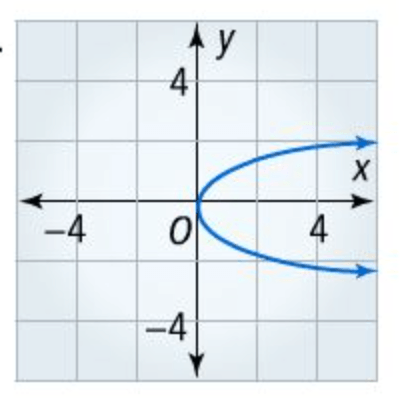
Is this graph a function or not a function? 
a)
Function
b)
Not a Function
6.
Is this graph a function or not a function? 
a)
Function
b)
Not a Function
7.
Is this graph a function or not a function? 
a)
Function
b)
Not a Function 
8.
f(x)=2x+1
If f(x)=4, what is the value of x?
a)
3/2
b)
2
c)
1/2
d)
4
9.
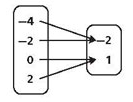
Give the domain and range. Tell if it is a function.
a)
D: {-4, -2, 0, 2}
R: {-2, -2, 1, 1}
Function
b)
D: {-4, -2, 0, 2}
R: {-2, 1}
Function
c)
D: {-4, -2, 0, 2}
R: {-2, -2, 1, 1}
Not a Function
d)
D: {-4, -2, 0, 2}
R: {-2, 1}
Not a Function
10.
All of the x values or inputs are called what?
a)
Domain
b)
Range
c)
Relation
d)
Function
11.
All of the y values or outputs are called what?
a)
Domain
b)
Range
c)
Relation
d)
Function
12.
For the function {(0,1), (1,-3), (2,-4), (-4,1)}, write the domain and range.
a)
D: {1, -3, -4,}
R: {0, 1, 2, -4}
b)
D:{0, 1, 2, -4}
R:{1, -3, -4}
c)
D:{0, 1, 2, 3, 4}
R:{1, -3, -4}
13.
If h(a) = 3 - 2a

Find h(-3).
a)
12
b)
-2
c)
-3
d)
9
14.
A company is selling bubble gum.  The function g(x)=3x+4 tells the company how much to charge if someone buys x packages of bubble gum.  Find g(8) and tell what it means within the context of the problem.
a)
g(8)=8.  This means that after 8 packages of gum, the company makes $8.
b)
g(8)=42.  This means that 8 packages of gum costs $42.
c)
g(8)=28.  This means that 8 packages of gum costs $28.
d)
g(8)=24.  This means that 8 packages of gum costs $24.
15.
What is the inverse of the given coordinates: (1, 2) (3, 8) (-3, 6)
a)
(1, 2) (3, 8) (-3, 6)
b)
(1, 2) (8, 3) (-3, 6)
c)
(-1, -2) (-3, -8) (3, -6)
d)
(2, 1) (8, 3) (6, -3)
16.
Find the inverse of f(x) = -4x - 12
a)
f-1(x) = 4x - 3
b)
f-1(x) = -1/4x - 3
c)
f-1(x) = 1/4x + 3
d)
f-1(x) = -4x - 3
17.
Find the inverse of
f(x) = 1/4x - 7
a)
f-1(x) = 4x + 7
b)
f-1(x) = -4x + 28
c)
f-1(x) = -4x - 7
d)
f-1(x) = 4x + 28
18.
Are the following inverses of each other?
a)
True
b)
False
19.

What is the equation that the inverse will reflect across?

a)

y = x

b)

y = 0

c)

x = 0

d)

y = - x

20.
f(x) = 3x + 10
g(x) = x - 2
Find f(g(5))
a)
19
b)
23
c)
-10
d)
None of these.
21.
f(x) = 3x + 10
g(x) = x - 2
Find f(g(0))
a)
16
b)
4
c)
-4
d)
None of these.
22.
f(x) = 3x + 10
g(x) = x - 2
Find f(g(x))
a)
3x2 - 2
b)
3x + 8
c)
3x + 4
d)
None of these.
23.
f(x) = 3x + 10
g(x) = x - 2
Find g(f(x))
a)
3x + 8
b)
3x - 2
c)
3x + 4
d)
None of these.
24.
Given
f(x) = 3x2 + 7x and g(x) = 2x2 - x - 1, find (f + g)(x).
a)
11x2 - 1
b)
5x4 + 6x2 - 1
c)
5x2 + 6x - 1
d)
5x2 + 8x - 1
25.
Given f(x) = -x + 4 and g(x) = 6x + 3, find (f - g)(x).
a)
-7x + 1
b)
5x +1
c)
-5x -1
d)
5x + 1
26.
When f(x) = 4x+8 and
g(x) = x+3, find
(f⋅g)(x)
a)
4x2+24
b)
4x2+20x+24
c)
4x2+12x+24
d)
4x2+4x+24
27.
When f(x) = x2 -9 
and g(x) = x+3 ,
find (f/g)(x). 
a)
x-3
b)
x+3
c)
x-12
d)
x-6
28.
√8 - 6√2
a)
-4√2
b)
2√2
c)
-6√6
d)
-6√10
29.
√5 + √20
a)
5
b)
25
c)
3√5
d)
2√3
30.
Find the domain and range of the function
Hint:  Use a scratch graph to help you visualize things. 
a)
Domain: (-∞, ∞)  Range: [-∞, 4]
b)
Domain: [1, ∞)  Range: (-∞, 4]
c)
Domain: [-1. ∞) Range: [4, ∞) 
d)
Domain: [4, ∞) Range: [-1,∞) 
31.

Solve for x.

a)

1

b)

0

c)

-3

d)

-2

32.

Solve for x.

a)

5

b)

11

c)

-7

d)

-1

33.
Identify the Range
a)
(- ∞, -2 ]
b)
[ -2, ∞ )
c)
All Real Numbers
d)
[ 0, ∞)
34.

Which equation is shown graphed?

a)

y = −√(x + 1) + 4

b)

y = −√(x − 1) + 4

c)

y = √(x − 1) + 4

d)

y = √(x + 1) + 4

35.
What type of function is shown?
a)
cube root
b)
square root
c)
logarithm
d)
exponential
36.

Simplify the radical √140

a)

14√10

b)

2√35

c)

4√35

d)

√140 is already simplified

37.

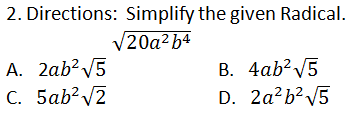
Simplify the radical...

√20a²b⁴

a)

2ab²√5

b)

4ab²√5

c)

5ab²√2

d)

2a²b²√5

38.
Simplify:
√10 ⋅ √45
a)
3√50
b)
8√2
c)
√450
d)
15√2
39.
Simplify the expression:
a)
-15 + 8√9
b)
9
c)
2 + 8√3 + 6√6
d)
9 + 14√3
40.
2√3 -√27 -√3 =
a)
5√3
b)
3√2
c)
-2√3
d)
2√3
41.
Simplify:
a)
A
b)
B
c)
C
d)
D
42.
Read the question carefully and choose the correct answer.
a)
A
b)
B
c)
C
d)
D
43.
Read the question carefully and choose the correct answer.
a)
A
b)
B
c)
C
d)
D
44.

Explain why the radical expression is or is not in simplified form?

a)

The expression is simplified because the radicand contains no fractions

b)

The expression is simplified because the radicand has no​ perfect-square factors other than 1.

c)

The expression is not in simplified form because a radical appears in the denominator of a fraction.

d)

The expression is not simplified because it contains a fraction.

45.
Which cannot be added or subtracted?
A) 12√5 + 4√5
B) 2√3 + 4√3
C) 4√5 - 4√7
D) 2√9 + 4√9
a)
A
b)
B
c)
C
d)
D
46.
a)
(x2√2x) ∕ y
b)
(10x2√x) ∕ (y√5)
c)
(2x5) ∕ (y2)
d)
x√(2x)
47.
What is the conjugate of the following:
5+√5
a)
-5+√5
b)
5+√5
c)
5-√5
d)
-5-√5
48.
Simplify.
a)
x9/8
b)
x4
c)
x3
d)
x1/2
49.

Fully simplify...

a)
b)
c)
d)
50.

Fully simplify...

a)
b)
c)
d)