wayground logo

Free Printable Worksheets

Font size

S
M
L
XL
Worksheets

CIA 3 Review

Total questions: 119

Worksheet time: 8hrs 56mins

Name
Class
Date
1.
Simplify the expression
a)
n / 2m 
b)
n / 3m 
c)
(m+ 4n2) / 12m
d)
n / 4m 
2.
Simplify the expression
a)
6x / 20xy
b)
3 / 10y
c)
(6x+1) / (20xy)
d)
3 / 20xy
3.

Simplify

a)

(-17x - 12y) / 15x

b)

(23x - 4y) / 15x

c)

(-17x - 4y) / 15x

d)

(-3x - 4y) / 8x

4.
What is the horizontal asymptote to this function?
a)
y=4
b)
y=0
c)
y=-2
d)
y=1
5.
What are the asymptotes?
a)
x=-3, y=1
b)
x=3, y =1
c)
x=-3, y =-1
d)
x=3 y=-1
6.
Which of these is NOT an asymptote on this graph?
a)
x=-3
b)
x=3
c)
y=2
d)
y=-3
7.

What is the horizontal asymptote of this graph?

a)

y = 0

b)

y = 1

c)

y = 2

d)

y = 3

8.

What is the vertical asymptote of this graph?

a)

x = 4

b)

x = -4

c)

x = 0

d)

x = 2

9.

What is the horizontal asymptote of this graph?

a)

y = -6

b)

y = 6

c)

y = 0

d)

y = -2

10.

What is an asymptote?

a)

lines

b)

silly lines that don't matter

c)

invisible lines that a graph will never touch

d)

they do that one thing

11.
Find the vertical asymptote.
x2-2x-8
__________
3x-2
a)
y=2/3
b)
x=3/2
c)
x= 2/3
d)
x=1/3
12.
Find the horizontal asymptote.
4x-16
_________
x2-16
a)
y=2
b)
y=1
c)
y=0
d)
none
13.
Which asymptotes are determined by looking at the coefficients of the highest power in a function? 
a)
vertical
b)
horizontal
c)
slant
d)
none
14.
The horizontal asymptote equals zero when:
a)
the exponents in the numerator and denominator are equal
b)
the exponents in the denominator are greater than the numerator
c)
the exponents in the numerator are greater than the denominator
d)
the numerator equals zero
15.
Find the least common denominator of the expression
a)
18
b)
6x
c)
3xy
d)
6xy
16.
Solve the equation for x.
a)
6
b)
12
c)
0
d)
3
17.
Solve 
a)
x = 0 , 4
b)
x = 1 , 3
c)
x = -4 , 0
d)
x = 5 , 2
18.

Describe the vertical asymptote and hole for the graph of the equation shown.

a)

VA on x = -4; hole when x = 2

b)

VA on x = -4 and x = 2

c)

VA on x = -5; hole when x = -4

d)

VA on x = 4; hole when x = -2

19.
Which asymptote(s) are determined by looking at the denominator?
a)
vertical
b)
horizontal
c)
slant
d)
none
20.
The holes of a rational function occur when :
a)
my pencil pokes a hole in the paper I'm working on
b)
there is something left in the denominator
c)
the value of f(0)
d)
a factor in the denominator cancels with a factor in the numerator
21.
a)
-1
b)
0
c)
4
d)
None
22.
What is the y-intercept?
a)
(0,1)
b)
(0,1/9)
c)
(0,-1/9)
d)
(0,-1)
23.
Multiply and Simplify 
a)
4(x+3)/(x+2),
b)
(x+2)/4(x+1)
c)
(x+2)/4(x+3),
d)
4(x+1)/(x+2), 
24.
Simplify. 
a)
A
b)
B
c)
C
d)
D
25.
Simplify. 
a)
A
b)
B
c)
C
d)
D
26.
a)

7(r + 2)/ (r + 2)

b)

(r - 8) / (r + 2)

c)

(r + 2) / 7

d)

(r - 8) / 7

27.
Simplify
a)
(x-9)/(x+9)
b)
1/(x-9)
c)
(x+9)
d)
1/(x+9)
28.
Divide and Simplify
a)
1/6
b)
x+10/ 6x+60
c)
x+8/ 6x+60 
d)
(x+10)(x+8)/ 6x+60
29.
a)
-6, -2
b)
-2, 6
c)
2, 6
d)
-6, 2
30.

Use the graph to determine the solutions.

a)

-1 and -3

b)

1 and -3

c)

1 and 3

d)

-1 and 3

31.

What are the zeros?

a)

x= 0 and x= -4

b)

x= 0 and x= 4

c)

y= 0

d)

x= 2

32.

What are the roots of the function?

a)

{x|x = 4, -1}

b)

(-4, 1)

c)

{x|x = -4, 1}

d)

(3, 0) (-4, 0)

33.
True or false:
The solutions, roots, x-intercepts, and zeros of a quadratic equation are all the same thing.
a)
True
b)
False, because the solution and root are the same but the x-intercept and zero are different
c)
False, because the x-intercept and root are the same but the zero and solution are different
d)
False, they are all different
34.

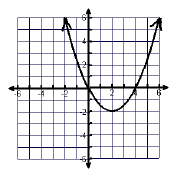
Which is a zero of the graph?

a)

2

b)

-1

c)

1.5

d)

-3

35.

.How many zeros does this parabola have?

a)

3

b)

2

c)

0

d)

1

36.

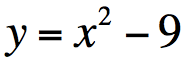
What are the x-intercept(s) of the function?

a)

(9,0)

b)

(-3,0)

c)

(3,0)

d)

(-3, 0),(3, 0)

37.
Simplify 100
a)
10
b)
1
c)
0
d)
100
38.
Find the zeros of the equation: 
(x+10)(x-2) = 0
a)
10 and 2
b)
-2 and 10
c)
-10 and 2
d)
-2 and -10
39.
Given x=5, x =3/2, and x= 5/3...
which of the following is the correct factored form? 
a)
(x-5)(2x-3)(3x-5)
b)
(x+5)(2x+3)(3x-5)
c)
(x-5)(x-3/2)(x-5/3)
d)
(x-5)(3x-2)(5x-3)
40.

One zero in the polynomial x3 + 18x2 + 83x + 66 is -1. What are the other zeros?

a)

-3, -22

b)

2, 33

c)

-6, -11

d)

-3, 11

41.
Identify the zeros
a)
x=2, x=6, x=-4
b)
(x+2)(x+6)(x-4)
c)
(x-2)(x-6)(x+4)
d)
x=-2, x=-6, x=4
42.

Pick the polynomial that has the factors 3, 2, -2

a)

f(x) = (x - 3)(x - 2)(x + 2)

b)

f(x) = (x + 3)(x + 2)(x - 2)

c)

f(x) = (3x)(2x)(-2x)

d)

f(x) = 3x2 + 2x - 2

43.
What is another way to say "where a function crosses the x-axis"?
a)
x-intercept
b)
zero
c)
root
d)
all of these.
44.
What are the solutions to this equation? (x-3)(x+2)=0
a)
x=3,-2
b)
x=-3,2
c)
x=2,3
d)
x=3,2
45.
Rewrite as an exponential:
log(10,000)=4.
a)
e4=10,000
b)
410,000=10
c)
104=10,000
d)
04=10
46.
Evaluate: log93
a)
½
b)
c)
2
d)
-2
47.
Simplify the following logarithmic function:
log22=
a)
8
b)
2
c)
1
d)
16
48.
Evaluate log41
a)
1
b)
0
c)
4
d)
undefined
49.
Rewrite log28 = 3 in exponential form/
a)
28 = 3
b)
23 = 8
c)
32 = 8
d)
83 = 2
50.
Rewrite logvn = a in exponential form.
a)
va = n
b)
na = v
c)
vn = a
d)
an = v
51.
The common logarithm has what base?
a)
10
b)
0
c)
e
d)
-e
52.
log525 = ?
a)
2
b)
5
c)
125
53.
Classify the following graph.
a)
Exponential Growth
b)
Exponential Decay
c)
Logarithmic
54.
Classify the following graph.
a)
Exponential Growth
b)
Exponential Decay
c)
Logarithmic
55.
The common logarithm is represented as what?
a)
log
b)
ln
56.
(-151)0
a)
0
b)
1
c)
-151
d)
151
57.
Does this graph represent exponential growth or decay?
a)
Growth
b)
Decay
58.

Simplify

a)

e/15

b)

e

c)

15

d)

1

59.

Simplify

a)

e

b)

0

c)

1

d)

-1

60.

Evaluate log1000

a)

1

b)

2

c)

3

d)

4

61.
Evaluate:
log416
a)
2
b)
4
c)
1/2
d)
-2
62.
Expand.
a)
log x + 5 log y
b)
5 log x + 5 log y
c)
5 log x - log y
d)
log x - 5 log y
63.
Expand log6(5x3/y).
a)
log65x3-log6y
b)
log65+log6x3-log6y
c)
log65+3log6x-log6y
64.
Expand log5(u3v5)
a)
1/2(log5u+log5v+log5uw)
b)
5 logu - 15 log5
c)
log5u + log5v +3 log5w
d)
3 log5u + 5 log5v
65.
Condense the expression to a single logarithm.
16 log u +4 log v 
a)
log(v4u16)
b)
log(v4u4)
c)
log(vuw4)
66.
Is the pictured graph growth, decay, or linear or none?  
a)
Exponential Growth
b)
Exponential Decay
c)
Linear
d)
None
67.
Classify the model as Exponential GROWTH or DECAY.
A=10(1.01)3
a)
Growth
b)
Decay
68.
The compound interest formula is:
A = P(1 + r)t

What does the A represent?
a)
The amount of interest earned.
b)
The amount of time that has passed.
c)
The total amount of money after a certain amount of time.
d)
The amount required to invest.
69.
A population of fish starts at 8,000 and decreases by 6% per year. Is this an example of growth, decay, or neither?
a)
growth
b)
decay
c)
neither
70.
Evaluate.
log6(1/216)
a)
3
b)
1/3
c)
-1/3
d)
-3
71.
Simplify 7log7(2x)
a)
0
b)
2x
c)
2
d)
1
72.

Evaluate without a calculator:

log61

a)

1

b)

0

c)

6

d)

undefined

73.

Evaluate without a calculator:

log2(-4)

a)

-2

b)

2

c)

-1/2

d)

undefined

74.

Evaluate without a calculator:

lne9

a)

e9

b)

e

c)

-9

d)

9

75.

Evaluate without a calculator:

ln(1/e)

a)

1

b)

-1

c)

e

d)

-e

76.
Rewrite as a single log: 4 log g - 2 log h
a)
log (4g/2h)
b)
log (g4/h2)
c)
log (g4 - h2)
d)
log (2gh)
77.
Write as a single log: log 12 + 2 log x
a)
log (12 + 2x)
b)
log (14x)
c)
log (12 * 2x)
d)
log (12x2)
78.
Separate; write as multiple logs: log (2x3)
a)
log 2 + 3 log x
b)
3 log 2x
c)
log 2* 3 log x
d)
2 log x3
79.
Separate; write as multiple logs: log (m2q4 / 3)
a)
log m2 + log q4 - log 3
b)
2 log m + 4 log q - log 3
c)
2 log m * 4 log q / log 3
d)
log m * log 2 + log q * log 4 - log 3
80.
log525 = ?
a)
2
b)
5
c)
125
81.
Expand the logarithm
log10 7x
a)
(log10 7)(log10 x)
b)
log10 7 + log10 x
c)
7log10 x
d)
xlog10 7
82.
Write as one logarithm. Simplify, if possible.
log5125 - log525
a)
1
b)
0
c)
5
d)
-1
83.
Write as one logarithm. Simplify, if possible.
log63 + log62
a)
0
b)
log65
c)
log61
d)
1
84.
A new savings account is opened with $400 and gains 3% every year. What is the exponential function?
a)
f(x)=400(1+3)x
b)
f(x)=400(1-0.03)x
c)
f(x)=400(1+0.03)x
d)
f(x)=400(0.03)x
85.
Solve:
3x-1 = 81
a)
5
b)
6
c)
9
d)
10
86.
log2(x + 5) = 3
a)
3
b)
4
c)
5
d)
6
87.
Solve for x:
logx(64)=2.
a)
10
b)
4
c)
8
d)
e
88.
Solve:
log (4x − 5) = log (2x − 1) 
a)
0
b)
1
c)
2
d)
3
89.
Solve for x:
a)
6
b)
-6
c)
-6,6
d)
No solution
90.
Evaluate. 
a)
A
b)
B
c)
C
d)
D
91.
Expand the logarithm
log10 7x
a)
(log10 7)(log10 x)
b)
log10 7 + log10 x
c)
7log10 x
d)
xlog10 7
92.
The common logarithm has what base?
a)
10
b)
0
c)
e
d)
-e
93.
The graph of a logarithmic function is given. Select the function for this graph
a)
f(x) = 1 - log3 x.
b)
f(x) = 1+ log3x
c)
f(x) = log10 (3x +1)
d)
f(x) =-log3x
94.

Solve

a)

-3

b)

3

c)

1/3

d)

No solution

95.

Solve

a)

-3

b)

3

c)

1/3

d)

-1/3

96.

Solve

a)

27

b)

-27

c)

1/27

d)

-1/27

97.

Solve

a)

0

b)

1

c)

-1

d)

No solution

98.

Solve

a)

0

b)

-1

c)

1

d)

No Solution

99.
What equation can be used to solve for x?
a)
Sin(40°)= x/40 
b)
Sin(40º)=x/19
c)
Cos(40º)=x/19
d)
Tan(40°)=19/x
100.
Find x round to the nearest tenth.
a)
46.1
b)
4.9
c)
16.4
d)
26.9
101.
Solve for x. Round to the nearest tenth.
a)
103.5
b)
4.7
c)
55.0
d)
23.4
102.
Solve for x. Round to the nearest tenth.
a)
9.8
b)
0.1
c)
0.038
d)
9.9
103.
Give the Ratio for TAN X
a)
Adj/Opp
b)
Opp/Adj
c)
Adj/Hyp
d)
Opp/Hyp
104.
Give the Ratio for COS X
a)
Adj/Hyp
b)
Opp/Adj
c)
Adj/Opp
d)
Opp/Hyp
105.
Give the Ratio for SIN X
a)
opp/adj
b)
Adj/hyp
c)
Opp/hyp
d)
adj/opp
106.
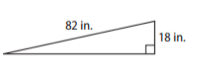
Find the length of the missing side. 
a)
20 in.
b)
68 in.
c)
16 in.
d)
80 in.
107.
Find the missing side
a)
48
b)
108
c)
83.6
d)
72
108.
Find the missing side
a)
9
b)
41
c)
6.4
d)
3
109.
Find a coterminal angle to 5 degrees.
a)
365
b)
255
c)
-220
d)
-365
110.
Find a coterminal angle to 45 degrees.
a)
360
b)
405
c)
315
d)
295
111.
Find a coterminal angle to 20 degrees.
a)
740
b)
690
c)
760
d)
320
112.
Find a coterminal angle to 100 degrees.
a)
820
b)
720
c)
360
d)
390
113.
Find a coterminal angle to 0 degrees.
a)
360
b)
180
c)
90
d)
270
114.
Find a coterminal angle to -180 degrees.
a)
180
b)
90
c)
270
d)
360
115.
Find a coterminal angle to -90 degrees.
a)
-450
b)
90
c)
180
d)
-180
116.
Find a coterminal angle to -27 degrees.
a)
-387
b)
27
c)
323
d)
-393
117.
Find a coterminal angle to -50 degrees.
a)
-770
b)
-310
c)
660
d)
710
118.
In which quadrant would you find an angle measuring -740°
a)
1
b)
2
c)
3
d)
4
119.
Which quadrant is -570⁰
a)
I
b)
II
c)
III
d)
IV