wayground logo

Free Printable Worksheets

Font size

S
M
L
XL
Worksheets

Rates of Reaction

Total questions: 23

Worksheet time: 21mins

Name
Class
Date
1.

Which factors affect the rate of a reaction?

a)

temperature

b)

concentration

c)

surface area

d)

pressure

e)

catalyst

2.

Why does a higher concentration increase the rate of reaction?

a)

it increases the amount of reactants

b)

it lowers the activation energy

c)

it increases the energy of particle collisions

d)

it increases the frequency of particle collisions

3.

Why does a higher temperature increase the rate of a reaction?

a)

it increases both the frequency and energy of particle collisions

b)

it only increases the frequency of particle collisions

c)

it only increases the energy of particle collisions

d)

it reduces the activation energy of the reaction

4.

Grinding a effervescent tablet into powder increases the rate of reaction due to increased

a)

concentration

b)

surface area

c)

temperature

d)

reactants

5.

Increasing the temperature gives particles more __________.

a)

Time

b)

Energy

c)

Space

d)

Frequency

6.

As the frequency of ______________ increases, the rate of reaction increases.

a)

Time

b)

Reactions

c)

Collisions

d)

Reactants

7.

Adding a catalyst ___________ the activation energy.

a)

Raises

b)

Lowers

c)

Doesn't affect

d)

Inreases

8.

The minimum amount of energy needed for colliding particles to react is called

a)

Chemical Energy

b)

Kinetic Energy

c)

Activation Energy

d)

Potential Energy

9.

Substance that changes the rate of a chemical reaction without being consumed in the reaction

a)

bonding

b)

catalyst

c)

chemical reaction

d)

activation energy

10.
What method can NOT be used to collect gas?
a)
Using a gas syringe
b)
Collecting it in a measuring cylinder under water
c)
Measuring the change in mass
d)
Seeing how quickly the solution goes cloudy
11.

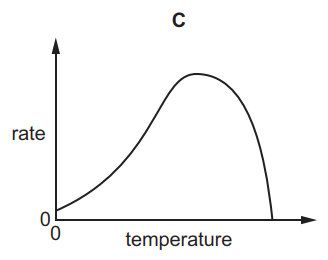
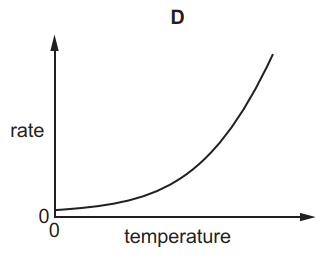
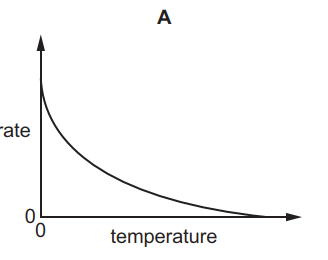
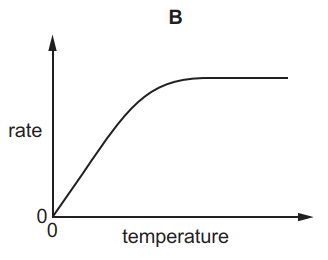
Which graph shows the effect of increasing temperature on the rate of reaction of calcium carbonate with dilute hydrochloric acid?
a)
b)
c)
d)
12.

P, Q, R and S are pieces of apparatus.

Which row describes the correct apparatus for the measurement made?

a)

A

b)

B

c)

C

d)

D

13.
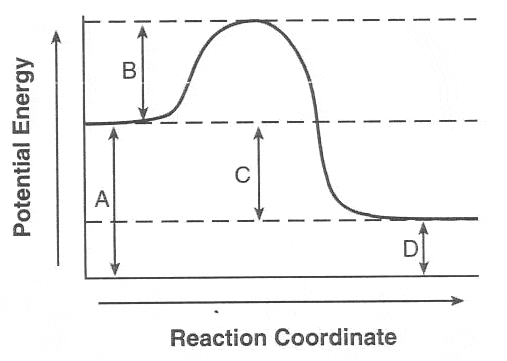
What type of reaction is this?
a)
Endothermic
b)
Exothermic
14.
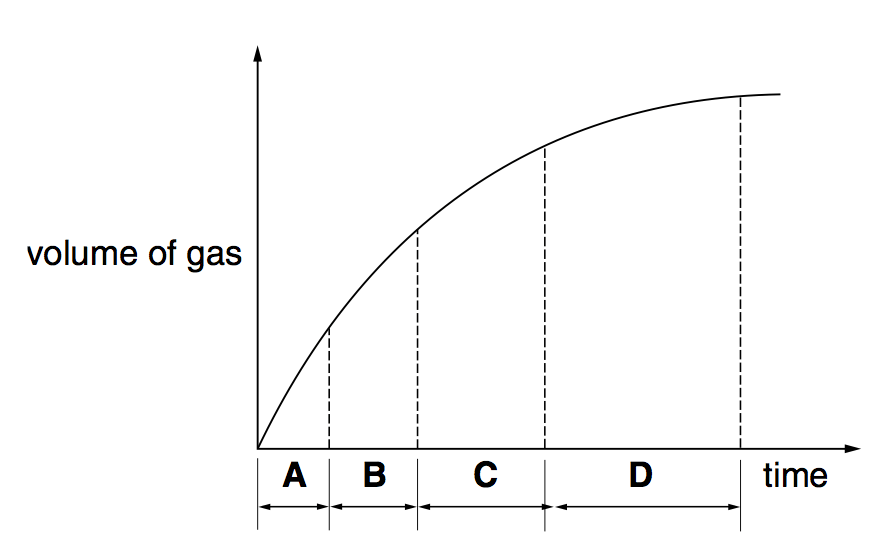
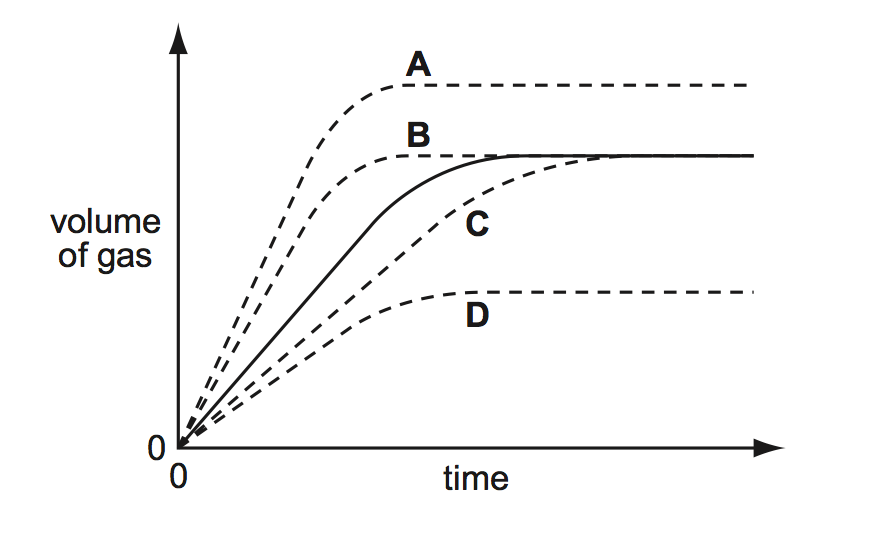
The graph shows how the total volume of a gas given off from a reaction changes with time. In which time interval is least gas given off? 
a)
A
b)
B
c)
C
d)
D
15.
In an experiment, a 2 g lump of zinc and 2 g of powdered zinc are added separately to equal volumes of dilute sulphuric acid. The solid line on the graph shows the volume of gas given off when the 2 g lump is used. Which dotted line is obtained when the zinc is powdered? 
a)
A
b)
B
c)
C
d)
D
16.

Icing sugar has a greater ______ _____ than a solid cube of

sugar.

a)

Surface Area

b)

Catalyst

c)

Temperature

17.
A solution of hydrogen peroxide releases oxygen slowly at room temperature.
 hydrogen peroxide → water + oxygen
 The diagrams show the effect of adding blood to the solution. What could be the reason for the observed change? 
a)
Blood contains an enzyme. 
b)
Blood contains water. 
c)
The hydrogen peroxide becomes more concentrated. 
d)
The hydrogen peroxide is neutralised by blood. 
18.
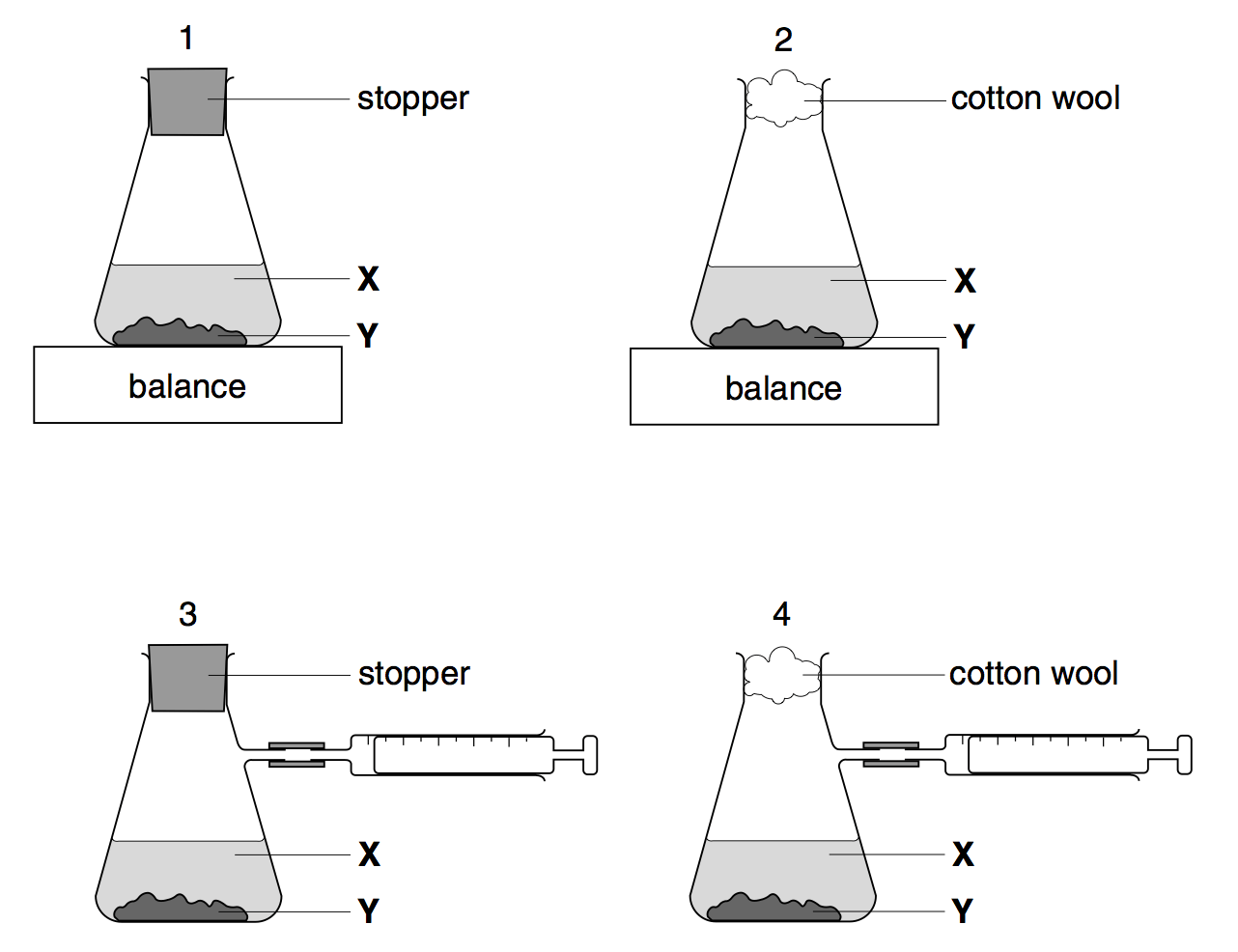
A liquid X reacts with solid Y to form a gas.
Which two diagrams show suitable methods for investigating the speed of the reaction? 
a)
1 and 3
b)
1 and 4
c)
2 and 3
d)
2 and 4
19.
In which experiment is the rate of reaction between hydrochloric acid and calcium carbonate slowest? 
a)
A
b)
B
c)
C
d)
D
20.
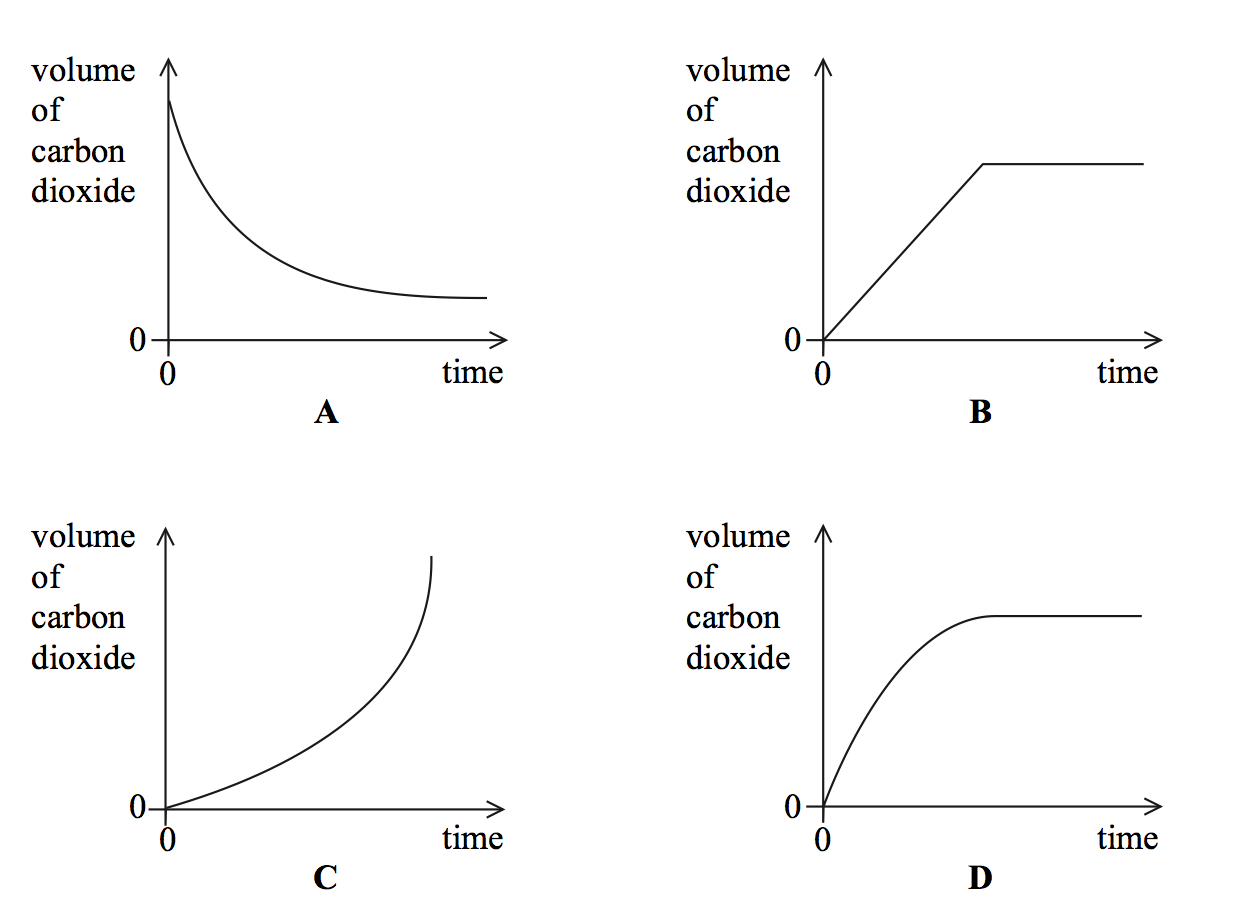
A student investigated the rate of reaction of calcium carbonate with dilute hydrochloric acid. Every minute, the student recorded the total volume of carbon dioxide produced, until some time after the reaction was complete.
Which graph shows the correct results? 
a)
A
b)
B
c)
C
d)
D
21.
Identify where the reaction has finished
a)
A
b)
B
c)
C
d)
D
22.
Order the letters from highest to lowest rate of reaction.
a)
A > B > C > D
b)
A > BC > D (B and C have the same rate)
c)
A > B > CD (C and D have the same rate)
d)
D > C > B > A
23.
Identify the part of the graph with the fastest rate of reaction.
a)
A
b)
B
c)
C
d)
D