
 Worksheets
Punnett Squares and DNA
Total questions: 40
Worksheet time: 40mins
Name
Class
Date
1.
How many alleles (letters) does a child get from each parent for each trait?
a)
1
b)
2
c)
3
d)
4
2.
Dominant alleles are represented by a:
a)
Male gene
b)
lowercase letter
c)
recessive trait
d)
capital letter
3.
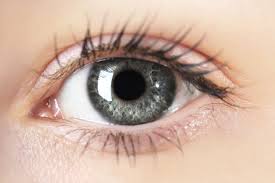
What you see, or the physical appearance.
a)
Genotype
b)
Phenotype
c)
Homozygous
d)
Heterozygous
4.

Each one of the boxes on the Punnett Square represents what probability of an offsprings' genotype?
a)
25%
b)
1%
c)
10%
d)
0%
5.
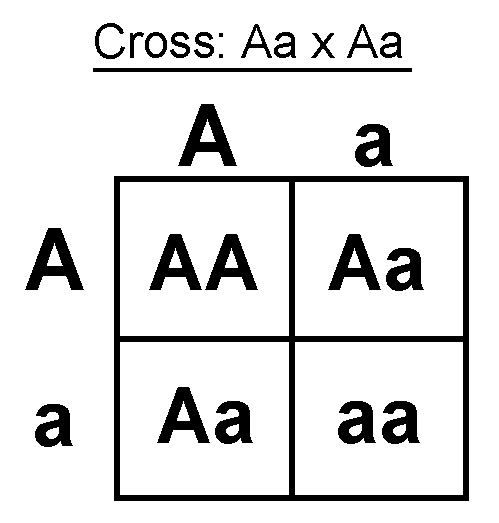
What is the phenotype of the offspring? (A-Brown hair; a-blond hair)
a)
50 % Brown Hair and 50% Blond Hair
b)
25 % Brown Hair and 75% Blond Hair
c)
75 % Brown Hair and 25% Blond Hair
d)
0% Brown Hair and 100% Blond Hair
6.
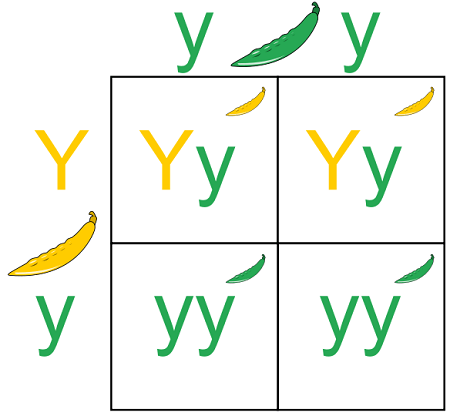
Which choice best represents the genotype of this cross?
a)
1 Yy: 2 yy: 0 YY
b)
2 Yy: 2 yy: 0 YY
c)
3 Yy: 1 yy: 0 YY
d)
1 Yy: 3 yy: 0 YY
7.
Which of the following is NOT a genotype?
a)
heterozygous
b)
a trait
c)
Bb
d)
homozygous recessive
8.
In plants, tall (T) is dominant to short (t). Perform the following cross: Tt x Tt. What is the probability of producing a short plant?
a)
0%
b)
25%
c)
50%
d)
75%
9.
W=white hair
w= non-white hair
If you cross a horse with WW and a horse with ww what fraction of the offspring would be expected to have white hair?
w= non-white hair
If you cross a horse with WW and a horse with ww what fraction of the offspring would be expected to have white hair?
a)
none
b)
3/4
c)
1/2
d)
all
10.

What is the probability of heterozygous offspring?
a)
25%
b)
50%
c)
0%
d)
100%
11.

What allele combination should go in the missing box?
a)
AA
b)
Aa
c)
aa
d)
none of these
12.
Aa, DD, bB, yy are all examples of
a)
genotypes
b)
phenotypes
13.
Which of the following genotypes is homozygous dominant?
a)
A
b)
Aa
c)
AA
d)
aa
14.
Which of the following genotypes is heterozygous?
a)
Bb
b)
BB
c)
bb
d)
B
15.
In a flowering plant species, red flower color (R) is dominant over white flower color (r). What is the genotype of any red-flowering plant resulting from this species?
a)
rr
b)
R
c)
RR
d)
RR or Rr
16.
Which of the following is homozygous recessive?
a)
Tt
b)
tt
c)
TT
d)
T
17.
G = green, g = yellow
The genotype for a yellow plant is...
The genotype for a yellow plant is...
a)
GG
b)
Gg
c)
gg
d)
all of the choices result in yellow
18.
What allele combination should go in the missing box?
a)
AA
b)
Aa
c)
aa
d)
none of these
19.
In a punnet square where are the parent alleles written?
a)
Top and inside the boxes
b)
Only on the left and right side of the boxes.
c)
outside of the boxes (top and left side)
d)
All on the top side of the boxes
20.
What is a punnett square?
a)
graph used to predict the possible genotypes of offspring in a given cross
b)
a graph used to predict the possible birth rate of offspring.
c)
a graph used to predict the possible behavioral characteristics an offspring could have
d)
None of the above
21.

Which of the following best describes a DNA molecule?
a)
double helix
b)
contains ribose
c)
made of amino acids
d)
contains Uracil
22.
Which of the following units are repeatedly joined together to form a strand of DNA? (This is the MONOMER of DNA.)
a)
amino acids
b)
nucleotides
c)
fatty acids
d)
polysaccharides
23.
Adenine bonds with ______________.
a)
Guanine
b)
Thymine
c)
Cytosine
d)
Adenine
24.
Guanine bonds with ______________.
a)
Adenine
b)
Guanine
c)
Cytosine
d)
Thymine
25.
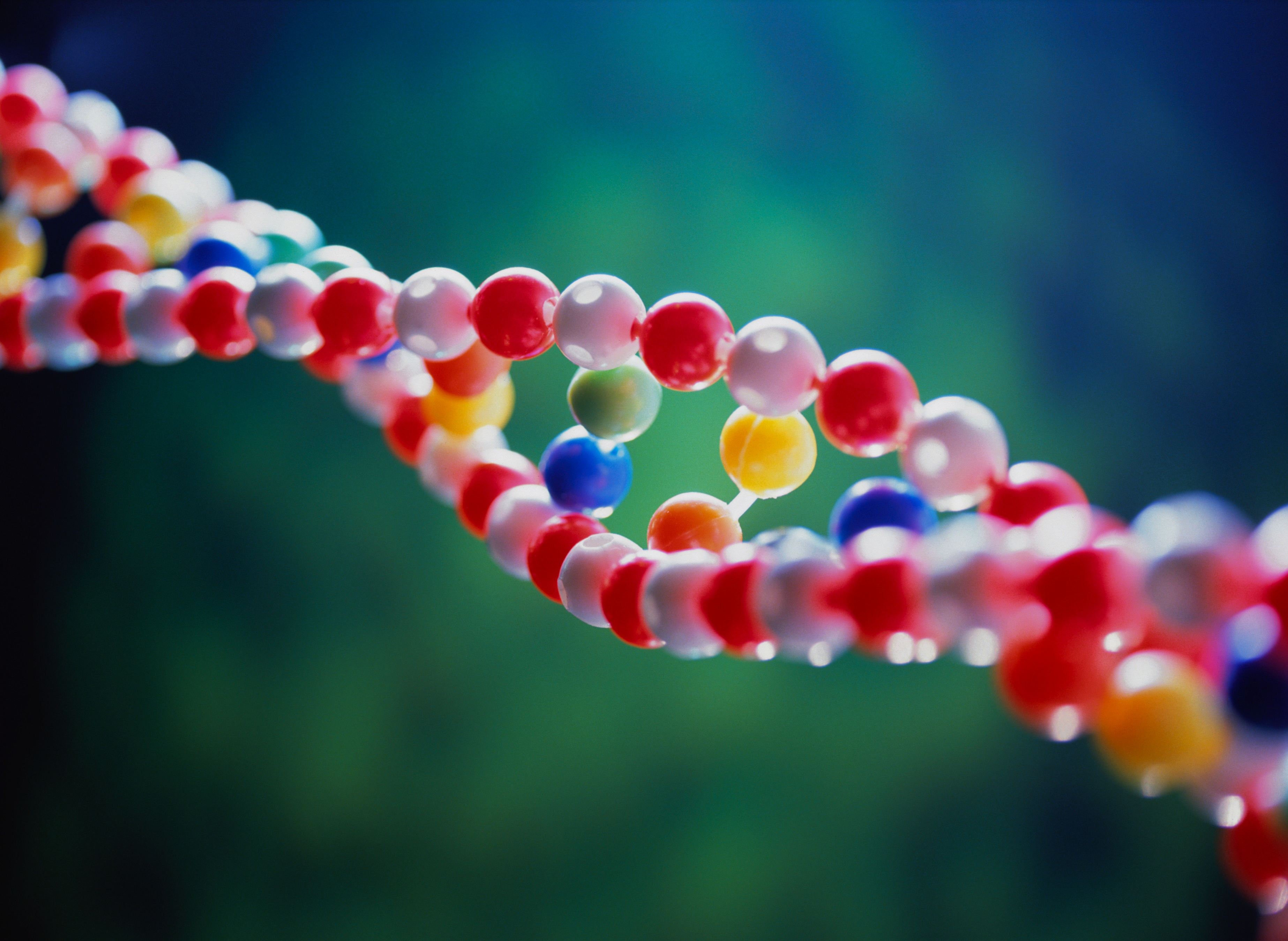
Why is DNA important?
a)
it is very small and very complicated
b)
it's in everything
c)
it serves as the blueprint for traits of all living things
d)
because we eat it every day for energy
26.
What are the 4 nitrogen bases?
a)
adenine, thymine, cytoplasm, and guanine
b)
adenine, thymine cytosine, and guanine
c)
adenine, thymine, cytosine, and gylcerol
d)
adenine, thymine, cytosine, and glucose
27.
Which 2 molecules forms the sides (backbone) of the DNA ladder?
a)
deoxyribose and adenine
b)
deoxyribose and a hydrogen bond
c)
sugar and the nucleus
d)
deoxyribose (sugar) and phosphate
28.
Which organelle is DNA usually found in?
a)
cell membrane
b)
vacuole
c)
chloroplast
d)
nucleus
29.
Which sequence of DNA bases would pair with this partial strand
ATG TGA CAG
ATG TGA CAG
a)
ATG TGA CAG
b)
TAC ACT GTC
c)
GTA AGT GAC
d)
CAT TCA CTG
30.

Sometimes mistakes occur curing cell division when DNA is being copied. What scientific word is used to describe the permanent changes in DNA?
a)
mutations
b)
alterations
c)
transformations
d)
mutilitions
31.
In DNA, cytosine always pairs with the base_________.
a)
adenine
b)
thymine
c)
cytosine
d)
guanine
32.
Genes are short segments of DNA and are located on the ______ in a cell.
a)
vaculoes
b)
chromosomes
c)
ribosomes
d)
lysosmes
33.
What does DNA stand for?
a)
ribonucleic acid
b)
dark night asteroid
c)
deoxyribnucleic acid
d)
deoxyribonucleic acid
34.

In a molecule of double-stranded DNA, the amount of Adenine present is always equal to the amount of
a)
cytosine
b)
guanine
c)
thymine
d)
uracil
35.
Which type(s) of cells contain DNA
a)
plant cells
b)
animal cells
c)
bacteria cells
d)
all cells
36.
What two scientists discovered the structure of DNA and won the nobel peace prize?
a)
Johnson and Johnson
b)
Rosalind Franklin and Eistein
c)
Watson and Holmes
d)
Watson and Crick
37.
What determines the code, or information, of a DNA molecule?
a)
the shape (structure) of the nitrogen bases
b)
the order (sequence) of the nitrogen bases
c)
the color of the nitrogen bases
d)
the frequency (number) of nitrogen bases
38.

What is this movie?
a)
Lion King
b)
Jungle Book
c)
Bambi
d)
101 Dalmatians
39.

What is this movie?
a)
Oliver and Company
b)
Lion King
c)
Lady & the Tramp
d)
Jungle Book
40.

What is this movie?
a)
Lion King
b)
Jungle Book
c)
Peter Pan
d)
Aladdin
100 %

