
 Worksheets
Structure of an Atom
Total questions: 40
Worksheet time: 56mins
Name
Class
Date
1.
Which subatomic particle has a positive (+) charge?
a)
Neutron
b)
Proton
c)
Electron
2.

True or False - Protons and Neutrons have about the same mass.
a)
True - They have about the same mass
b)
False - They do not have about the same mass
3.
Which subatomic particle has a negative (-) charge?
a)
Proton
b)
Electron
c)
Neutron
4.
Which subatomic particle has a neutral or no charge?
a)
Proton
b)
Electron
c)
Neutron
5.
Where is the nucleus located in an atom?
a)
Near the electron shells/levels
b)
Near the center of an atom
6.

Which two subatomic particles make up the nucleus of an atom?
a)
Protons and Electrons
b)
Neutrons and Electrons
c)
Electrons and Protons
d)
Protons and Neutrons
7.

Where are the Electrons found in the structure of an atom?
a)
In the nucleus
b)
In spaces around the nucleus
8.

How many electron shells/levels does this atom have?
a)
1
b)
2
c)
3
d)
4
9.

How many electrons does this picture show?
a)
4
b)
5
c)
6
d)
3
10.
The atomic number identifies the number of __________.
a)
electrons
b)
atoms
c)
protons
d)
neutrons
11.

The number 16 for the atomic element sulfur is the
a)
ionic number
b)
isotope
c)
atomic mass
d)
atomic number
12.

How many protons does sulfur have?
a)
32
b)
16
c)
48
d)
12
13.

How many electrons does sulfur have
a)
16
b)
32
c)
48
d)
12
14.
The name of this particle means indivisible and it is the building block of matter
a)
molecule
b)
compound
c)
atom
d)
isotope
15.
Subatomic particle that has a positive charge
a)
electron
b)
poitron
c)
neutron
d)
proton
16.
Which of the following is a substance that can not be broken down into a simpler substance?
a)
Isotope
b)
Element
c)
Compound
d)
Atomic Number
17.
What is the model of the atom that scientists now use?
a)
Thompson
b)
Electron Cloud
c)
Bohr
d)
Dalton
18.
Which scientist said that the atom was like PLUM PUDDING?
a)
Dalton
b)
Thompson
c)
Rutherford
d)
Bohr
19.
The mass number equals the number of
a)
protons + neutrons
b)
protons
c)
protons + electrons
d)
neutrons
20.
The atomic number always equals the _________
a)
protons
b)
neutrons
c)
electron configuration
d)
mass number
21.
Lithium with atomic number 3 has how many electrons in the 2nd energy level?
a)
0
b)
1
c)
2
d)
3
22.
Lithium with atomic # 3 and mass number of 7 has how many neutrons?
a)
3
b)
4
c)
10
d)
7
23.
Ag--110 and Ag--112 are two forms of silver with different mass # so they are
a)
compounds
b)
isotopes
c)
orbitals
d)
neutrons
24.
protons, electrons, and neutrons can be distinguished by their ________ ?
a)
mass
b)
charge
c)
location in the atom
d)
all three of the other answers
25.

The total number of Protons and Neutrons.
a)
Mass Number
b)
Atomic Number
c)
Matter
d)
Ion
26.

Number of protons in an atom.
a)
Atomic Number
b)
Mass Number
c)
Isotope
d)
Valence electrons
27.

Electrons in the outermost orbital.
a)
Protons
b)
Neutrons
c)
Valence Electrons
d)
Isotopes
28.

Group on the periodic table that is naturally stable and does not react with other elements.
a)
Nobel Gases
b)
Alkali Metals
c)
Alkaline Earth Metals
d)
Halogens
29.
Anything that has mass and takes up space
a)
isotope
b)
matter
c)
ion
d)
atomic number
30.

Atoms of the same element but with different numbers of neutrons.
a)
Ion
b)
Isotope
c)
Mass Number
d)
electron
31.

An atom that has become charged by gaining or losing electrons.
a)
Ion
b)
Isotope
c)
Electron
d)
Valence Electron
32.

Who came up with this model of an atom?
a)
J.J. Thompson
b)
Ernest Rutherford
c)
Neils Bohr
d)
James Chadwick
33.

How many neutrons are in a Gold atom?
a)
79
b)
196
c)
118
d)
275
34.

How many electrons does a Copper atom have?
a)
63
b)
29
c)
92
d)
34
35.

What is the number of protons that the element in this image contain?
a)
14
b)
7
c)
15
d)
18
36.
If an element has 14 protons, 15 neutrons, and 14 electrons, what is that elements atomic mass
a)
28
b)
14
c)
29
37.

This bohr diagram is for what element?
a)
oxygen
b)
carbon
c)
helium
d)
neon
38.

What element is represented in this Bohr Model?
a)
Carbon
b)
Hydrogen
c)
Aluminum
d)
Lithium
39.

What is the atomic number of this atom?
a)
2
b)
4
c)
6
d)
none of the above
40.
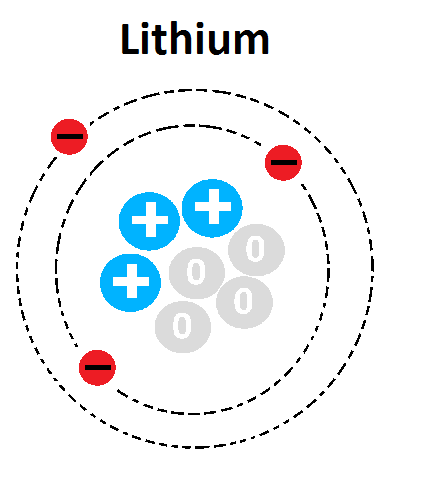
What is the atomic mass of this atom?
a)
1
b)
3
c)
4
d)
7
100 %

