
 Worksheets
Electrostatics Induction, Conduction, Friction
Total questions: 19
Worksheet time: 38mins

Physics students studied various behaviors and features of charged particles and how they interact with other charged materials. The image below shows the results of sending a charged particle through two oppositely charged electric plates. What is the charge on the particle moving between the two electrically charged plates shown based on its movement?
positive
negative
neutral
cannot be determined

Balloon A is negatively charged. Balloons A and B attract each other. Balloon B does not interact with neutral paper bits. Balloon B is...
positive
negative
neutral

When an aluminum tin is brought near a positive charged plate, what will the charge distribution in the pan look like?
positively charged
negatively charged
polarized, neutral
even distribution, neutral

A positive charge is brought near a neutral conducting rod. What will happen to the rod's charge distribution?
electrons will move toward the balloon, negative charge on rod
electrons will move toward the balloon, polarize, neutral rod
protons will move away from the balloon, polarize, neutral rod
electrons will move on the surface away from the balloon, polarize, neutral rod

Two spheres are charged positively and hang from a string. They experience the forces shown. How does this demonstration relate the electric force to the force of gravity?
gravity is stronger, but only electric force can repel
electric force is stronger and only electric force can repel
electric force is stronger, and both electric and gravitational force can repel
gravity is stronger, and both gravitational and electric force can repel

How will charges move in the three rectangles?
electrons will move all the way to the left and stop at the leftmost insulator
electrons will move to the left and stop when they hit the first insulator
electrons will not move
electrons will move toward the right until they hit the conductor

A positively charged balloon is brought near an aluminum can, and a hand touches the can. How will electrons move?
e- will move from the can into the hand away from the balloon
e- will move from the hand into the can towards the balloon
e- will move towards the hand, but stop at the end of the can
e- will move towards the can, but stop at the end of the hand

A negative balloon moves near a conducting neutral sphere, and a hand touches it. Where will e- flow?
e- move into the sphere
e- move into the hand
e- move towards the hand but stay in the sphere
e- move towards the sphere but stay in the hand
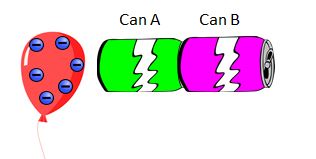
The negative charges in Can B move towards the balloon through can A
The negative charges in Can A move away from the balloon through can B
The positive charges in Can B move away from the balloon
The positive charges in Can A move toward the balloon

A neutral metal pan is brought near a negative charged plate. A hand touches the pan. What is the result?
electrons move into the hand; the pan is negative
protons move into the pan; the pan is positive
electrons move into the pan; the pan is negative
electrons move into the hand; the pan is positive

Which is the electric field of a positive charge?
Left
Right

Which diagram correctly shows the field lines between two like charges?
A
B
Both
Neither


A metal block has a net -10 charge. What will happen when a neutral grounding wire touches the block?
The block will gain protons until it is neutral
Electrons will flow out of the ground wire and into the block until the block is neutral
Electrons will flow out of the block, into the ground wire until the block is neutral
The block will gain electrons and become more negative
As two oppositely charged particles approach each other, what happens to the electrical force between them?
The attractive force increases
The magnitude of the electric force decreases
The repulsive force increases
The magnitude of their charges increases
Which of the following is correct if two objects are rubbed together, and one transfers negative particles to the other?
The two objects will now have the same charge.
The two objects will now have opposite charges.
The two objects will repel each other.
The two objects will both have a neutral charge.

