Wayground logo

Free Printable Worksheets

Font size

S
M
L
XL
Worksheets

historical geology

Total questions: 52

Worksheet time: 2hrs 40mins

Name
Class
Date
1.
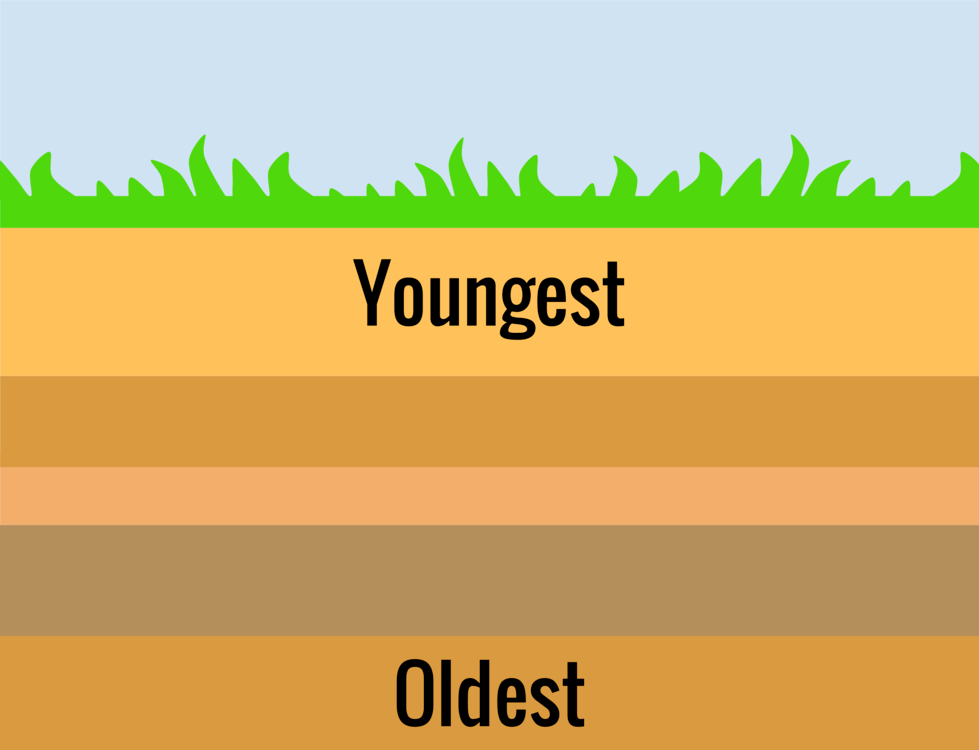
The statement that the oldest layer will be at the bottom in an undisturbed sequence of rock layers is called the Principle of ....
a)
Inclusions
b)
Unconformities
c)
Cross-Cutting Relationships
d)
Superposition
2.
The Principle of Cross-Cutting Relationships states that an igneous intrusion is 
a)
always younger than the layers it cuts across
b)
always older than the layers it cuts across
c)
the same age as the rock it melted
d)
none of the answers are correct
3.
Relative age dating is used to determine the...
a)
actual age of an event
b)
length of time between two events
c)
age of one event in comparison with other events
d)
rate at which a gologic process occurs
4.
Which of the following correctly lists the layers in order from oldest to youngest?
a)
A, B, C, D, E
b)
E, B, C, D, A
c)
E, D, C, B, A
d)
C, B, A, D, E
5.
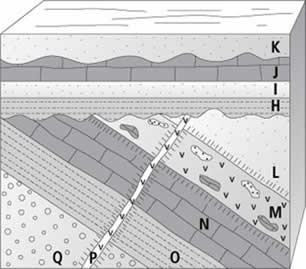
The rock formation labeled "P" is a(n)...
a)
fault
b)
intrusion
c)
inclusion
d)
unconformity
6.
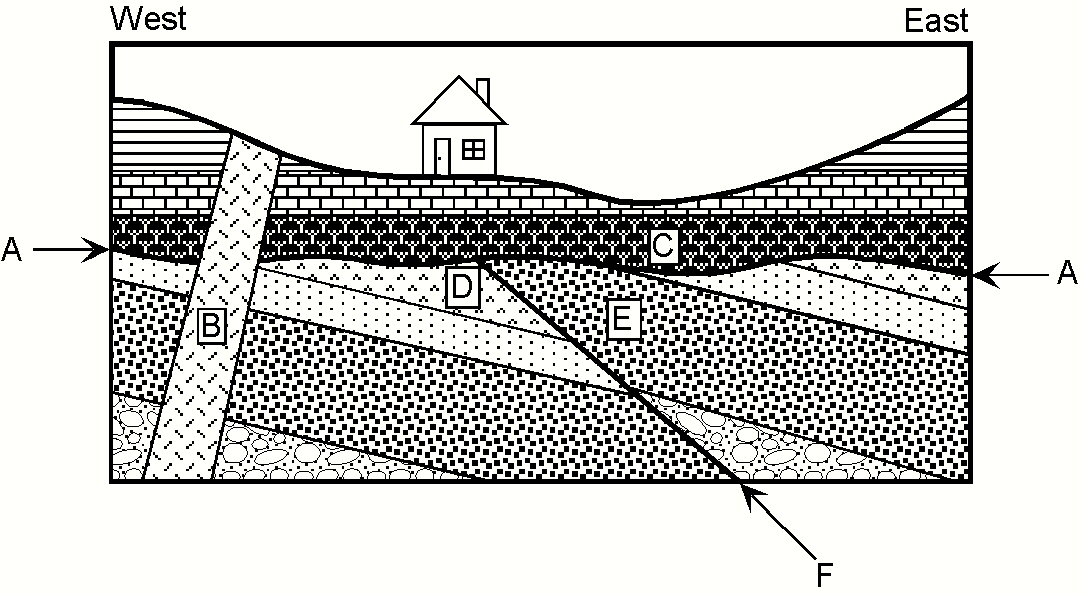
Letter "F" is a....
a)
inclusion
b)
intrusion
c)
fault
d)
unconformity 
7.
Letter "A" is an....
a)
inclusion
b)
intrusion
c)
fault
d)
unconformity 
8.
An archaeologist made the following diagram of a dig site. What can be said about the pottery as compared to the skull found in the site?
a)
The rock layer with the pottery is more recent than the rock layer with the skull.
b)
The rock layer with the skull is more recent than the rock layer with the pottery.
c)
The rock layer with the skull is approximately the same age as the rock layer with the pottery.
d)
The rock layer with the skull has an absolute date of 17,000 years.
9.
The age of a rock compared to the ages of other rocks is the rock's
a)
absolute age
b)
geologic age
c)
sedimentary age
d)
relative age
10.
The number of years that have passed since the rock formed is the rock's
a)
relative age
b)
law of superposition
c)
absolute age
d)
index fossil
11.
The best index fossils have which two traits?
a)
widespread geographically, long lifespan
b)
widespread geographically, short lifespan
c)
specific place, long lifespan
d)
specific place, short lifespan
12.
The ________ states that layers of sediment were originally deposited horizontally under the action of gravity.
a)
law of superposition
b)
law of horizontality 
c)
uniformitarianism 
d)
unconformities
13.
Which of the following is the oldest?
a)
Layer L
b)
Intrusion D
c)
Intrusion H
d)
Layer E
14.
In this rock layer diagram there are two unconformities, a fault at E and an intrusion at D. Which unconformity occurred first?  How do you know?
a)
Intrusion D occurred first because the instrusion has been moved by the fault.
b)
The fault occurred first because it has moved the intrusion D.
c)
Intrusion D occurred first because it can be seen in all of the rock layers.
d)
Fault E occurred first because it is a normal fault.
15.

Which layer is OLDER? Layer M or Intrusion P?

a)

Layer M

b)

Intrusion P

16.

Which layer is OLDER? Layer E or Intrusion A?

a)

Layer E

b)

Intrusion A

17.

What geologic principle(or law) is best displayed here?

a)

Superposition

b)

Original horizontality

c)

Cross-cutting relationships

d)

Unconformities

18.

What geologic principle(or law) is best displayed here?

a)

Superposition

b)

Original horizontality

c)

Cross-cutting relationships

d)

Inclusions

19.
The ___ parts of organisms are more likely to become fossils.
a)
hard
b)
soft
c)
outer
d)
inner
20.
If a sample starts with 400 radioactive isotopes, how many are left after 3 half lives?
a)
200
b)
100
c)
50
d)
25
21.
Suppose you had a sample containing 20 g of a parent isotope. After how many half lives would less than 2 g of the parent isotope remain?
a)
one
b)
two
c)
four
22.
The number of years that have passed since the rock formed is the rock's
a)
relative age
b)
law of superposition
c)
absolute age
d)
index fossil
23.
Which is the most accurate form of absolute dating?
a)
radiometric dating
b)
erosion rate
c)
deposition rate
d)
index fossils
24.
Older rocks contained within newer rocks are called...
a)
intrusions
b)
inclusions
c)
fossils
d)
faults
25.
If a radioactive substance has a half life of 200 years, how much time has passed if ¼ (25%)  of the original isotope is left?  
a)
25 years
b)
600 years
c)
50 years
d)
400 years
26.

What happens to the amount of parent isotope as it undergoes radioactive decay?

a)

The amount of parent isotope increases.

b)

The amount of daughter isotope decreases.

c)

The amount of parent isotope decreases.

d)

The amount of parent isotope doesn’t change.

27.

How much of the parent and daughter isotope remain after one half-life?

a)

25% parent, 75% daughter

b)

25% daughter, 75% parent

c)

50% daughter, 50% parent

d)

12.5% parent, 87.5% daughter

28.

What does it mean if an atom is radioactive?

a)

It's stable.

b)

It's unstable.

c)

It is safe for humans.

d)

It is not dangerous to humans.

29.

What is a half-life?

a)

The time it takes half of the parent isotope to decay.

b)

The time it takes half of the daughter isotope to decay.

c)

The time it takes for half the universe to decay.

d)

The time it takes for half the Earth to decay.

30.

What is one advantage of using Absolute-Age Dating?

a)

It is unaffected by location, climate, or temperature.

b)

It is only affected by location.

c)

It is only affected by climate.

d)

It is only affected by temperature.

31.

Outcrops A,B,C, and D are located within 15 kilometers of each other. When the rock layers at outcrops A, B, C and D are correlated, which outcrop contains the youngest layer?

a)

A

b)

B

c)

C

d)

D

32.
A break in the geologic record that is made when rock layers are eroded over a long period of time
a)
Law of Superposition
b)
Law of Crosscutting
c)
Relative Dating
d)
Unconformity
33.
Traces or remains of organisms that lived long ago
a)
Fossil
b)
Unconformity
c)
Superposition
d)
Column
34.
Analyze the seashell found in the white layer.  Which statement is true of the rock layer that contains this fossil?
a)
It could also contain a fossil from the bottom layer.
b)
It is older than the layers below it.
c)
It is younger than the layers above it.
d)
It is older than the layers above it.
35.
Which animal is the youngest in site 1?
a)
bird
b)
ammonite 
c)
shell
36.
If sedimentary rock layers are tilted, they must have
a)
formed at an angle
b)
moved after they formed
c)
been cross-out by igneous rock
d)
formed from deposits on a mountainside
37.

Geologic processes that occur today are similar to those that occurred in the past.

a)

uniformitarianism

b)

catastrophism

c)

superposition

d)

correlation

38.

Process of matching rocks and fossils from separate locations

a)

correlation

b)

inclusion

c)

relative age

d)

superposition

39.

Which letter matches with the OLDEST layer of rock?

a)

W

b)

X

c)

Y

d)

Z

40.

If the original mass of a radioactive element was 36 grams how much would be left after 1 half life?

a)

36 grams

b)

18 grams

c)

9 grams

d)

4.5 grams

41.

What kind of rock would you typically find fossils in?

a)

igneous

b)

metamorphic

c)

sedimentary

42.
Paleozoic, Mesozoic & Cenozoic are all
a)
Epochs
b)
Eras
c)
Periods
d)
Eons
43.
The Geologic Time Scale is a record of what?
a)
old geologists
b)
sweet geology music
c)
the known history of rocks and fossils
d)
a list of every living thing ever
44.
The Era when humans first appeared was...
a)
Cenozoic
b)
Mesozoic
c)
Paleozoic
d)
Precambrian
45.
"age of reptiles"
a)
Paleozoic Era
b)
Cenozoic Era
c)
Mesozoic Era
d)
Precambrian Era
46.
"age of mammals"
a)
Cenozoic Era
b)
Precambrian Era
c)
Paleozoic Era
d)
Mesozoic Era
47.
"ancient life"
a)
Precambrian Era
b)
Mesozoic Era
c)
Cenozoic Era
d)
Paleozoic Life
48.
A hollow space in rock in the shape of an organism. 
a)
Mold fossil
b)
Cast fossil
c)
Body fossil
d)
Trace fossil
49.
These fossils shows evidence of activity. Scientists use these fossils to study animal behaviors. 
a)
Mold fossil
b)
Trace Fossil
c)
Cast fossil
d)
Body Fossil
50.
This fossil is made when mud or dirt fill in a mold fossil and create a 3-D version of an organism. 
a)
Mold fossil
b)
Cast Fossil
c)
Body Fossil
d)
Trace Fossil
51.
All of the following have preserved the original remains of an organism EXCEPT 
a)
tar 
b)
ice
c)
amber 
d)
water 
52.
Which rock layer most likely contains fossils of the most recently evolved organisms?
a)
1
b)
2
c)
3
d)
4