Wayground logo

Free Printable Worksheets

Font size

S
M
L
XL
Worksheets

4th Grade Science MAP Review

Total questions: 183

Worksheet time: 2hrs 26mins

Name
Class
Date
1.
What is the most abundant gas found in the atmosphere?
a)
Carbon Dioxide
b)
Nitrogen
c)
Oxygen
d)
Water Vapor
2.
The device that measures air pressure is...
a)
Barometer
b)
Thermometer
c)
Anemometer
d)
Zapometer
3.
Humidity is the...
a)
Amount of Water Vapor in the Air
b)
Amount of Wind in the Air
c)
Amount of Precipitation in the Air
d)
Amount of Pressure in the Air
4.
Clouds that are flat and layered are known as...
a)
Stratus Clouds
b)
Cumulus Clouds
c)
Cumulonimbus Clouds
d)
Cirrus Clouds
5.
Which front is represented on a map by a line with triangles attached to it? 
a)
Cold Front
b)
Warm Front
c)
Stationary Front
d)
Occluded Front
6.
A person who studies weather and weather patterns is a(n)
a)
Botanist
b)
Astronomer
c)
Geologist
d)
Meteorologist
7.
A hypothesis is formed...
a)
After You State the Conclusion
b)
Before You State the Problem
c)
Before You Perform the Experiment
d)
After You Record and Analyze Data
8.
The amount of matter an object contains is its...
a)
Density
b)
Volume
c)
Weight
d)
Mass
9.
What unit of measurement would best measure the length of the paperclip?
a)
Meters
b)
Kilometers
c)
Centimeters
d)
Millimeters
10.
This weather instrument measures the speed of wind.
a)
anemometer
b)
barometer
c)
rain gauge
d)
wind vane
11.
What does this weather instrument (shown here) measure?
a)
wind speed
b)
air pressure
c)
amount of fallen rain
d)
temperature
12.
Climate is
a)
the further you get from the equator
b)
the higher you go, the colder it gets
c)
the conditions of the atmosphere at a certain place and time.
d)
the average weather conditions of an area over a long period of time.
13.
This is Earth's blanket and is made up of many layers of gases.
a)
air mass
b)
air pressure
c)
atmosphere
d)
front
14.
Which three gases are present in our atmosphere?
a)
carbon dioxide, ice, water
b)
oxygen, nitrogen, water vapor
c)
nitrogen, soil, transpiration
d)
hydrogen, sweat, stratosphere
15.
These clouds bring or indicate fair weather.
a)
stratus and cirrus clouds
b)
cirrus and cumulonimbus clouds
c)
stratus and cumulonimbus clouds
d)
cirrus and cumulus clouds
16.
This form of precipitation falls from clouds when water droplets are heavy.
a)
hail
b)
rain
c)
sleet
d)
snow
17.
This form of precipitation forms as ice crystals in clouds that are below freezing.
a)
rain
b)
sleet
c)
snow
d)
hail
18.
What is a tornado?
a)
a large body of air with the same temperature and humidity throughout
b)
a rapidly spinning tube of air that extends from cumulonimbus clouds and touches the ground.
c)
a rapidly spinning ballerina that rotates on her tip toes
d)
a large body of air with mainly cold temperature and a lot of humidity that causes heavy rains
19.
Instrument used to determine wind direction
a)
air pump
b)
wind vane
c)
cyclone
d)
air pressure
20.
Measurement of the speed of moving air
a)
leaf blower
b)
fan
c)
wind speed
d)
tornado
21.
Meeting of two different types of air masses
a)
warm and cold
b)
hurricane
c)
precipitation
d)
weather front
22.
Instrument for measuring temperature
a)
temperature vane
b)
hygrometer
c)
thermometer
d)
rain gauge
23.
A long, low, gray cloud that could be layered
a)
stratus
b)
nimbus
c)
cumulus
d)
cirrus
24.
Instrument for measuring the amount of rain that falls
a)
rain gauge
b)
wind vane
c)
hygrometer
d)
thermometer
25.
Rain, snow, sleet, hail, etc
a)
rocks that fall out of the sky
b)
tornado
c)
precipitation
d)
forecast
26.
Instrument used to measure relative humidity
a)
thermometer
b)
wind vane
c)
hygrometer
d)
rain gauge
27.
Big, puffy, white clouds
a)
cirrus
b)
cumulus
c)
storm 
d)
stratus
28.
All the air surrounding the earth
a)
atmosphere
b)
hydrosphere
c)
mesosphere
d)
air
29.
The weight of air in the atmosphere pressing down upon Earth
a)
scale
b)
measurement
c)
air pressure
d)
wind gauge
30.
High, wispy or feathery clouds
a)
cumulus
b)
numbus
c)
cirrus
d)
stratus
31.
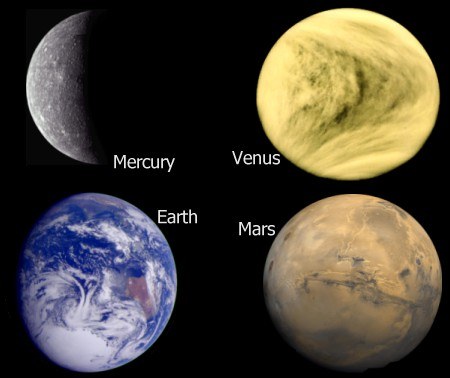
The four terrestrial planets all have
a)
Rocky surfaces
b)
Hot temperatures
c)
Deep atmospheres
d)
Large size
32.
The flash of light produced when a meteoroid passes through Earth's atmosphere is a(n)
a)
Meteorite
b)
Asteroid
c)
Meteor
d)
Comet
33.
The planet Venus is similar to Earth in its 
a)
Rotation
b)
Internal structure
c)
Atmospere
d)
Surface temperature
34.
The _______ is between the orbits of Mars and Jupiter. 
a)
Oort Cloud
b)
Asteroid belt
c)
Kuiper belt
d)
Photosphere
35.
A(n) ________ is a loose collection of ice, dust and small rocky particles that typically has a long, narrow orbit. 
a)
Asteroid
b)
Planet
c)
Meteroid
d)
Comet
36.
The layer of the sun's atmosphere that gives off the visible light we see is the 
a)
Corona
b)
Chromosphere
c)
Photosphere
d)
Convection zone
37.
The moon of Jupiter that astronomers think could support forms of life because there is liquid water under the layers of ice is...
a)
Ganymede
b)
Europa
c)
Io
d)
Titan
38.
The _____ is found right after Neptune's orbit. 
a)
Meteroid belt
b)
Kuiper Belt
c)
Oort Cloud
d)
Asteroid Belt
39.
______ are meteoroids that entered our atmosphere and hit Earth without completely burning up. 
a)
Meteors
b)
Comets
c)
Meteorites
d)
Asteroid
40.
The sun's _____ is the laser of the atmosphere that has a reddish glow. 
a)
photosphere
b)
chromosphere
c)
Corona
d)
Core
41.
The planet ____ rotates on its axis in about the same amount of time as Earth does. 
a)
Mercury
b)
Venus
c)
Mars
d)
Pluto
42.
Mars has two moons that are named...
a)
Io & Titan
b)
Phobus & Io
c)
Demos & Phobus
d)
Demos & Titan
43.
The planet _____ has an atmosphere with high air pressure made mostly of carbon dioxide. 
a)
Venus
b)
Earth
c)
Mercury
d)
Mars
44.
T/F (if false replace the word in blue)
In the sun's radiation zone, hot gases rise and move energy towards the sun's surface
a)
True
b)
chromosphere
c)
photosphere
d)
convection 
45.
What shape of the moon is when you can see more than half on the lit side, but not all of it?
a)
full moon
b)
gibbous
c)
crescent
d)
new moon
46.
Earth and the other planets closest to the Sun are made mostly of _______
a)
gas
b)
metal
c)
water
d)
rock
47.
Earth's ________ on its axis causes day and night.
a)
rotation
b)
revolution
c)
phase
d)
comet
48.
One complete orbit of Earth moving around the sun takes one year. This is called
a)
revolution
b)
rotation
c)
mare
d)
umbra
49.
The path on object takes as it moves around another object is called
a)
revolution
b)
rotation
c)
orbit
d)
mare
50.
Where does the moon get its light?
a)
sun
b)
planets
c)
other stars
d)
itself
51.
In this portion of the lunar phases the moon appears to be shrinking
a)
waning
b)
waxing
c)
umbra
d)
penumbra
52.
In this portion of the lunar phases the moon appears to be growing
a)
waxing
b)
waning
c)
umbra
d)
penumbra
53.
How long does it take for the Earth to revolve around the sun?
a)
24 hours
b)
one month
c)
365 days
d)
two years
54.
How long does it take for the Earth to rotate one complete time?
a)
24 hours
b)
28 days
c)
1 month
d)
365 days
55.
Which phase of the moon shows an entire circle reflected by the sun?
a)
New
b)
Full Moon
c)
Waxing Crescent
d)
Waning Crescent
56.
Almost Earth’s twin in size and mass, this planet has very thick atmosphere.
a)
Venus
b)
Mars
c)
Mercury
d)
Neptune
57.
This is the largest planet in the solar system.
a)
Saturn
b)
Jupiter
c)
Uranus
d)
Venus
58.
This is the smallest planet in the solar system
a)
Mercury
b)
Venus
c)
Earth
d)
Mars
59.
Only planet known to have life
a)
Earth
b)
Mars
c)
Venus
d)
Mercury
60.
The earth orbits around...
a)
the sun.
b)
the moon
c)
other planets
d)
the Milky Way
61.
What are the reasons for the seasons?
a)
Earth's tilt and rotation.
b)
Earth's rotation and revolution.
c)
Earth's tilt and revolution.
d)
Earth's tilt and resolution
62.
The order of the planets is:
a)
Mars,Venus,Earth,
Mercury,Saturn
Jupiter, Uranus, Neptune
b)
Earth,Venus,Mars
Jupiter, Neptune,
Mercury,Saturn,
Uranus
c)
Mercury,Venus,Earth
Mars,Jupiter,
Saturn,Uranus
Neptune
d)
Mars, Venus, Mercury, Jupiter, Earth, Saturn, Neptune, Uranus
63.
What are most outer planets made up of?
a)
Rock
b)
Hydrogen and Water 
c)
Gas (Helium and Hydrogen)
d)
Clouds of Acidic Rain
64.
About how many days does it take to moon to go through a complete cycle?
a)
7 days
b)
365 days
c)
29 days
d)
20 days
65.
The earth's axis is
a)
straight
b)
round
c)
tilted
66.
Which phase of the moon can you see less than half of the lit side, but not all is gone?
a)
crescent
b)
new moon
c)
full moon
d)
gibbous
67.
The part of the earth receiving the sun's most direct rays is having
a)
spring
b)
fall
c)
winter
d)
summer
68.
How old is the sun?
a)
400 million years
b)
460,000 years
c)
4 1/2 billion years
d)
40 billion years
69.
The sun is an averaged sized star?
a)
True
b)
False
70.
What does a waxing moon mean?
a)
when the lit part of the moon increases
b)
when the lit part of the moon decreases
c)
the pathway the earth takes around the sun
d)
all of the planets, moon, and other space objects going around the sun
71.
What is the center of our solar system?
a)
moon
b)
earth
c)
sun
d)
Jupiter
72.
Which one takes 24 hours?
a)
rotation
b)
revolution
73.
What describes the earth going around the sun?
a)
rotation
b)
revolution
74.
What causes day and night?
a)
rotation
b)
revolution
75.
What causes the seasons to change?
a)
rotation
b)
revolution
76.
Which one takes one year?
a)
rotation
b)
revolution
77.
What is energy created by the sun called?
a)
sun energy
b)
hot energy
c)
solar energy
d)
solar heat
78.
What is the sun?
a)
a star
b)
a comet
c)
a planet
d)
an asteroid
79.
How does the moon get its light?
a)
it reflects the sun's light onto the earth
b)
it creates its own light, similar to a star
c)
it gathers light from earth during the day
d)
the moon is actually a yellow color, so it appears to be bright during the nighttime
80.
Energy is
a)
the ability to cool
b)
what is needed to do work or cause change
c)
what stops motion
81.
Energy produced by a machine or moving part
a)
thermal
b)
electrical
c)
mechanical
82.
Energy that causes a transfer of heat between materials
a)
thermal/heat
b)
electrical
c)
mechanical
83.
Radiant energy that our eyes can see
a)
light
b)
thermal
c)
electrical
84.
Energy produced from air vibrations
a)
sound
b)
light
c)
heat
85.
Anytime anything moves, energy is involved.
a)
True
b)
False
86.
A hand crank to sharpen a pencil uses
a)
light energy
b)
thermal energy
c)
mechanical energy
87.
Campfires use which form of energy to cook food?
a)
light
b)
thermal
c)
electrical
88.
A flashlight is an example of
a)
light energy
b)
mechanical energy
c)
sound energy
89.
A girl riding a bike is an example of which form of energy?
a)
thermal 
b)
mechanical
c)
light
90.
Sound energy allows people to
a)
stay warm
b)
communicate
c)
see lights
91.
An iron produces
a)
sound energy
b)
light energy
c)
thermal/heat energy
92.
A lamp is an example of
a)
sound energy
b)
light energy
c)
heat/thermal energy
93.
How does light travel?
a)
in wavy lines
b)
it doesn't travel
c)
in a straight line
d)
in waves
94.
What is wax paper?
a)
transparent
b)
translucent
c)
opaque
d)
none of the above
95.
What is light?
a)
energy
b)
light
c)
sun
d)
star
96.
How does sound travel?
a)
straight lines
b)
it doesn't
c)
waves
d)
I don't care
97.
When light travels to a different medium it will ______
a)
reflect
b)
do nothing
c)
break
d)
refract
98.
Which of the below is true?
a)
light is only from the sun
b)
light and sound are he same things
c)
light goes into our eyes
d)
ligt comes out of our eyes
99.
Sound travels slowest in _______
a)
gas
b)
solids
c)
liquid
d)
sound travels the same speed in all of them
100.
How fast does light travel?
a)
1,000,000,000 mph
b)
over 670,000,000 mph
c)
who cares
d)
100 mph
101.
What does R.O.Y G. B.I.V.
a)
Random Over Your Green Blue Idea Very
b)
Red or your great blue Indigo viking
c)
Ropes Or yellow Gibbons but it vampires
d)
Red Orange Yellow Green Blue Indigo Violet
102.
How does sound travel?
a)
it doesn't 
b)
vibrations
c)
waves
d)
Both B and C
103.

Pitch

a)

To move back and forth or up and down

b)

A metal tool designed to have a specific pitch

c)

The Lowness or highness of a sound

d)

Something that you hear when your brain responds to sound wave

104.

Sound

a)

Something that you hear when your brain responds to sound wave

b)

To move back and forth or up and down

c)

A metal tool designed to have a specific pitch

d)

The Lowness or highness of a sound

105.

Tuning Fork

a)

The Lowness or highness of a sound

b)

To move back and forth or up and down

c)

A metal tool designed to have a specific pitch

d)

Something that you hear when your brain responds to sound wave

106.

Vibrate

a)

The Lowness or highness of a sound

b)

To move back and forth or up and down

c)

•Something that you hear when your brain responds to sound wave

d)

A metal tool designed to have a specific pitch

107.

______________ is the tightness of an object, for example, a tightly stretched rubber band or string.

a)

tension

b)

length

c)

vibration

108.

The closer the source of the sound, the ___________ the volume of the sound will be.

a)

louder

b)

softer

c)

harder

d)

brighter

109.

Volume

a)

The number of sound waves produced by an object in one second

b)

the loudness of a sound

c)

A unit of measure used to describe how loud a sound is

110.

Decibel:

a)

A unit of measure used to describe how loud a sound is

b)

The number of sound waves produced by an object in one second

c)

loudness of a sound

111.

Frequency:

a)

loudness of a sound

b)

A unit of measure used to describe how loud a sound is

c)

The number of sound waves produced by an object in one second

112.

Dark colors reflect light better than bright colors.

a)

True

b)

False

113.

Light bends when it hits water or glass.

a)

True

b)

False

114.

Which is NOT a property of light?

a)

Light can be absorbed.

b)

Light can be reflected.

c)

Light travels in curved lines.

d)

Light can be refracted.

115.

Which is NOT a property of sound?

a)

Sound travels in straight paths.

b)

Sound can be absorbed.

c)

Sound can be refracted.

d)

Sound can be modified.

116.

Which an example of artificial light?

a)

sun

b)

lantern fish

c)

stars

d)

light bulb

117.

Which is an example of natural light?

a)

LED bulb

b)

glow stick

c)

computer screen

d)

stars

118.

Pitch is ___________________________.

a)

how loud a sound is

b)

how high or low a sound is

c)

how a sound travels

d)

how a sound is absorbed

119.

Volume is ____________________.

a)

how loud a sound is

b)

how high or low a sound is

c)

how a sound travels

d)

how a sound bends

120.
a deep sleep that uses very little energy
a)
hibernate
b)
camouflage
121.
The walkingstick uses..
a)
Blending
b)
Color changing
c)
Mimicry
d)
Patterns
122.
Looking like something else is....
a)
Patterns
b)
Mimicry
c)
Color changing
d)
costume
123.
Which feature of a rose helps it grow without being eaten by large animals?
a)
flowers with bright colors
b)
sharp thorns
c)
small seeds
d)
deep roots
124.
This animal is using
a)
hibernation
b)
camouflage
c)
mimicry
125.
Camouflage is used to attract predators.  
a)
True
b)
False
126.
When a living thing copies the appearance of another living thing as a means of protection 
a)
mimicry
b)
a behavioral adaptation
c)
mockery
d)
natural selection
127.
The colors & patterns on a turtles shell help it blend in with the forest floor.  This is:
a)
hibernation.
b)
behavior.
c)
migration.
d)
camouflage.
128.
A cactus can live in the desert because of this adaptation
a)
has wide flat leaves to catch water
b)
has shallow roots
c)
thick, waxy leaves help it store water
129.
a physical feature or behavior that helps an organism survive
a)
adaptation
b)
migrate
130.
Which would help an animal that lives in a forest?
a)
bright colors
b)
mixed colors
131.
A group of organisms that produces organisms of the same kind is a
a)
species
b)
extinct
132.
What helps a giraffe find food?
a)
long neck
b)
talons
c)
sharp teeth
d)
claws
133.
a place where an animal lives
a)
adaptation
b)
habitat
134.
What is a niche?
a)
a physical feature that helps an animal survive
b)
the role a plant or animal plays in its habitat
135.
Why do some animals become extinct?
a)
People hunt them until they are gone
b)
they eat too much food
136.
A rainforest has many types of plants, animals, and other organisms.  Which is true about this biome?
a)
It is rich in biodiversity.
b)
It is limited in biodiversity.
c)
It is barren.
d)
There are few relationships between organisms here.
137.
A biome is a specific type of which of the following?
a)
Community
b)
Biosphere
c)
Ecosystem
d)
Population
138.
Which is an example of a terrestrial biome?
a)
Forest
b)
Pond
c)
Estuary
d)
Ocean
139.
Which is an example of an aquatic biome?
a)
deciduous forest
b)
lake
c)
rainforest
d)
desert
140.
Which plants may thrive in grasslands?
a)
Tall grasses
b)
Short grasses
c)
Scattered trees
d)
All of these
141.
Which animals may thrive in grasslands?
a)
Bison, zebra, and prairie dogs
b)
Foxes, voles, and cardinals
c)
Polar bears and black bears
d)
Frogs and salamanders
142.
Which best describes a rainforest?
a)
A dry biome.
b)
An aquatic biome.
c)
A biome with rich biodiversity.
d)
A biome with few animals.
143.
Which best describes a difference between a terrestrial and an aquatic ecosystem?
a)
Terrestrial is water-based
b)
Aquatic is land-based
c)
Terrestrial is land-based
d)
None of these
144.
Soil, water, air and nutrients are needed by all _______.
a)
Plants
b)
Fish
c)
Birds
d)
Insects
145.
Which adaptation helps the duck move in water?
a)
Eyes
b)
Bill
c)
Feathers
d)
Feet
146.
A tiger's fur is striped to ________.
a)
Keep them warm
b)
Help him hide in tall grass
c)
Help them run faster
d)
Keep insects off 
147.
Which adaptation is most helpful for an animal that catches other animals for food?
a)
Thick layer of fur and fat
b)
Sharp teeth and claws
c)
Long busy tail
d)
Tiny eyes and ears
148.
Which of the following would promote the growth of new plants?
a)
Snow falling
b)
Long periods of darkness
c)
Rain and warm temperatures
d)
Flooding
149.
The energy that flows through a food chain begins with ______.
a)
The sun
b)
Wind
c)
Rainfall
d)
The Moon
150.
In the food chain, the fox gets its energy when it eats the ______.
a)
Sun
b)
Grass
c)
Mouse
d)
Snake
151.
What would happen to the animals in this environment if the field mice decreased?
a)
Few plant seeds
b)
Fewer snakes
c)
More eagles
d)
More snakes
152.
A caterpillar represents which stage in the monarch’s life cycle?
a)
Egg
b)
Larva
c)
Pupa
d)
Adult
153.
The life cycle begins when the beetle produces ______.
a)
Eggs
b)
A larva
c)
A pupa
d)
An adult
154.

How does the bee-like appearance of its flower help the bee orchid?

a)

It doesn't help the bee orchid.

b)

It attracts pollinators.

c)

It scares predators away.

d)

It helps it grow.

155.

Is a spider spinning a web a learned behavior or an instinct?

a)

Learned Behavior

b)

Instinct

156.

Is a child speaking English a learned behavior or an instinct?

a)

Learned behavior

b)

Instinct

157.

Is a sea lion balancing a ball on its nose a learned behavior or an instinct?

a)

Learned Behavior

b)

Instinct

158.

Is a dog staying away from a skunk a learned behavior or an instinct?

a)

Learned behavior

b)

Instinct

159.

The function of the sepals of a flower is to ______.

a)

hold the plant up

b)

protect the petals

c)

protect the flower buds

d)

attract pollinators

160.

A waste product of photosynthesis is ____.

a)

Carbon dioxide

b)

Sugar

c)

Oxygen

d)

Green leaves

161.

A characteristic that scientists use to classify plants is _____.

a)

how they reproduce

b)

its chloroplasts

c)

its photosynthesis process

d)

how much chlorophyll it has

162.

A flamingo's feathers turn pink from its diet. Does this characteristic show a change due to a stimulus in the environment?

a)

Yes

b)

No

163.

Where and why do geese migrate?

a)

They migrate from warm places like Mexico to places like England.

b)

They migrate from cold places like Canada to warm places like Mexico.

c)

They have an instinct to migrate.

d)

They learned to migrate from their parents.

164.
Behavioral adaptations are:
a)
Body parts that help a living thing survive in its environment
b)
Behaviors that help a living thing survive in its environment
165.
Physical adaptations are:
a)
Body parts that help a living thing survive in its environment
b)
Behaviors that help a living thing survive in its environment
166.
Cactus have a thick waxy coating on their stem that keeps them from drying out- is this a behavioral adaptation or physical adaptation?
a)
Behavioral adaptation
b)
Physical adaptation 
167.
Venus flytraps have two leaves to trap bugs - is this a behavioral adaptation or a physical adaptation?
a)
Behavioral adaptation
b)
Physical adaptation
168.
Penguins huddle together to stay warm - is this a behavioral adaptation or a physical adaptation?
a)
Behavioral adaptation
b)
Physical adaptation
169.

What organelle controls the cell?

a)

Ribosome

b)

Nucleus

c)

Cell membrane

d)

Vacuole

170.

What is the job of mitochondria in a cell?

a)

make ribosomes

b)

control the cell

c)

produce energy

d)

make protien

171.

What is the job of chloroplasts in the cell?

a)

produce protien

b)

catch sunlight and turn it into food

c)

nothing

d)

clean up

172.

What is the job of Endoplasmic Reticulum in the cell?

a)

Make energy

b)

make protien

c)

Surround and protect the cell

d)

a passageway for protein to travel

173.

This type of cell has a cell wall and chloroplasts.

a)

Plant cell

b)

Animal cell

c)

Bacteria cell

174.

The powerhouse of the cell is the...It converts energy from food into energy the cell can use

a)

Mitochondria

b)

Cytoplasm

c)

Nucleus

d)

Ribosome

175.

Where are proteins made? These are small, grain-like or rod shaped organelles.

a)

Vacuole

b)

Mitoichondria

c)

Chloroplast

d)

Ribosome

176.
This organelle is in both plants and animals. It is a barrier between the cell and the environment.  It controls what goes in and out of a cell.
a)
cell wall
b)
cell membrane
c)
cell organelles
d)
mitochondria
177.
This cell part is in ALL cells. It is the gel-like substance that provides cell shape.
a)
Chloroplasts
b)
Chromosomes
c)
Cytoplasm
d)
Mitochondria
178.

Plants create their own food using the chemical called ________________.

a)

Cytoplasm

b)

Chlorophyll

c)

Chloroplast

d)

Cell membrane

179.
This structure is only in plant cells. It is outside of the cell membrane and adds more support/structure to the plant.
a)
Cell membrane
b)
Cell Nucleus
c)
Cell Wall
d)
Endoplasmic Reticulum
180.
This structure controls what can enter and leave a cell.
a)
Nucleus
b)
Cytoplasm
c)
Cell Membrane
d)
Golgi Body
181.

This structure is a storage area for the cell. Plants usually have one large one.

a)

Chloroplast

b)

Vacuole

c)

Ribosome

d)

Cytoplasm

182.
What shape are most plant cells?
a)
round / irregular
b)
rectangular
183.
What shape are most animal cells?
a)
round / irregular
b)
rectangular