
 Worksheets
Circular Motion, Torque and Momentum Review
Total questions: 27
Worksheet time: 44mins
Name
Class
Date
1.
The velocity is always _____ to the line of a circle.
a)
outwards
b)
towards the center
c)
tangent
d)
faster
2.
Centripetal acceleration always points
a)
in the direction of the object's motion
b)
in the opposite direction of the object's motion
c)
towards the center of the circle
d)
towards the outside of the circle
3.
The units of tangential (linear) velocity are
a)
m s-1
b)
rad s-1
4.
Centripetal acceleration acts towards the ___________ of the circular motion
a)
centre
b)
circumference
5.

Which represents the acceleration of the ball?
a)
A
b)
B
c)
C
d)
D
6.
Calculate the velocity of an object moved around a circle with a radius of 1.65 m and an acceleration of 3.5 m/s2.
a)
2.4 m/s
b)
3.6 m/s
c)
3.9 m/s
d)
4.2 m/s
7.
Calculate the centripetal force required to make a 5 kg ball move 4 m/s in a circle with a radius of 2 m.
a)
10 N
b)
20 N
c)
30 N
d)
40 N
8.
You are moving a ball in a circle using 72 N of centripetal force. What would the force be if you doubled the radius of the circle.
a)
18 N
b)
36 N
c)
72 N
d)
144 N
9.
What is the force that causes centripetal acceleration when a car goes around a curve?
a)
Friction
b)
Gravity
c)
Normal
d)
Tension
10.
A test car moves at a constant speed around a circular track. If the car is 48.2 m from the track's center and has a centripetal acceleration of 8.05 m/s2, what is the car's tangential speed?
a)
19.7 m/s
b)
5.99 m/s
c)
0.17 m/s
d)
388.01 m/s
11.
At the top of a rollercoaster loop, In what directions do gravity and the normal force point. A free body diagram is useful to help answer the question
a)
gravity: down, normal force: up
b)
gravity: down, normal force: down
c)
gravity: down: normal force: direction of motion
12.
A 800N man is playing on a seesaw with son who has a weight of 200N. If the child is sitting 3 meters away, how far will the man have to sit to balance the seesaw?
a)
0.75m
b)
3m
c)
1.5m
d)
1m
13.
What is the Unit for Torque
a)
Nm
b)
N
c)
W
d)
J
14.

Does a bridge anchored resting on two pillars have any torque?
a)
No, it isn't moving
b)
Yes, but it is at equilibrium
c)
Yes, but it will soon break because of the torque
d)
No, Bridges can't have torque
15.
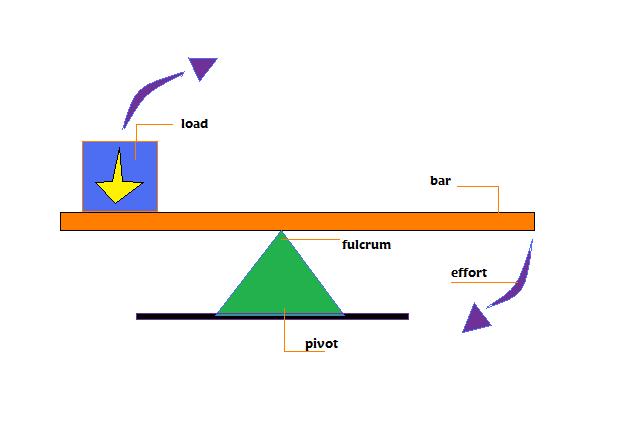
What force does not cause any torque?
a)
Force perpendicular to the fulcrum.
b)
Force horizontal to the planck.
c)
Force slightly off center of the fulcrum
d)
Forces at a 45 degree angle to the fulcrum, and not on the fulcrum
16.
When an object is experiencing a net torque
a)
it is in dynamic equilibrium.
b)
it is in static equilibrium.
c)
it is rotating.
d)
it is translating.
17.

If the torque required to loosen a nut on the wheel of a car has a magnitude of 60.0 N• m, what minimum perpendicular force must be exerted by a mechanic at the end of a 45.0 cm wrench to loosen the nut?
a)
.666 Nm
b)
133.3 N
c)
66.7 N
d)
13.3 Nm
18.

What force is equal to the normal force from the wall acting on the ladder?
a)
Friction from the floor
b)
Normal force from the floor
c)
Friction from the wall
d)
Weight of the ladder
19.

Which would have a greater linear velocity?
a)
Kid near the center of the merry go round
b)
Kid near the outside of the merry go round
c)
neither
20.

What happens to her rotational inertia when a figure skater brings in her arms?
a)
Increase her rotational inertia
b)
Decrease her rotational inertia
c)
has no affect
21.

Why are you more stable when riding a bicycle at a faster speed?
a)
You have more mass
b)
The wheels have angular momentum
c)
It's not easier to ride at a faster speed
d)
The bike has more momentum
22.
A disc rotates through 20 rotations in 5 seconds. If the disc starts from rest, what is the angular velocity?
a)
5 rotations/s
b)
100 rotations/s
c)
4 rotations/s
d)
10 rotations/s
23.
The drive chain in a bicycle is applying a torque of 0.850 N ∙ m to the wheel of the bicycle. You can treat the wheel as a thin uniform hoop (or ring) with a mass of 0.750 kg and a radius of 33.0 cm. What is the angular acceleration of the wheel?
a)
10.4 rad/s2
b)
3.43 rad/s2
c)
5.20 rad/s2
d)
1.06 rad/s2
24.

Which of these gives rotational kinetic energy?
a)
a
b)
b
25.

What does this formula measure?
a)
moment of inertia
b)
impulse
c)
electric current
d)
angular momentum
26.
What does the rotational inertia describe?
a)
The average position of mass in an extended object.
b)
How the mass of an object is distributed
c)
How a force can rotate an object.
d)
The tendency of an object to move in a straight line.
27.

The linear speed of an object directed along the tangent to the object’s circular path.
a)
centrifugal speed
b)
tangential speed
c)
linear speed
d)
angular speed
100 %

