
 Worksheets
Atomic and Nuclear Physics
Total questions: 42
Worksheet time: 31mins
Name
Class
Date
1.
The four fundamental forces of nature are:
a)
Electromagnetism, Gravity, Strong Nuclear, Weak Nuclear
b)
Gravity, Strong Nuclear, Weak Nuclear, Medium Nuclear
c)
Normal Force, Force due to gravity, Magnetism, Nuclear
d)
Nuclear, Electricity, Gravity, Atomic
2.
Rank the four fundamental forces of nature in order from weakest to strongest:
a)
Electromagnetism, Gravity, Strong Nuclear, Weak Nuclear
b)
Weak Nuclear, Gravity, Electromagnetism, Strong Nuclear
c)
Gravity, Weak Nuclear, Electromagnetism, Strong Nuclear
d)
Weak Nuclear, Electromagnetism, Gravity, Strong Nuclear
3.
Gravity is due to:
a)
the pull between Earth and the moon.
b)
the pull between the Sun and Earth.
c)
the pull between any objects with mass.
d)
the pull between atomic nuclei.
4.
________ can be either a force of attraction or repulsion while ____________ is only a force of attraction.
a)
Gravity; Electromagnetism
b)
Electromagnetism; Gravity
c)
Gravity; Strong nuclear force
d)
Magnetism; Electricity
5.
____________ and ____________ are short range forces.
a)
Gravity, Electromagnetism
b)
Strong Nuclear, Weak Nuclear
c)
Electromagnetism, Strong Nuclear
d)
Gravity, Weak Nuclear
6.
Gravity has a range that is ____________.
a)
Short
b)
Long
c)
Infinite
d)
Variable
7.

An apple falling from a tree is an example of the force of ____________.
a)
Gravity
b)
Electromagnetism
c)
Strong Nuclear
d)
Weak Nuclear
8.
_____________ is the force that binds protons together in the nucleus of an atom.
a)
Gravity
b)
Electromagnetism
c)
Strong Nuclear
d)
Weak Nuclear
9.

When mass increases then gravity
a)
Decreases
b)
Increases
c)
Stays the same
10.
The weakest of the four fundamental forces is:
a)
Gravity
b)
Electromagnetism
c)
Strong Nuclear
d)
Weak Nuclear
11.
The strongest of the four fundamental forces is:
a)
Gravity
b)
Electromagnetism
c)
Strong Nuclear
d)
Weak Nuclear
12.

This is an example of a
a)
Force diagram
b)
Interaction table
c)
Free-Body Diagram
13.
A force that acts where two objects touch
a)
Contact Force
b)
Non-contact Force
c)
Balanced Force
d)
Unbalanced Force
14.
The splitting of a nucleus into smaller nuclei is
a)
fusion
b)
fission
c)
half-life
d)
gamma radiation
15.
The product of nuclear fission includes
a)
neutrons and electrons
b)
several nuclei and neutrons
c)
several nuclei and electrons
d)
several nuclei and protons
16.
Two nuclei with low masses are combined to form one nucleus of larger mass is called what?
a)
Nuclear fission
b)
Nuclear fussion
c)
Nuclear half-life
d)
Half-life
17.
Which of the following is true about nuclear fusion?
a)
It is easy to implement.
b)
It produces less energy than nuclear fission.
c)
It produces more energy than nuclear fission.
d)
It has the ability to occur easily in everyday life.
18.
How do nuclear power-plants work?
a)
Fusion
b)
Half-life
c)
Fission
d)
Fusion or fission
19.
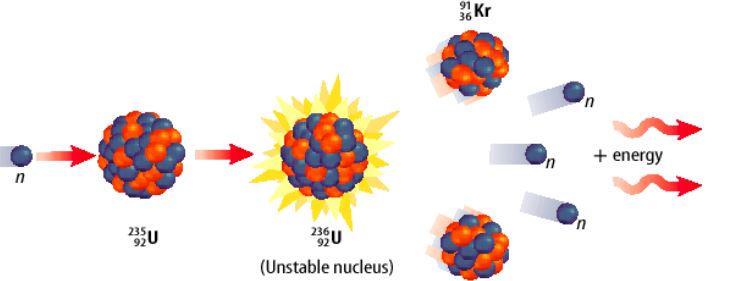
This is an example of...
a)
Fission reaction
b)
Fusion reaction
c)
Decomposition reaction
d)
Decay
20.
Where does fusion occur naturally?
a)
Underwater
b)
All around us
c)
In the radioactive waste
d)
On the sun
21.
Which atoms combine together during fusion reaction on the sun?
a)
Helium and Hydrogen atoms
b)
Hydrogen atoms
c)
Hydrogen and Lithium atoms
d)
Hydrogen and Carbon atoms
22.
Very high temperature and pressure is required for:
a)
Fission
b)
Fusion
c)
Radioactive Decay
23.
U-235 is the primary fuel
a)
Fission
b)
Fusion
c)
Radioactive Decay
24.
What is the major drawback to fission power?
a)
Radioactive Waste
b)
CO2 Emissions
c)
SO2 Emissions
d)
All of the Above
25.
___________ starts the fission of a uranium atom.
a)
Energy
b)
Protons
c)
One Neutron
d)
All of the above
26.
Alpha particles.....
a)
a) are positively charged.
b)
b) consist of two protons and four neutrons.
c)
c) can penetrate any thickness of matter
d)
d) All of the above
27.
The process of nuclear change in an atom of radioactive material is called...
a)
nuclear decay
b)
nuclear mass
c)
isotopes
d)
radon
28.
During beta decay, a nucleus ....
a)
gives up two protons and two neutrons.
b)
maintains the same number of protons and neutrons.
c)
loses a proton and gains a neutron.
d)
gains a proton and loses a neutron.
29.
When a nucleus undergoes nuclear decay by gamma rays, the atomic number of the element....
a)
remains the same
b)
decreases by one.
c)
increases by one.
d)
increases by two.
30.
The process of the production of lighter nuclei from heavier nuclei is called
a)
mass energy
b)
magneticism
c)
fusion
d)
fission
31.
Radioactive materials have unstable...
a)
electrons
b)
protons
c)
nuclei
d)
neutrons
32.
The type of radioactive particle that can be stopped by a sheet of paper is the ____.
a)
alpha particle
b)
beta particle
c)
gamma ray
d)
uranium
33.
The most penetrating type of radiation is the ____.
a)
alpha particle
b)
gamma ray
c)
beta particle
d)
uranium
34.
A helium nucleus with two protons and two neutrons is called a(n) ____.
a)
alpha particle
b)
electroscope
c)
beta particle
d)
gamma ray
35.
Negatively charged particles emitted from a nucleus at a high speed are ____.
a)
alpha particle
b)
gamma rays
c)
beta particles
d)
X rays
36.
The three types of nuclear radiation in increasing order of penetrating power are ____.
a)
alpha, beta, gamma
b)
X ray, beta, gamma
c)
alpha, gamma, beta
d)
X ray, gamma, beta
37.
The process by which nuclei having low masses are united to form nuclei with larger masses is ____.
a)
a chain reaction
b)
fission
c)
a chemical reaction
d)
fusion
38.
What is Half-life?
a)
The amount of time it takes for some of the nuclei in a sample of the isotope to decay
b)
The amount of time it takes for half the electrons in a sample of the isotope to decay
c)
The amount of time it takes for half the nuclei in a sample of the isotope to decay
d)
the amount of time it takes to double the nuclei in a sample of the isotope to decay
39.
After the third half-life, how much of the sample is left?
a)
1/2
b)
1/3
c)
1/16
d)
1/8
40.
When an element loses protons, its __________changes.
a)
protonic number
b)
electronic number
c)
neutronic number
d)
atomic number
41.
When nuclei decay, massive amounts of __________ is released.
a)
energy
b)
jello
c)
protons
d)
neutrons
42.
What makes an element radioactive?
a)
When it's nuclei expands
b)
When it's electrons explode
c)
When it's nuclei behave
d)
When it's nuclei decay
100 %

