
 Worksheets
3.5 IB Biotech Roundup
Total questions: 25
Worksheet time: 2hrs 43mins

What is the purpose of PCR?
To produce millions of copies of the DNA genome
To produce millions of copies of a specific region of DNA
To add nucleotides to a DNA sequence
To watch polymerase work.

What is the function of a primer?
To identify the particular region of DNA to be copied by PCR.
To copy DNA.
To create DNA nucleotides.
To maintain the temperature of the PCR reaction.

From where does Taq polymerase come?
Bacteria that live in hydrothermal vents/hot springs.
Pig cells
The rain forest
The CDC

What are the uses of PCR?
Cloning
Paternity Testing
Genotyping
DNA Profiling

A special protein that targets a specific base sequence and cuts DNA into smaller fragments.
PCR
DNA Polymerase
Helicase
Restriction Enzyme

What is the term given to symmetrical ends of DNA after being cut by a restriction enzyme?
Blunt Ends
Sticky Ends
Ligated Ends
Restrictive Ends
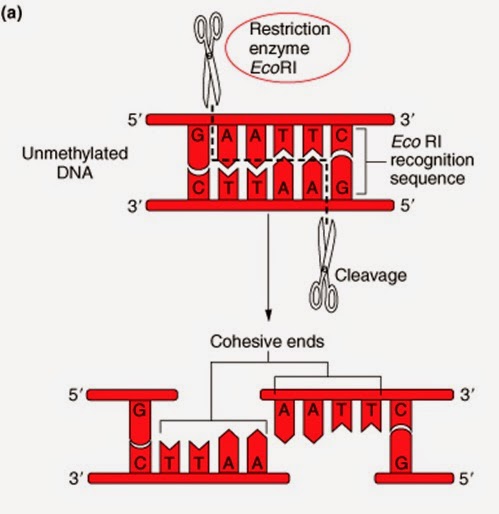
The recognition sites for restriction enzymes are usually...
alliterations
pallindromes
acronyms
analogies

Restriction Enzymes were primarily used as....
defense by protozoa against antibiotics
tools by viruses to cleave bacterial genome
defense by bacteria against bacteriophages viruses
tools to cleave DNA during replication

Which restriction enzymes from above make blunt cuts? (2)
Alul
HaeIII
BamHI
HindIII
EcoRI

Another name for a restriction enzyme is...
an endonuclease
an extremophile
Taq polymerase
a pallindromic ligase

What is a plasmid?
Chloroplast DNA
Mitochondrial DNA
A bacterial chromosome
Small circle of DNA that can transfer genes to or from a prokaryote

Why do the fragments of DNA in gel electrophoresis travel away from the negative electrode?
DNA is negatively charged so attracted to the positive end of the unit
DNA is positively charged so is attracted to the negative end of the unit
the agarose gel is negatively charged
the agarose gel is positively charged

In gel electrophoresis, the largest DNA fragment will appear....
closest to the starting wells
farthest from the starting wells
three quarters away from the starting wells
it depends on how many fragments there are

Gel electrophoresis enables scientists to.....
separate DNA fragments.
combine DNA fragments.
count the genes in DNA
insert DNA in cells

How many restriction sites are there on this plasmid for the endonucluease BamHI?
1
2
3
4

Which is happening during stage 'A'?
The DNA sample is being amplified using a polymerase chain reaction
The DNA sample is being cut into fragments using a restriction enzyme
The DNA sample is being amplified using restriction enzymes
The DNA sample is being cut into fragments using a polymerase chain reaction

When Dolly the Sheep was cloned, what type of cell was taken from the adult sheep that she was cloned from?
Gamete
Egg
Somatic
Sperm

Which of the following is not true about clones and cloning?
Clones are two organisms with identical DNA.
Clones can happen naturally
Clones can be made in labs
Only maternal twins are clones
Clones do not live as long as non-clones

What happens during somatic cell nuclear transfer (SCNT)?
An organism is naturally cloned
The DNA in a somatic cell is placed into an egg cell
The DNA of an egg cell is placed into a somatic cell
An organisms does sexual reproduction

Fact or myth: Cloning can happen in nature.
Fact
Myth

What is natural cloning?
When scientists insert the the DNA of a somatic cell into a nucleus free egg cell
A natural form of reproduction that has allowed life forms such as bacteria to survive
When a mother is carrying paternal twins during pregnancy
Cultivating a population of cells from a single cell.

All offspring of asexual reproduction are identical
True
False

Bacteria reproduce asexually by a process called
replication
meiosis
mitosis
binary fission

Which is not a GMO?
A genetically modified organism
An organism with altered DNA
An organism developed by scientists to have desired traits
An organism that has identical DNA to it's parent

What is a major difference between a somatic cell and an egg cell?
Somatic cells are halpoid (23 chromosomes), egg cells are diploid (46 chromosomes)
Egg cells are halpoid (23 chromosomes), somatic cells are diploid (46 chromosomes)
Somatic cells can divide, egg cells cannot
Egg cells have DNA in their nucleus, somatic cells do not

