
 Worksheets
Tessellations
Total questions: 27
Worksheet time: 14mins

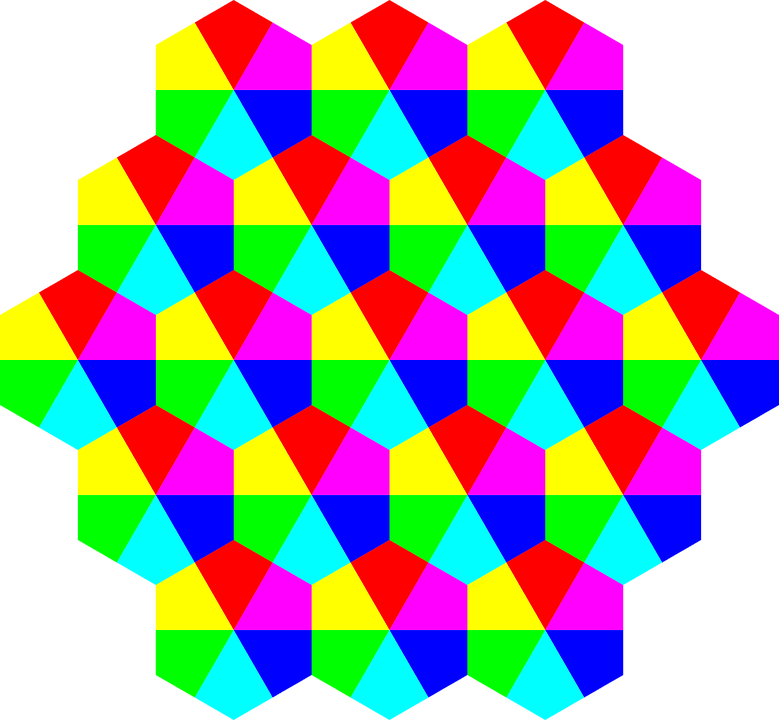
Which of these images represents a tessellation?


The three polygons that can make a regular tessellation are the triangle, the square and the ___________.
pentagon
hexagon
octagon
decagon
It is a fact that any triangle and any quadrilateral can cover the plane.
True
False

What shape makes up the tessellation in the image?
Triangles
Squares
Hexagons
Pentagons
In a tessellation, the measures of the angles that meet at each vertex must add up to 360°.
True
False

Is this a semi-regular tessellation?
Yes, it is.
No, it is not.

What shapes make up the tessellation in the image?
Triangles and Squares
Triangles and Rectangles
Triangles and Triangles
Triangles and Hexagons
What type of tessellation is this?
Regular
Semi-regular
Irregular
Mutations

What animal makes up the tessellation in the image?
Birds
Swans
Flamingos
Dogs
To decide if given figures will tessellate, we first look at the shapes' _____________________.
number of sides
interior angles
number of vertices
size

What character is in this tessellation?
Daffy Duck
Daisy Duck
Donald Duck
Bugs Duck
This figure can always be used to tessellate, because its sum of internal angles is 360°.
Triangle
Quadrilateral
Pentagon
Hexagon


135+135+90=360

135+135+60=360
135+60+60=360

Non-polygonal figures can also make tessellations.
Yes, they can.
No, they can't.

Can this be considered a tessellation where figures were reflected?
Yes, of course!
Definitively not.

Tessellations can be done with a combination of concave and convex irregular polygons.
True
False

M.C. Escher was an artist that used rotation, reflection and translation to make art. Are these pieces considered tessellations?
Yes, they fill the gaps with no overlaps.
No, they have gaps and overlaps.

This is an example of a tessellation made of mutated figures done by using ______________.
Repeated
Reflection
Translation
Rotation

This is an example of a tessellation made with repeated, ___________ figures.
Translated
Rotated
Reflected
Refracted

This is an example of a tessellation made with figures that were ______________.
Reflected
Refracted
Translated
Rotated

Can you find tessellations in nature?
Yes, I can find them in nature.
No, I can not find them in nature.

