wayground logo

Free Printable Worksheets

NEW

Font size

S
M
L
XL
Worksheets

Virus

Total questions: 16

Worksheet time: 18mins

Name
Class
Date
1.
Needs host cell to reproduce.
a)
Virus
b)
Bacteria
c)
Fungus
d)
Protozoan
2.

What happens in the lytic cycle?

a)

Virus enters and leaves the host cell

b)

Virus quickly kills the host cell

c)

Virus remains inactive inside the host cell

d)

Virus stays dormant for a long time

3.

What happens in the lysogenic cycle?

a)

Virus goes in and leaves the host cell

b)

Virus quickly kills the host cell

c)

Virus injects the nucleic acid into the host cell, and the nucleic acid integrates into the host cell DNA, and stays dormant for a long time

d)

Bacteria injects DNA into a host cell

4.
The lytic cycle takes the longest out of the two viral reproductive cycles. 
a)
True
b)
False
5.

What do the lytic and lysogenic cycles have in common?

a)

The host cell dies

b)

The virus dies

c)

The virus inserts its genetic information into the host cell

d)

Copies of the virus are immediately released from the host

6.
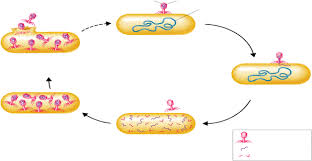
What process is this?
a)
phagocytosis
b)
lytic cycle
c)
lysogenic cycle
d)
formation of antibodies
7.
What is shown here?
a)
Lysogenic Cycle
b)
Lytic Cycle
c)
Binary Fission
d)
Conjugation
8.

This infectious viral disease has many symptoms, from chills, fever, and aching muscles to coughing and sneezing to nausea and vomiting. The symptoms show up within 2-7 days after the cell is infected. This is an example of?

a)

Lytic Cycle

b)

Lysogenic Cycle

c)

Meiosis

9.
Symptoms of HIV do not show up immediately because the virus can 
a)
stay dormant for years
b)
mutate quickly 
c)
stay outside the cell for a long time
10.

What is the difference between the lytic and lysogenic virus reproductive cycles?

a)

Lysogenic is longer

b)

They are the same

c)

Lytic is longer

d)

Both are different each time

11.
What is the 1st step of virus infection?
a)
Entry
b)
Attachment
c)
Replication
d)
Assembly
12.
The lysing of a cell occurs in which phase?
a)
1
b)
2
c)
4
d)
5
13.

Do antibiotics kill viruses?

a)

True

b)

False

14.
Which of the following systems protects the body from disease?
a)
Digestive System
b)
Nervous System
c)
Immune System
d)
Skeletal System
15.
In what way are a virus and a bacteria similar?
a)
They contain antibodies
b)
They reproduce by mitosis
c)
They have identical genomes
d)
They lack membrane-bound organelles
16.
What is a way to become immune to a disease without first having the disease?
a)
antibiotics
b)
Anti-retroviral drugs
c)
Vaccinations
d)
Exposure Therapies