
 Worksheets
Science Boot Camp - Ice WED
Total questions: 15
Worksheet time: 14mins
Name
Class
Date
1.

These rocks were broken apart from the continuous freeze/thaw of water in the cracks of the rocks. This is an example of:
a)
ice wedging
b)
acid rain
c)
gravity
d)
abrasion
2.
Select the answer that shows the order of events a rock goes through.
a)
erosion, weathering, deposition
b)
weathering, erosion, deposition
c)
deposition, weathering erosion
d)
erosion, deposition, weathering
3.
What letter of the alphabet does a glacial valley most closely resemble?
a)
U
b)
V
c)
W
d)
X
4.
2. Where do glaciers form?
a. Near the South Pole
b. Near the North Pole
c. High in the mountains
d. All of the above
e. None of the Above
a)
a
b)
b
c)
c
d)
d
e)
e
5.

Why are glaciers important?
a)
They protect certain species
b)
melting glaciers would increase sea level
c)
melting glaciers would throw off the ecosystem of the oceans
d)
all of the above
6.
The process by which wind, water, ice, or gravity transports soil and sediment from one location to another.
a)
erosion
b)
chemical weathering
c)
deposition
d)
physical weathering
7.
A large mass of ice that exists year round and moves over land
a)
dune
b)
lake
c)
river
d)
glacier
8.
When water in the ground freezes and expands causing a crack in the ground.
a)
ice wedging
b)
erosion
c)
physical weathering
d)
chemical weathering
9.

The diagrams shows a natural process that weathers rock.
Which statement best explains why this process results in weathering?
Which statement best explains why this process results in weathering?
a)
frozen water acts as a solute
b)
water expands when it freezes
c)
the mass of water increases when it freezes
d)
frozen water dissolves most types of rock
10.
Which of the following is NOT an agent of erosion?
a)
Wind
b)
Water
c)
Ice Wedging
d)
Gravity
11.
Glaciers form...
a)
by build-up of ice over many years
b)
by pieces of ice breaking off of a Mountain
c)
by water freezing into a block of ice
d)
by it snowing really hard for days at a time
12.
what constantly pulls a galcier downhill
a)
gravity
b)
water
c)
mud
d)
metal
13.
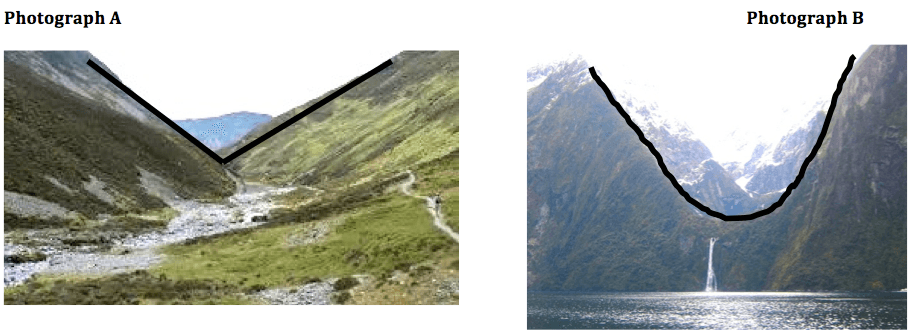
Which list best identifies the agent of erosion that primarily determined the shape of each valley?
a)
photograph A—glacier; photograph B—river
b)
photograph A—river; photograph B—glacier
c)
Both A and B—river
d)
Both A and B—glacier
14.
Which term best describes the rate at which glacial erosion takes place?
a)
quick
b)
slow
c)
sudden
15.
Why is it hard to see glacial erosion in action?
a)
Because glaciers are so big
b)
Because light from glaciers refracts too much
c)
Because glaciers move very, very slowly
d)
Because glacial erosion is usually very subtle
100 %

