
NEW
Font size
S
M
L
XL
 Worksheets
SLO Test Prep
Total questions: 23
Worksheet time: 17mins
Name
Class
Date
1.
If the percentage of DNA is made of 30% Thymine, what is the correct percentage of Guanine?
a)
30
b)
15
c)
20
d)
60
2.
DNA replication results in two DNA molecules,
a)
each one with two original strands
b)
each one with two new strands
c)
each one with one new strand and one original strand
d)
one with two new strands and the other with two original strands
3.
A process in which DNA has the unique ability to make an exact copy of itself.
a)
Replication
b)
Translation
c)
Transcription
4.
The bonds that hold the two strands of DNA together come from...
a)
the attraction of phosphate groups
b)
strong bonds between bases and sugars
c)
carbon to carbon bonds in the sugar
d)
weak hydrogen bonds between the bases
5.
What are the 4 nitrogen bases?
a)
adenine, thymine, cytoplasm, and guanine
b)
adenine, thymine cytosine, and guanine
c)
adenine, thymine, cytosine, and gylcerol
d)
adenine, thymine, cytosine, and glucose
6.
The nucleic acid DNA is composed of
a)
sugar, protein, and nitrogenous bases.
b)
protein, nitrogenous bases, and phosphate.
c)
nitrogenous bases, phosphate, and RNA.
d)
sugar, phosphate, and nitrogenous bases.
7.

Name this structure
a)
double helix
b)
nucelotide
c)
twisted ladder
d)
hydrogen bond
8.
The process of going from DNA to mRNA is called
a)
Transcription
b)
Translation
c)
Transportation
d)
Transient
9.
The process where DNA is transcribed to mRNA happens in what part of the cell?
a)
Nucleus
b)
Mitochondria
c)
Cytoplasm
d)
Endoplasmic Reticulum
10.
The process where mRNA is read and made into an amino acid chain.
a)
Transcription
b)
Translation
c)
Transportation
d)
Transient
11.
How many amino acids are coded for by this sequence of nucleotides:
ATG GGA ACT CCA
ATG GGA ACT CCA
a)
4
b)
2
c)
6
d)
12
12.
In proteins, the amino acid order is determined by
a)
nitrogenous bases in RNA
b)
random placement
c)
nitrogenous bases in DNA
d)
there is no order
13.
This molecule carries genetic information from the nucleus to the ribosomes in the cytoplasm.
a)
rRNA
b)
tRNA
c)
mRNA
d)
DNA
14.
Which of these nitrogenous bases is NOT in RNA?
a)
Uracil
b)
Thymine
c)
Cytosine
d)
Guanine
15.
Which of the following would result in a frameshift mutation?
a)
Insertions only
b)
Substitution only
c)
Deletion only
d)
Insertions and Deletions
16.
What mutation has occurred here?
T-G-A-C-C-A
T-G-A-G-C-A
T-G-A-C-C-A
T-G-A-G-C-A
a)
Substitution
b)
Deletion
c)
Insertion
d)
Frameshift
17.
A mutation is defined as:
a)
A change in the cell's structure
b)
Anything that changes in an embryo
c)
Any change in the physical features of a human
d)
A change in the DNA sequence
18.
Why are insertion and deletion (frameshift) mutations so harmful?
a)
They change all of the codons from the mutation on down the line, which changes the amino acid sequence
b)
They insert things that an organism doesn't need.
c)
They often delete things that organisms need.
d)
Insertion and deletions are not any more harmful than substitution mutations.
19.
Genetic mutations can be...
a)
beneficial, harmful, or neutral
b)
beneficial only
c)
harmful only
d)
neutral only
20.
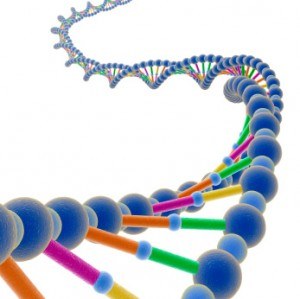
Which of the following best describes a DNA molecule?
a)
double helix
b)
contains ribose
c)
made of amino acids
d)
contains Uracil
21.
Why is DNA important?
a)
it is very small and very complicated
b)
it's in everything
c)
it serves as the blueprint for traits of all living things
d)
because we eat it every day for energy
22.
Which 2 molecules form the sides (backbone) of the DNA ladder?
a)
deoxyribose sugar and adenine
b)
deoxyribose sugar and a hydrogen bond
c)
deoxyribose sugar and the nucleus
d)
deoxyribose sugar and phosphate
23.
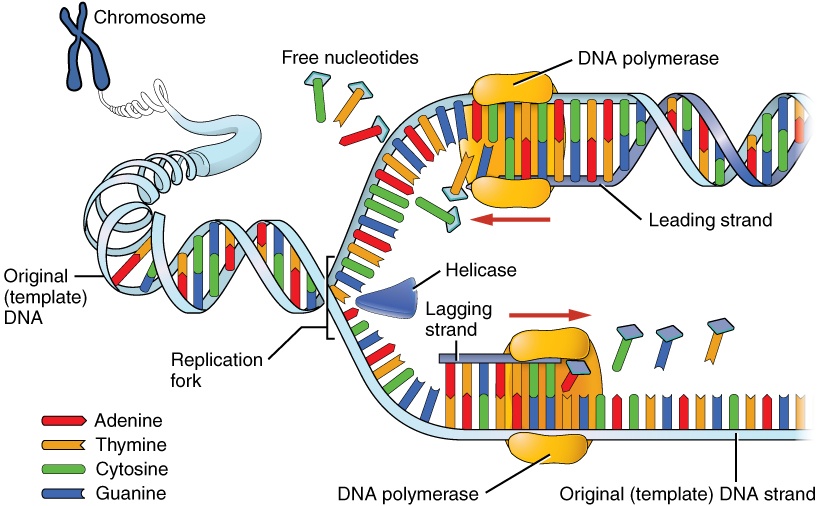
What is the complement to the DNA strand below:
5'-ATGCCAT-3'
5'-ATGCCAT-3'
a)
5'-TACGGTA-3'
b)
3'-TACGGTA-5'
c)
3'-ATGGCAT-5'
d)
5'-ATGGCAT-3'
Reset

