Wayground logo

Free Printable Worksheets

Font size

S
M
L
XL
Worksheets

Geography of Greece

Total questions: 50

Worksheet time: 40mins

Name
Class
Date
1.

independent self-governing city and the territory around it

a)

democracy

b)

clan

c)

polis

d)

city-state (polis)

2.

Which type of landscape best describes Ancient Greece?

a)

Plains

b)

Mountainous

c)

Desert

d)

Rainforest

3.

In what continent is Greece located in?

a)

Africa

b)

South America

c)

Europe

d)

Asia

4.

What is the climate like in Ancient Greece?

a)

Hot all year round!

b)

Cold all year round!

c)

Cold summers and Hot Winters

d)

Hot Summers and Mild Winters

5.

What is a peninsula

a)

Mountains

b)

Land surrounded by water on 1 side

c)

Land Surrounded by water on 3 sides

d)

Land surrounded by water on 6 sides

6.

Farming was hard in Greece because

a)

there was too much water

b)

there was not enough water

c)

the land was very rocky and mountainous

d)

the climate did not allow for seasonable growth

7.
Because Greece was made up of many mountains, it made travel hard.  This lead to what?
a)
Led to the development of isolated city-states
b)
Focused on growing different kinds of crops
c)
Travelled by sea instead of over land
d)
Greeks became fishermen and sailors instead of farmers
8.
What is the geography of greece
a)
seas
b)
mountains
c)
islands
d)
all of the above
9.

What body of water does NOT surround Greece?

a)

Ionian Sea

b)

Mediterranean Sea

c)

Pacific Ocean

d)

Aegean Sea

10.

If mountains and seas cut off Greek center of population from one another, you can infer that ...

a)

trade was easy

b)

civilization declined

c)

separate groups developed

d)

agriculture was impossible

11.
Why was communication difficult between communities in Ancient Greece?
a)
They did not have telephones
b)
Mountains and Water
c)
communication was easy
d)
most people had horses
12.

Why did the people in ancient Greece set up colonies?

a)

People wanted to see the world

b)

Not enough farmland to grow food

13.

The Ionian sea is what direction from Greece?

a)

north

b)

south

c)

east

d)

west

14.
Which physical feature does the following describe? Mountains, Seas, or Both?
Separated city-states from on another. 
a)
Mountains
b)
Seas
c)
Both
15.

Which physical feature does the following describe? Mountains, Seas, or Both?

Helped travel, or moving from place to place.

a)

Mountains

b)

Seas

c)

Both

16.
Which physical feature does the following describe? Mountains, Seas, or Both?
Helped the Greeks exchange ideas or goods. 
a)
Mountains
b)
Seas
c)
Both
17.

Greece was surrounded by many of these, the biggest of which is Crete.

a)

Peninsulas

b)

Islands

c)

Rivers

18.
The ancient Greeks grew grapes, olive, and barley.  Why were they limited to these crops?
a)
They didn't like to farm.
b)
The soil was rocky and dry due to mountains. 
c)
The rivers flooded the land. 
d)
None of the above
19.

The early Greeks, like the Minoans, became skilled shipbuilders and sailors. Why?

a)

They wanted to be pirates.

b)

Greece had many harbors.

c)

Greece was surrounded by 3 seas and had many islands.

20.
Where is the Mediterranean Sea?
a)
B
b)
G
c)
E
21.
Where is the Ionian Sea?
a)
B
b)
G
c)
E
22.
Where is the Aegean Sea?
a)
B
b)
G
c)
E
23.
Where is Crete?
a)
F
b)
C
c)
H
d)
A
24.
What is located at D?
a)
Balkan Mountains
b)
Mount Olympus
c)
Athens
d)
Black Sea
25.

The two animals the Greek herders raised.

a)

Goats

b)

Sheep

c)

Cows

d)

Chickens

26.

How did the Minoans get their wealth?

a)

With the help of aliens

b)

With the help of Ancient Egyptians

c)

Through Trade

d)

Through warfare

27.
Which invading civilization conquered the Minoans?
a)
Trojans
b)
Spartans
c)
Pericles
d)
Mycenaeans
28.

The earliest civilization in Europe was ?

a)

Minoans

b)

Mycenaen

c)

Trojans

d)

Spartans

29.
The 300 died at what battle? 
a)
Palatea
b)
Marathon
c)
Thermopylae
d)
Salamis
30.
Which popular sporting activity resulted from the first battle of the Persian Wars?
a)
The Marathon
b)
The Triathlon
c)
The Olympics
d)
The Pentathlon
31.
The Persian Empire was victorious against _______ at the Battle of Thermopylae.
a)
Athens
b)
Sparta
c)
Macedonia
d)
Olympia
32.
The Greek city-state of ____ is known for their powerful army.
a)
Sparta
b)
Athens
c)
Troy
d)
Mycenae
33.
Why did the first Persian War start?
a)
Persia wanted to punish Athens for interfering in the Ionian Revolt.
b)
Sparta and Athens were competing to be the best city-state .
c)
Persia wanted revenge for their defeat at Marathon.
d)
Sparta and Athens both wanted to defeat Persia.
34.
Who was the main rival of ancient Greece?
a)
The Persian Empire
b)
The Ottoman Empire
c)
The American Empire
d)
The Galactic Empire
35.
At the Battle of Marathon, ________________.
a)
Persian Empire was defeated by Alexander the Great.
b)
Athens was defeated by Persian Empire.
c)
Sparta was defeated by Athens. 
d)
Persian Empire was defeated by Athens.
36.
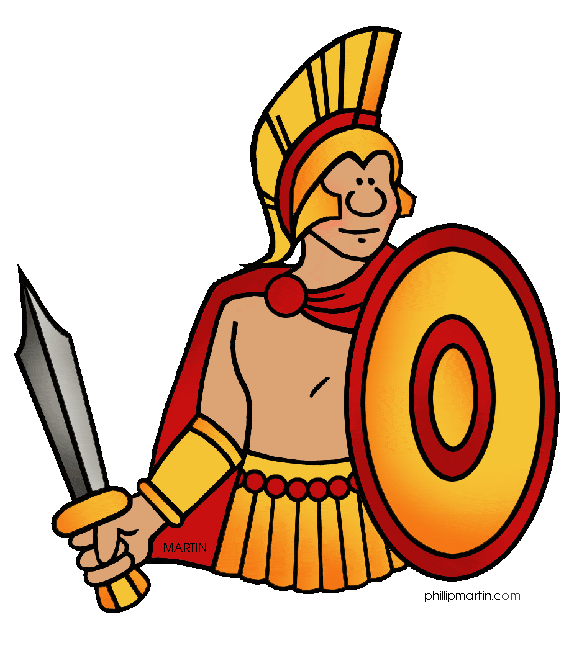
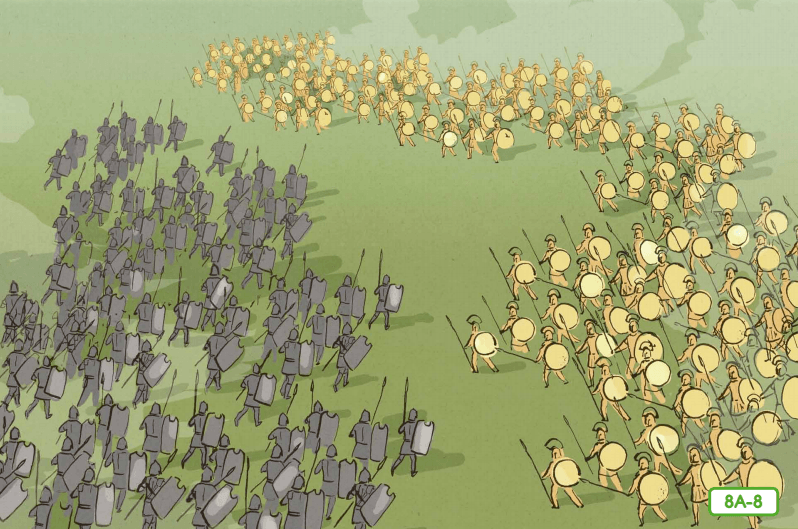
What was a Greek soldier called and what was the name of the formation that he often fought in?
a)
Hoplite, phalanx
b)
Hoplite, trireme
c)
Spartan, greaves
d)
Cuirass, hoplite
37.
Which of the following statements is true concerning the Persian Wars?
a)
The Persians defeated the Greek city-states
b)
Athens started its decline after the end of the war
c)
Sparta and Athens were united against the Persians
d)
Persian ideas were adopted by the Athenians
38.
A marathon is a foot race that covers ____ miles.
a)
10
b)
26
c)
150
d)
18
39.
The Spartan leader who led the Greek army at Thermopylae was
a)
Lycurgus
b)
Themistocles
c)
Leonidas
d)
Pheidippides
40.
What type of natural landform is Greece on?
a)
Peninsula
b)
Island
c)
Canal
d)
Isthmus
41.
The majority of Greece is __________
a)
Mountains
b)
Desert
c)
Farmland
d)
Ice
42.
______________ controlled and dominated the Delian League.
a)
Athens
b)
a peace keeping Sparta
c)
Persia
d)
Macedonia
43.
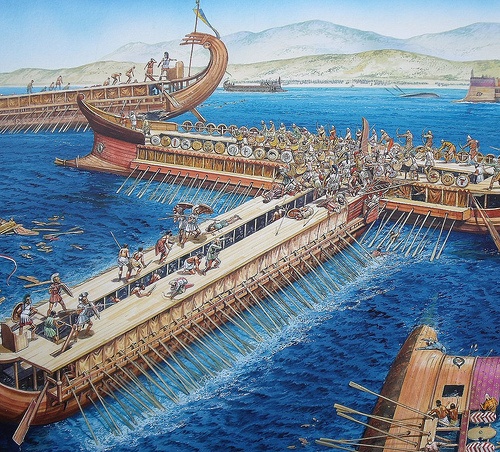
The Persian navy was destroyed at this battle.
a)
Plataea
b)
Salamis
c)
Thermopylae
d)
Marathon
44.
This Persian king led the 2nd invasion of Greece to avenge his fathers defeat.
a)
Hippias
b)
Xerxes
c)
Cliesthenes
d)
Leonidas
45.
What happened to the Persian ships once they were in the narrow waterway?
a)
The could not maneuver their ships
b)
They docked the ships and unloaded the army
c)
They started to fish because they were bored
d)
They started the battle at Athens
46.
Who ultimately won the Persian War?
a)
Greeks
b)
Spartans
c)
Persians
d)
Athens
47.
Ten years after the first battle in the Persian Wars, Darius' son Xerxes tried to conquer Greece once more.
Which Greek city-state helped Athens?
a)
Mycenae 
b)
Crete
c)
Sparta
d)
Troy
48.
The Greek city-state of ____ is known for their powerful army.
a)
Sparta
b)
Athens
c)
Troy
d)
Mycenae
49.

Which of the following states how Greece was affected by the Persian War?

a)

Their loss led to a time of disorder and chaos.

b)

Their victory gave them power over the Persians.

c)

Their victory united them as a nation for the first time.

d)

Their loss caused them to be controlled by the Persians for a time longer.

50.
The following information describes which battle of the Persian War: Athens beat the army of the Persians (on land) and forced them to leave Greece.
a)
Thermopylae
b)
Salamis
c)
Plataea
d)
Marathon