
 Worksheets
Adaptations_TEST_Review
Total questions: 31
Worksheet time: 22mins
What did Darwin infer from his observations of organisms in South America and the Galapagos Islands?
The organisms on the islands were virtually identical to mainland organisms.
A small number of different plant and animal species had come to the mainland from the islands.
The organisms on the islands were completely unrelated to mainland organisms.
A small number of different plant and animal species had come to the islands from the mainland.
Differences between members of the same species are called
predators
selections
traits
variations
What did Darwin observe about finches in the Galapagos Islands?
Their feathers were adapted to match their environment.
Their beaks were adaptations related to the foods the finches ate.
They had identical shapes and sizes in all locations
They have identical claws.
A trait that helps an organism survive and reproduce is called a(n)
mutation.
selection.
adaptation.
variation.
Which term refers to the process by which individuals that are better adapted to their environment are more likely to survive and reproduce?
natural selection
overproduction
competition
variation
Over many generations, populations of giraffes developed longer necks. Why might such a change have occurred?
Long necks help giraffes escape from predators.
Humans find long necks are more attractive in giraffes.
Giraffes with longer necks can obtain food sources other animals cannot reach.
Giraffes with longer necks require more food than giraffes with shorter necks.
Why did the population of peppered moths change from light to dark after the Industrial Revolution?
Light colored moths were killed by the ash.
Dark colored moths were produced by the industrial revolution.
Light moths were more obvious against the ash in the trees.
The birds ate the dark moths that were killed by the ash.
Which of the following is NOT a principle of natural selection?
Organisms produce more offspring than can survive.
Difference occur among individuals of a species.
All variations are passed on to all the offspring.
Individuals with helpful variations survive and reproduce better than those without them.
How could competition for food sources led to different shells in the Galapagos Island turtles?
The shells did not change for the turtles. Some just learned to stretch their necks higher than others.
Tortoises with high neck arches in their shells were better adapted to eat food from low and high places. Tortoises without the arch were adapted only for eating food found low to the ground.
Those with low doomed shaped shells were better adapted to eating low to the ground and were better able to survive.
Tortoises that were not able to stretch their necks as far as others did not survive.
There are two types of ostriches: ones that run fast and ones that run slowly. The fast birds can reach up to 40 miles per hour. Jackals love to eat ostrich, and they can reach speeds of up to 35-40 miles per hour. Which animal will natural selection work AGAINST?
slow jackal
fast jackal
slow ostrich
fast ostrich
There are two types of ostriches: ones that run fast and ones that run slowly. The fast birds can reach up to 40 miles per hour. Jackals love to eat ostrich, and they can reach speeds of up to 35-40 miles per hour. Which of Darwin's 5 Principles does this situation BEST illustrate?
A population will change over time.
More offspring are produced than can survive.
Those that survive have favorable traits.

Use the branching tree in the image to answer the question.
What do marsupials, dogs, and cats have in common?
fur
shearing teeth
retractable claws
ability to jump
The diet of white-tailed deer consists primarily of shrubs. Sika are another species of deer that eat both grasses and shrubs. After an extended drought period, why might the sika population be favored over the white-tailed deer population?
Sika require less food than do the white-tailed deer.
Sika require more water than do the white-tailed deer.
Sika have more food sources than do the white-tailed deer.
Sika have fewer food sources than do the white-tailed deer.

Use the line graph to answer the question.
Why was their a sudden drop in the number of finches during each year?
Dry seasons result in less food sources for the birds.
The constant change in the seasons resulted in birds not be able to adapt quickly enough.
Overpopulation occurred during the during dry seasons which caused the population to decrease during the wet seasons.
Which of the following is the best example of an adaptation?
coyotes moving into a new area where they can hunt deer
horses having long legs so they can run away from predators
a breeder mating two black dogs to get a litter of black puppies
people learning to ride horses for exercise

In which layer of sediment would you expect to find the oldest fossil?
A
B
C
D


What is the adaptation?
Black and brown bears have dark fur. They live in wooded areas. Polar bears have
white fur. They live in Arctic areas. How does the color of each bear’s fur help it
survive?
The color helps each type of bear blend into its environment.
The color of each matches its food source so hunting is easier.
The color absorbs the right amount of sun each needs for warmth.
The color is a signal to the enemies of each to keep them from attacking.

A mosquito population was sprayed with a certain brand of insecticide, a poison that kills mosquitoes. After being sprayed, the number of surviving mosquitoes within the population was counted and recorded as a percentage of the total. This process was repeated until a total of six
generations of mosquitoes had been sprayed. The results are shown in the table above. Which statement best describes the table above?
The population of mosquitoes decreased from generation 1 to 6 because the insecticide killed more of the offspring.
Generation 5 had fewer numbers of mosquitoes surviving than Generation 2 due to a smaller initial population.
Generation 1 did not survive because it had several members that were old and weak.
The survival rate of the mosquito population increased from generation 1 to 6 which may be due to insecticide resistance in the mosquito population.


The hornet moth (pictured) and the hornet look similar to each other. Why?
The hornet mimics the moth to attract predators.
The moth and the hornet are closely related.
The moth mimics the hornet to repel predator.
The moth had one hornet as a parent.
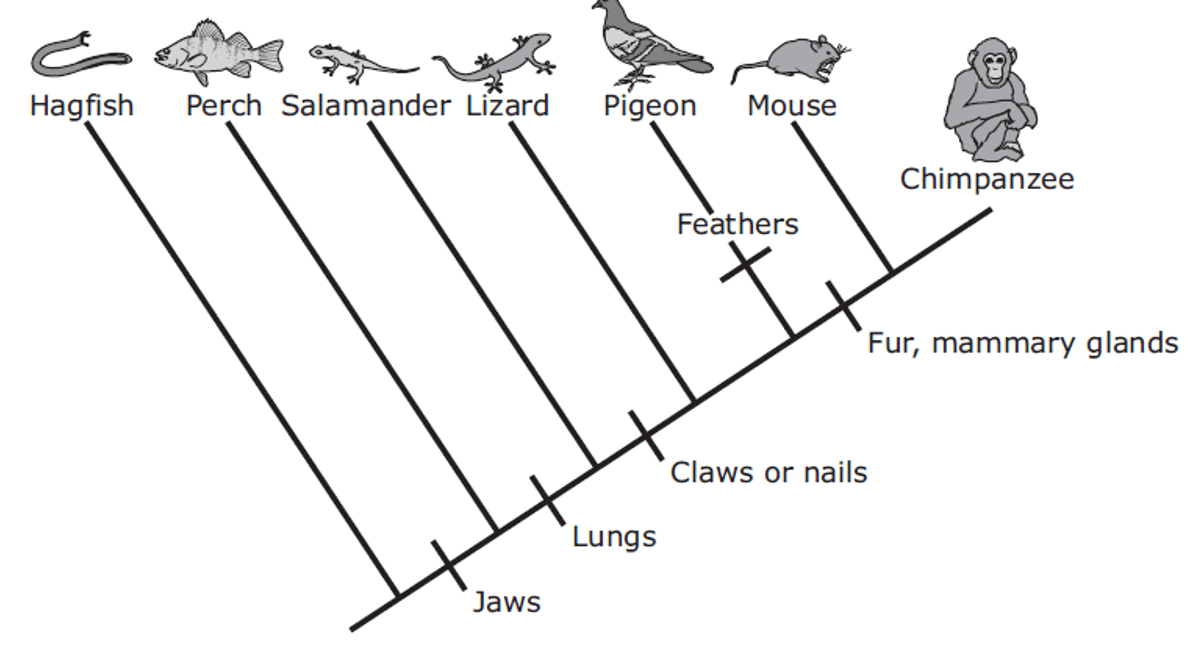
What is the difference between the salamander and the lizard based on this branching tree?
Fur
Claws or nails
Lungs
Jaws

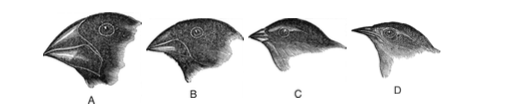
The four different types of beaks shown are most likely the result of

