
 Worksheets
Evolution, Natural Selection & Adaptations
Total questions: 25
Worksheet time: 15mins

The remains, imprints or preserved evidence of a prehistoric organism.
population
species
fossil
variation

Inherited trait that makes an individual physically DIFFERENT from other members of the same species.
competition
variation
mutation
vestigial structure

Survival of the Fittest. Individuals that are best suited to their environment will survive & reproduce.
natural selection
artificial selection
variation
overproduction

SIMILAR body parts among different species indicating that they possibly share a common ancestor.
comparative embryology
homologous structures
variation
vestigial structures

Inherited trait that HELPS an organism to survive and reproduce in its environment.
adaptation
evolution
competition
variation
A group of organisms that share similar characteristics and CAN reproduce with one another.
community
population
species
ecosystem

Body part that is no longer needed for survival, but may have served an important function in the organism's ancestor.
comparative embryology
homologous structures
variation
vestigial structure

When organisms work against one other for a RESOURCE that is in short supply.
selection
overproduction
environmental change
competition

This scientist developed the theory of EVOLUTION by natural selection. He sailed to the Galapagos Islands to do his research & wrote the book, "On the Origin of Species".
Albert Darwin
Charles Darwin
Albert Einstein
Charles Einstein

Humans come in all different heights. Adults range from 2.5 feet to 8 feet tall. What is this an example of?
adaptation
natural selection
vestigial structure
variation

Humans cross-breed two types of strawberry plants to get strawberries that are larger & extra sweet. What is this an example of?
natural selection
artificial selection
evolution

An owl is born with a feather pattern that helps it camouflage in its forest environment. This HELPS it hide from predators. What is this an example of?
adaptation
competition
environmental change
variation
Organisms that are best adapted to their environment, are more likely to survive & pass on their traits. True or false?
True
False
Major changes to a population of species can happen very quickly. True or False?
True
False

Ligers can't reproduce (cubs), therefore they are not a species. True or false?
True
False
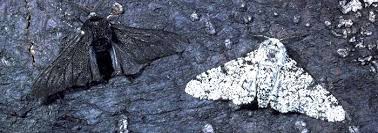
Predict... which moth population will INCREASE?
light
dark
Darwin is most famous for his studies on which type of animal?


These forelimbs, from different organisms, show common ancestry because:
They have the same basic structure (design)
They perform the same function (job)
They are parts of mammals
They are the same size

A scientist finds dinosaur fossils in the BOTTOM layer of a cliff and mammal fossils in the TOP layer. What can be inferred?
dinosaurs ate the mammals
dinosaurs were eaten by mammals
both organisms lived at the same time
dinosaurs lived before mammals
Which of these scenarios is an example of NATURAL selection?
Farmers crossbreed two types of cows to produce a cow that has high-quality beef and can tolerate a hot climate.
Dogs of the same breed, with a desirable coat color, are bred with one another to produce puppies with that same coat color.
Wolves with thick coats survive a cold winter more than wolves with thin coats. Thick-coated wolves have more offspring the following spring.

Which situation that could lead to the EXTINCTION of a species?
increase in living space
increase in food supply
increase in competition
decrease in predators
Which describes a likely reason WHY a species would become extinct after a mass ENVIRONMENTAL CHANGE?
The environmental changes leads to fewer predators.
There are not enough members of a species born with a trait necessary to survive in the new environment.
The change in the environment creates more resources and less competition.
There is more living space for the species in the changed environment.
Which is an example of a COMMUNITY?
All the hawks in Rolling Meadows.
All the Hawks, Squirrels, Oak trees in Rolling Meadows.
All the Hawks, Squirrels, Oak trees and Water in Rolling Meadows.
All the Hawks, Squirrels, Oak trees and Water in a Forest.

Which is NOT an adaptation of a polar bear?
White fur
Large Feet
Thin Layer of fat
Strong Swimmer

A change in a species over a LONG period of time.
adaptation
evolution
fossil
variation

