wayground logo

Free Printable Worksheets

NEW

Font size

S
M
L
XL
Worksheets

STAAR Biology Review - Reporting Category 2

Total questions: 50

Worksheet time: 1hrs 9mins

Name
Class
Date
1.
Which sequence of complementary DNA bases would pair with this partial strand
ATG TGA CAG?
a)
ATG TGA CAG
b)
TAC ACT GTC
c)
GTA AGT GAC
d)
CAT TCA CTG
2.
Which of the following monomers are repeatedly joined together to form a strand of DNA?
a)
amino acids
b)
nucleotides
c)
fatty acids
d)
polysaccharides
3.
What determines the code, or information, of a DNA molecule?
a)
the shape (structure) of the nitrogen bases
b)
the order (sequence) of the nitrogen bases
c)
the color of the nitrogen bases
d)
the frequency (number) of nitrogen bases
4.
The two strands of nitrogenous bases in DNA are joined by which type of bond?
a)
polar bonds
b)
ionic bonds
c)
covalent bonds
d)
hydrogen bonds
5.

A process in which DNA has the unique ability to make an exact copy of itself.

a)

Replication

b)

Translation

c)

Transcription

d)

Protein Synthesis

6.
What process is shown in the diagram?
a)
replication
b)
transcription
c)
mitosis
d)
translation
7.
X outlines a(n) ___________.
a)
amino acid
b)
nitrogen base 
c)
nucleotide
d)
nitrogen base pair
8.
In what phase of the cell cycle does DNA replication take place?
a)
G1
b)
S
c)
G2
d)
M
9.
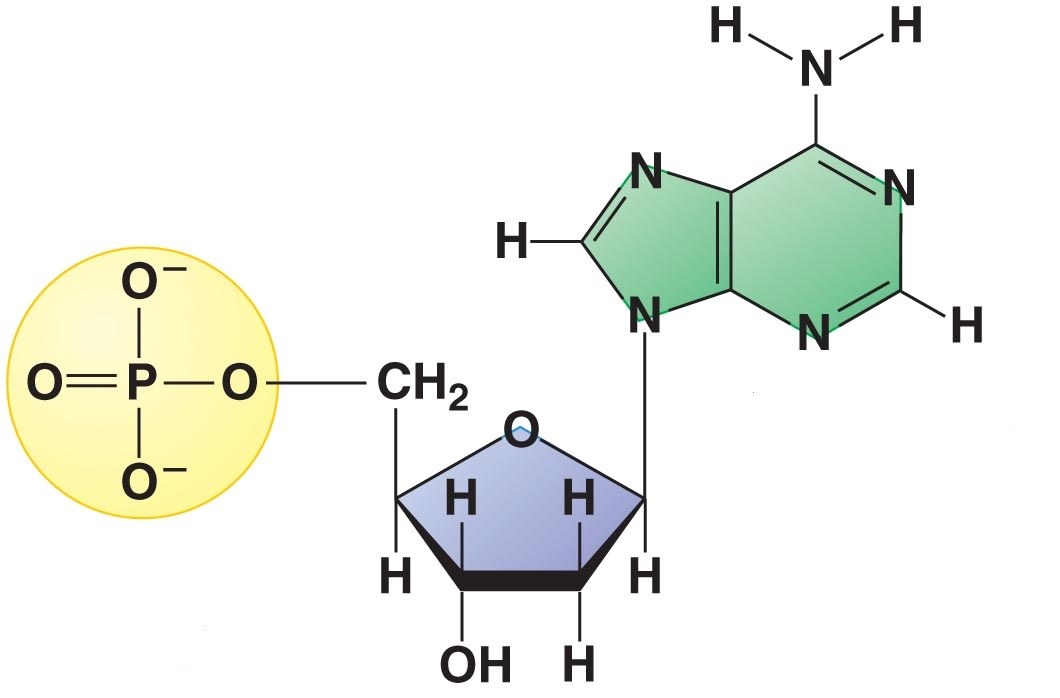
Name this structure
a)
double helix
b)
nucelotide
c)
twisted ladder
d)
hydrogen bond
10.
Which series is arranged in order from largest to smallest in size?
a)
gene, chromosome, nucleus, cell, DNA, nucleotide
b)
cell, nucleus, chromosome, DNA, gene, nucleotide
c)
nucleotide, chromosome, cell, DNA, nucleus
d)
cell, DNA, gene, nucleotide, nucleus, chromosome
11.
What process is occurring in this photo?
a)
Transcription
b)
DNA unwinding
c)
Translation
d)
Transfer RNA is creating bases
12.
What process is occurring in this photo?
a)
Transcription
b)
Translation
c)
mRNA is matching with amino acids
d)
tRNA is transcribing the DNA
13.
What is the correct amino acid sequence for the mRNA code AUGCCAGUAUGA?
a)
 Met-Pro-Val-Stop
b)
Met-Pro-Arg-Stop
c)
 Tyr-Gly-His
d)
Tyr-Gly-Arg-His
14.
Which RNA bases would pair with TACGAA in transcription? 
a)
AUGCUU 
b)
ATGCTT
c)
GCATCC
d)
GCAUCC
15.
What is transcription?
a)
When DNA is turned into RNA
b)
When RNA is turned into proteins
c)
When proteins are turned into DNA
d)
When proteins are turned in RNA
16.
What is translation?
a)
When DNA is turned into RNA
b)
When RNA is turned into proteins
c)
When proteins are turned into DNA
d)
When proteins are turned in RNA
17.
Which is NOT a difference between RNA and DNA?
a)
RNA is single stranded and DNA is double stranded
b)
RNA contains Uracil, DNA doesn't
c)
DNA has to stay in the nucleus, RNA doesn't
d)
RNA has extra proteins attached and DNA doesn't
18.
Which is the organelle that makes proteins?
a)
Nucleus
b)
Ribosomes
c)
Rough ER
d)
Golgi Apparatus
19.
Where is the DNA located?
a)
Nucleus
b)
Ribosome
c)
Golgi Apparatus
d)
Rough ER
20.
What is true about RNA?
a)
It is indestructible
b)
It can travel outside of the nucleus
c)
It has five nucleotides
d)
It contains twice as much thymine as DNA
21.
What is the correct order?
a)
Transcription then Translation
b)
Translation then transcription
c)
Translation then replication
d)
Replication then Translation
22.
DNA molecule segment is : TTACGCAAG
The mutated DNA segment is TTCGCAAG. This is an example of ___ mutation.
a)
Substitution
b)
Deletion
c)
Insertion
d)
Inversion
23.
mRNA is read in chunks of three, called...
a)
quadralets
b)
anticodons
c)
codons
d)
capsids
24.
What is a Gene?
a)
A segment of RNA that encodes for a protein
b)
A chromosome
c)
A segment of DNA that encodes for a protein
d)
Your genome
25.
Normal-
GAG-CTC-GAC-AGA
Mutant
GAG CTC-CAC-AGA
a)
no mutation
b)
substitution
c)
insertion
d)
deletion
26.
Original: ATC CAT
Mutation: ATC GCAT
What mutation occurred?
a)
deletion
b)
insertion
c)
silent
d)
transverse
27.
Are all mutations bad?
a)
Yes
b)
No
28.

Which type of mutation is MOST LIKELY to cause the greatest disruption?

a)

Frameshift

b)

Silent

c)

Point

29.

Failure of homologous chromosomes

to separate during meiosis.

Results in gametes with either one extra or one missing chromosome.

a)

Translocation

b)

Nondisjunction

c)

Replication

d)

Transcription

30.

A point mutation where DNA adenine (A)

is replaced by thymine (T) resulting in a single amino acid change during translation(affects blood cell

shape and function)

a)

Encephelitis

b)

Hemophilia

c)

Sickle Cell Anemia

d)

Influenza

31.
What are the building blocks of proteins called?
a)
DNA
b)
RNA
c)
Ribosomes
d)
Amino Acids
32.
Why is the order of amino acids so important?
a)
The order of amino acids dictates what shape the protein will fold into.
b)
It is not important. The protein folding chamber will force the protein to fold into the correct shape.
33.
Would a mutation in the DNA of a skin cell be passed on to an organism's offspring?
a)
Yes, because any change to the DNA is passed on to the offspring
b)
Maybe. Sex cells only use half of the body's genetic code. It might get the copy of a gene that wasn't mutated.
c)
No. Only mutations that occur in the gametes (sex cells) are passed on to the offspring
d)
Without knowing the animal, it would be hard to tell whether or not the mutation would be passed on.
34.
Using the codon chart here or at your table to identify the amino acid sequence:
AUG-CCA-GUA-GGG-UAA
a)
MET-HIS-ALA-GLY-STOP
b)
MET-PRO-GLY-VAL-STOP
c)
MET-PRO-VAL-GLY-STOP
d)
MET-THR-SER-ASP-STOP
35.
Long tongues (T) are dominant to short tongues in green tree frogs.  What is the probability that two frogs that are heterozygous for long tongues could produce offspring with short tongues?
a)
100%
b)
75%
c)
50%
d)
25%
36.
Why is crossing over important?
a)
Increases the number of genes that can be inherited
b)
Increases genetic variation
c)
Decreases the occurrence of genetic diseases
d)
Decreases the number of genes that can be inherited
37.
Purple is dominant to white. A heterozygous purple flower is crossed with a white flower. What are the genotypes and phenotypes of the offspring?
a)
100% Pp (purple)
b)
50% Pp (purple); 50% pp (white)
c)
75% Pp (purple); 25% pp (white)
d)
25% PP, 50% Pp, 25% pp
75% purple, 25% white
38.
A calico cat shows both the traits for orange fur and black fur. What kind of allele expression is this?
a)
Incomplete Dominance
b)
Co dominance
c)
Independent assortment
d)
Recessive inheritance
39.
A dihybrid cross shows the possible outcomes of _______ 
a)
two alleles
b)
two parents
c)
two traits/characters
d)
a self pollination
40.
T4 - Black fur in mice (B) is dominant to brown fur (b). Short tails (T) are dominant to long tails (t). What percentage of the offspring of the cross BbTt x BBtt will have black fur and long tails?
a)
0%
b)
25%
c)
50%
d)
100%
41.
What gamete possibilities could come from this parent's genotype?
a)
AB, AB, aB, aB
b)
Ab, AB, Ab, ab
c)
Ab, Ab, Ab, Ab
d)
AB, aB, ab, aB
42.
What is a phenotype
a)
The genetic make up (code)
b)
The physical trait
43.
An allele whose trait only shows up when no dominant allele is present.
a)
hidden allele
b)
dominant allele
c)
recessive allele
d)
present allele
44.
Which of the following genotypes would be considered heterozygous?
a)
BB
b)
gg
c)
Ff
d)
TT
45.
Which of the following alleles is homozygous recessive?
a)
Tt
b)
tt
c)
TT
d)
T
46.

The passing of genetic traits from parent to offspring is known as

a)

heredity

b)

trait

c)

gene

d)

allele

47.

An organism's genetic makeup

a)

phenotype

b)

genotype

c)

heterzygous

d)

allele

48.
Which statement best describes the importance of sexual reproduction?
a)
sexual reproduction produces variation in offspring
b)
sexual reprosuction provides regeneration of body parts
c)
sexual reproduction occurs between individuals of the same species
d)
sexual reproduction produces offspring that are identical
49.
Which of the following cell types is formed by meiosis?
a)
skin cells
b)
sperm cells
c)
blood cells
d)
muscle cells
50.
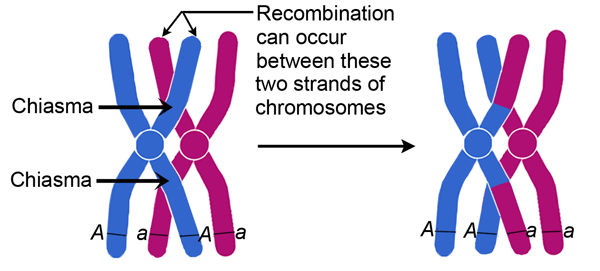
This image shows chromosomes during Prophase 1. Which of the following correctly describes the process shown?
a)
segregation of sister chromatids
b)
condensation and segregation of alleles
c)
mutationin which the DNA content of the gene is altered
d)
crossing - over in which alleles are exchanged