
 Worksheets
Causes of the Civil War
Total questions: 86
Worksheet time: 42mins
What was the first state to secede after the Election of 1860?
Alabama
Florida
Mississippi
South Carolina
An American who opposes immigration is called a ___________.
communist
patriot
nativist
Republican
What event led to large-scale migration from the Ireland and Britain in the mid-1840s?
British Civil War
The War of the Roses
Irish Potato Famine
Holocaust
What caused California to grow in population so quickly that it was ready for statehood in 1849?
The American Civil War
The Gold Rush
The Mexican-American War
European immigration
What was the concept that people living in a territory or state would vote on whether to allow slavery?
abolitionism
manifest destiny
popular sovereignty
transcendentalism
Who led the Pottawatomie Massacre to get revenge on slaveholders in Kansas?
John Brown
Charles Sumner
Nat Turner
Harriet Tubman
What Kansas town was sacked and burned by pro-slavery border ruffians?
Kansas City
Topeka
Lawrence
Abilene
What law put harsh penalties in place for assisting a slave in escaping?
Kansas-Nebraska Act
Fugitive Slave Act
Dred Scott decision
Missouri Compromise of 1820
What slave sued his owner in the Supreme Court, arguing that by being brought into free states by his owner he had been set free?
Dred Scott
Frederick Douglass
Nat Turner
Ralph Waldo Emerson
Which of the following effectively eliminated Congress's power to limit slavery?
Compromise of 1850
Kansas-Nebraska Act
Scott v. Sandford
Marbury v. Madison
According to the Dred Scott decision, no one who was a slave or had descended from a slave could be a citizen.
True
False
Where was the arsenal that John Brown tried to capture?
Harper's Ferry, Virginia
Lawrence, Kansas
Pottawatomie Creek, Arkansas
Charleston, South Carolina
What party was founded to either limit or eliminate slavery?
Democratic Party
Know-Nothing Party
Republican Party
Whig Party
Who was elected in the presidential election of 1856?
Abraham Lincoln
Franklin Pierce
James Buchanan
Millard Fillmore
Who was elected in the presidential election of 1852?
Abraham Lincoln
Franklin Pierce
James Buchanan
Millard Fillmore
Who was elected in the presidential election of 1860?
Abraham Lincoln
Franklin Pierce
James Buchanan
Millard Fillmore
Which of the following was never elected president?
Abraham Lincoln
Franklin Pierce
James Buchanan
Millard Fillmore
Who was the first member of the Republican Party to be elected president?
John C. Fremont
Abraham Lincoln
Stephen Douglas
Zachary Taylor
Which president was bullied by Stephen Douglas into signing the Kansas-Nebraska Act?
Abraham Lincoln
Franklin Pierce
James Buchanan
Millard Fillmore
Who came up with the Missouri Compromise of 1820?
Daniel Webster
James Polk
Henry Clay
John Quincy Adams
Who developed the Compromise of 1850?
Henry Clay
Millard Fillmore
Roger Taney
Abraham Lincoln
What problem was the Compromise of 1850 intended to solve?
The admittance of California to the union as a free state
The citizenship status of slaves
The end of the slave trade


The result of the Dred Scott decision was that (select all correct answers)
slaves are property, not citizens
slaves are free if living in a free state
slavery can be outlawed in the territories
slavery can spread anywhere (North or South)
This voided the Missouri Compromise and removed the 36* 30' line.
Compromise of 1850
Kansas Nebraska Act
The Constitution
Lincoln/Douglas Debates
What was the Compromise of 1850? Select all that apply.
California would enter the Union as a free state.
Texas would be allowed to enter the Union as a slave state.
The Fugitive Slave Law was passed
The slave trade would end in the nation’s capital.
Which of the following best describes John Brown?
radical abolitionist who used violence to try to end slavery
a peaceful abolitionists who hated violence
a pro-slavery Senator
a strong supporter of slavery who used violence to spread slavery
What was John Brown's master plan?
To show the democratic party that he would stop at nothing to end slavery
To make American's all across the country to recognize him as a political threat
To get Abraham Lincoln elected
To attack an arsenal and start a slave rebellion
Although John Brown's raid on Harper's Ferry was an attempt to challenge the institution of slavery, the raid resulted in
A compromise between the North and South over the question of slavery
A decrease in slavery's influence in the South
Further tensions between Northern and Southern states over the issues of slavery and state's rights
The demand for more rights for slaves and free blacks
In 1854 - anti-slavery Whigs and Democrats, Free Soilers and reformers from the Northwest met and formed this party in order to keep slavery out of the territories
Constitutional Union Party
Northern Democrats
Southern Democrats
Republican
He and his followers (his sons and others) killed five men in the pro slavery settlement of Pottawatomie Creek.
Abraham Lincoln
John Brown
Dred Scott
John Bell
(1850) a law that made it a crime to help runaway slaves; allowed for the arrest of escaped slaves in areas where slavery was illegal and required their return to slaveholders, punishment up to 6 months in jail and a $1000 fine
Compromise of 1820
Compromise of 1850
Popular Sovereignty
Fugitive Slave Act
Supreme Court case which ruled that slaves are not citizens but are property, affirmed that property cannot be interfered with by Congress, slaves do not become free if they travel to free territories or states, fueled abolitionist movement, hailed as victory for the south
Harper's Ferry
Sectionalism
Dred Scott
Fugitive Slave Act
Lincoln, the Republican candidate, won because the Democratic party in the South was split over slavery. As a result, the South no longer felt like it has a voice in politics and a number of states seceded from the Union. Zero people in the South voted for Lincoln.
Popular Sovereignty
Kansas-Nebraska Act
Dred Scott Case
Election of 1860
Formal withdrawal of states or regions from a nation
Sectionalism
Popular Sovereignty
Secession
Abolition
Chief Justice that ruled in the Dred Scott Case
Roger B. Taney
John Brown
John Bell
Robert E. Lee
Loyalty to one's own region of the country, rather than to the nation as a whole
Secession
Sectionalism
Abolitionism
Appeal
Nickname for the violence in Kansas
Howling Kansas
Wounded Kansas
Bleeding Kansas
Bloody Kansas
Southern Democrat who ran for president in 1860
John Bell
Abraham Lincoln
John C. Breckinridge
Stephen A. Douglas
Presidential candidate of the Constitutional Union Party. He drew votes away from the Democrats, helping Lincoln win.
John Bell
Jefferson Davis
John C. Breckinridge
Stephen A. Douglas
Northernmost slave states that stayed in the Union (did not secede with the South) are known as ___.
Union States
Union Border States
Confederate States
Delaware, Kentucky, Maryland, and Missouri are ___.
Union States
Union Border States
Confederate States
California, Connecticut, Illinois, Indiana, Iowa, Kansas, Maine, Massachusetts, Michigan, Minnesota, New Hampshire, New Jersey, New York, Ohio, Oregon, Pennsylvania, Rhode Island, Vermont, West Virginia, and Wisconsin were ___.
Union States
Union Border States
Confederate States
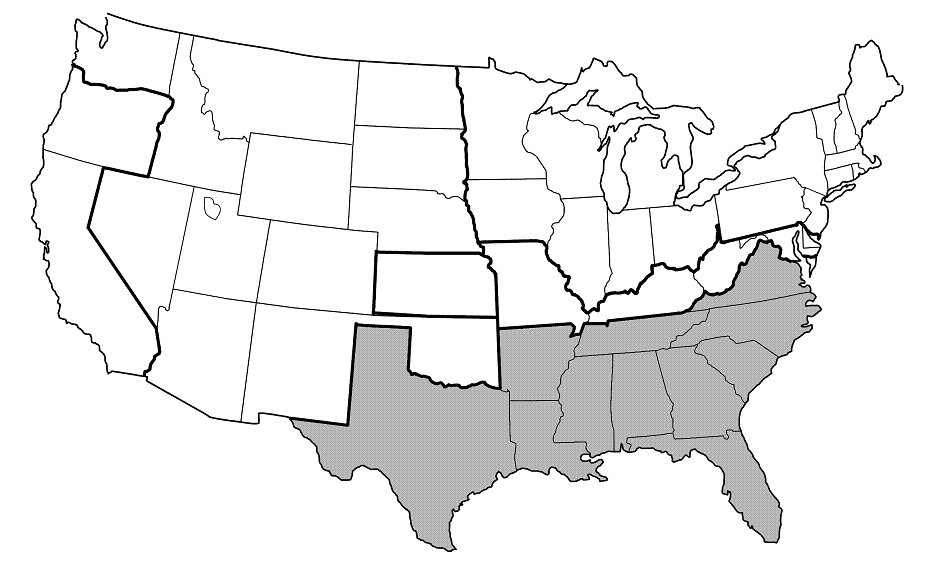
Alabama, Arkansas, Florida, Georgia, Louisiana, Mississippi, North Carolina, South Carolina, Tennessee, Texas, and Virginia were ___.
Union States
Union Border States
Confederate States
Which map shows the Union?
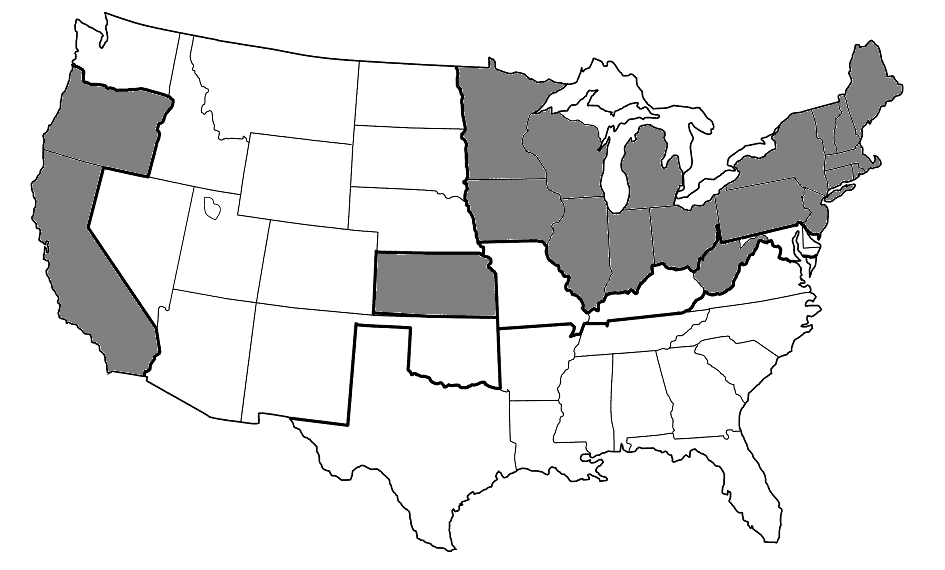
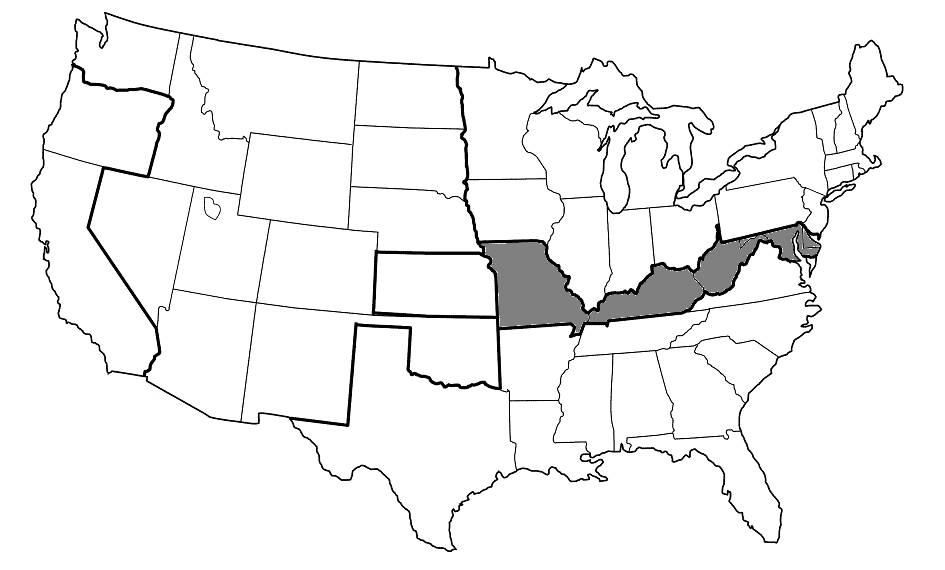
Which map shows the Union Border States?
Which map shows the Confederate States?

Click all that apply
Georgia
Alabama
Border State
Union
Confederate

Click all that apply
Kansas
Nebraska
Border State
Union
Confederate

Click all that apply
Indiana
Illinois
Border State
Union
Confederate

Alabama
Georgia
Mississippi
Union
Confederate

Wyoming
California
Oregon
Union
Confederate

Maryland
West Virginia
Border State
Union
Confederate

Missouri
Arkansas
Border State
Union
Confederate

Tennessee
Kentucky
Border State
Union
Confederate


Name the state that is colored red
New York
Connecticut
Delaware
Massachusetts



