
 Worksheets
Intro Kinetics
Total questions: 14
Worksheet time: 12mins
Name
Class
Date
1.
What two factors govern whether a collision between reacting particles will be effective?
a)
orientation and potential energy
b)
kinetic energy and temperature
c)
kinetic energy and orientation
d)
potential energy and kinetic energy
2.
Under the collision theory, the particles must collide with ____ and ____ for a reaction to occur.
a)
sufficient rate and sufficient energy
b)
sufficient surface area and correct orientation
c)
sufficient catalyst and sufficient energy
d)
sufficent energy and correct orientation
3.
Which of the following is NOT a factor affecting reaction rate?
a)
temperature
b)
catalysts
c)
particle size
d)
polarity
4.

Which group of particles shows that increasing surface area increases collisions among particles?
a)
Left side
b)
Right side
c)
Cannot be determined by either picture
5.
Decreasing the particle size increases the reaction rate because
a)
It makes particles move faster
b)
It increases the likelihood of collisions with the correct geometry
c)
It decreases the surface area available to react
d)
It increases the number of collisions
6.
Products will form faster if____________
a)
the particle size of the reactants are larger.
b)
temperature is decreased.
c)
concentration of the reactants are increased.
d)
the reaction is not stirred.
7.
Why does a higher temperature increase the rate of a reaction?
a)
it increases both the frequency and energy of particle collisions
b)
it only increases the frequency of particle collisions
c)
it only increases the energy of particle collisions
d)
it reduces the activation energy of the reaction
8.
Decreasing the particle size increases the reaction rate because
a)
It makes particles move faster
b)
It increases the likelihood of collisions with the correct geometry
c)
It decreases the surface area available to react
d)
It increases the surface area of the reactants thus more particles collides with each other therefore increase the frequency of effective collisions
9.
Adding a catalyst to a chemical reaction changes the rate of reaction by causing
a)
a decrease in the activation energy
b)
an increase in the activation energy
c)
a decrease in the heat of reaction
d)
an increase in the heat of reaction
10.

Which interval represents the activation energy of the forward reaction?
a)
A
b)
B
c)
C
d)
E
11.
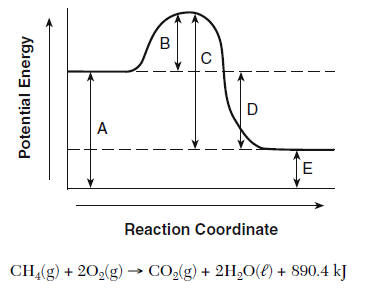
Which numbered interval on the diagram would change when a catalyst is added?
a)
B & C
b)
C & D
c)
E & C
d)
A & D
12.

Which species is the catalyst in this reaction mechanism?
a)
R
b)
W
c)
X
d)
There is no catalyst.
13.
step 1: O3 → O2 + O
step 2: O3 + O → 2 O2
The oxygen atom (O) is considered to be a(n)...
step 2: O3 + O → 2 O2
The oxygen atom (O) is considered to be a(n)...
a)
reactant
b)
catalyst
c)
reaction intermediate
d)
activated complex
14.
What would be my the overall order of this rate law?
Rate=[A]2[B]1
Rate=[A]2[B]1
a)
0 Order
b)
1st Order
c)
2nd Order
d)
3rd Order
100 %

