

wayground logo

Free Printable Worksheets

NEW

Font size

S
M
L
XL
Worksheets

Biology EOC RC 5

Total questions: 20

Worksheet time: 22mins

Name
Class
Date
1.
A pond ecosystem is shown in the diagram below. Which statement describes an interaction that helps maintain the dynamic equilibrium of this ecosystem?
Which statement describes an interaction that helps maintain the dynamic equilibrium of this ecosystem?
a)
The frogs make energy available to this ecosystem through the process of photosynthesis.
b)
The algae directly provide food for both the rotifers and the catfish.
c)
The green-backed heron provides energy for the mosquito larvae.
d)
The catfish population helps control the populations of water boatman and waterfleas.
2.
According to the food web, which of these supply energy for all the other organisms?     
a)
snakes
b)
insects
c)
grasses
d)
cougars
3.
Deforestation by burning has been described as a "double whammy" to the environment, meaning it has 2 negative impacts. Why is this description accurate? 
a)
Forest burning releases CO2 while decreasing oxygen, which disrupts cycles
b)
Deforestation reduces the amount of oxygen in the atmosphere, which depletes the ozone layer
c)
Forest clearing is often followed by land development, which often leads to increased noise pollution
d)
Deforestation increases the number of plant and animal species by destroying habitat
4.
The number of species within a specific habitat.
a)
Conservation
b)
Sustainable development
c)
Biodiversity
d)
Preservation
5.
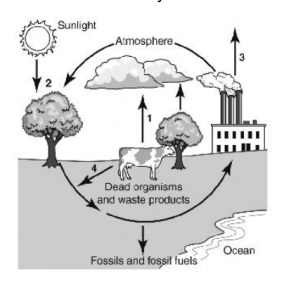
What is happening at 1?
a)
respiration: releasing CO2
b)
decomposing CO2 in the soil
c)
photosynthesis: absorbing CO2
d)
turning CO2 from the atmosphere into organic molecules
6.
Which organism recieves the least amount of energy from the producer?
a)
Owl
b)
Grasshopper
c)
Lilypad
d)
Mouse
7.
The recycling of matter in ecosystems requires the breakdown of dead organic matter. This is accomplished by
a)
decomposers
b)
primary consumers
c)
secondary consumers
d)
primary producers
8.
In the food chain, how much energy will make it to the trophic level of the sharks if the producers have 100,000 calories?
a)
10 calories
b)
1 calorie
c)
100 calories
d)
1,000 calories
9.
How does the growth of hardwood trees affect the organisms in an ecosystem?
a)
grasses become fewer because the trees take up the light
b)
Trees provide shelter for a variety of mammals, birds, insects, etc.
c)
In autumn, the falling leaves provide nutrients for decomposers
d)
All of the above
10.
Why does secondary succession have more species diversity than primary succession?
a)
There is no species diversity.
b)
Secondary succession has more species diversity due to the lack of soil.
c)
Secondary succession has more species diversity due to the microorganisms that survived in the soil.
d)
Primary succession ALWAYS has more species diversity.
11.
Phytoplankton blooms cause deadzones in bodies of water. Sewage, fertilizers, and burning of fossil fuels increase the phytoplankton levels. Which of the following increases dead zone levels?
a)
rain runoff
b)
clean water plant
c)
farming without fertilizers
d)
Using windmills instead of coal burning factories
12.
The overgrowth of algae poses a major problem for coral reefs. Intensive fishing is one factor that contributes to algae overgrowth because it does which of the following?
a)
Allows more sunlight to be available to algae
b)
 Inhibits the spread of pathogens in algae colonies
c)
 Reduces the number of organisms that feed on algae
d)
Increases the competition between different algae species
13.
Which of the following are missing from the food web shown above?
a)
producers
b)
decomposers
c)
omnivores
d)
carnivores
14.
A student is studying the ecology of a playa lake, which forms after a rainfall in a dry lake bed. The table lists the organisms that the student observed.
Which level of biological organization has the student described in the table?
a)
 Biosphere
b)
Organelle
c)
Ecosystem
d)
Community
15.
The acacia ant (Pseudomyrmex ferruginea) lives in the bullshorn acacia plant, as shown above. The acacia ant nests and feeds in the plant’s hollow thorns. The ant helps protect the bullshorn acacia by attacking insects and grazing animals that come near the plant. The relationship between the acacia ant and the bullshorn acacia is an example of which of the following?
a)
 Commensalism
b)
Mutualism
c)
Neutralism
d)
Parasitism
16.

According to the graph shown, what effect did the brown tree snake have on the birds in Guam?

a)

The snakes had no effect on the bird populations.

b)

The snakes caused a decline in the number of bird populations.

c)

The snakes formed a mutualistic relationship with the birds.

d)

The snakes caused an increase in the number of bird populations.

17.
What are the Abiotic factors in this image? 
a)
water, sunlight, dirt, air
b)
birds and plants
c)
birds, water, dirt
d)
plants, water
18.

A prey population consists of individuals with a variety of running speeds.


The adaptation that allows some of these animals to run fast would be an example of natural selection if it helps them —

a)

survive and undergo mutations in their DNA

b)

lower the mortality rates of the population

c)

produce offspring that run at average speeds

d)

reproduce and increase the frequency of their genes in the population

19.

The amount of energy the producers in this energy pyramid provide the primary consumers is 54,000 joules. From this amount, 540 joules are provided to the tertiary consumers.


Based on this model, how much of the energy was provided to secondary consumers?

a)

53,460 J

b)

5,400 J

c)

540 J

d)

54 J

20.

Which of the following is most likely to cause the greatest disruption to an ecosystem?

a)

Emptying an aquarium containing non-native species into a local waterway

b)

Cutting down a small cedar tree to make holiday decorations

c)

Cleaning the windshield of a car with an alcohol-based glass cleaner

d)

Mowing the lawn in a city park
